

Archive position — measured, not model output
0 likes on Devpost
2,263 of the 7,850 archived projects have more likes, and 5,587 share exactly 0 — so this project's #7,028 place in the like-ranked listing is a tie-break inside that group, not a ranking.
Projects (log scale)
Likes on Devpost. ▲ marks this project's group.
Show the figures
| Likes | Projects | Share of archive |
|---|---|---|
| 0 | 5,587 | 71.2% |
| 1 | 1,758 | 22.4% |
| 2 | 284 | 3.6% |
| 3–4 | 132 | 1.7% |
| 5–9 | 75 | 1.0% |
| 10+ | 14 | 0.2% |
 User Stories BotA demo video on every pull request
Get a demo video on every new feature
GitHub App that watches your pull requests and records a narrated, captioned demo.
Save time on demo prep and make informed decisions faster with a video walkthrough of every new feature.
Executive Summary
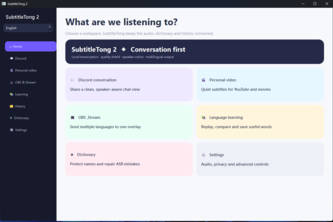
SubtitleTong 2 is a self-reported Windows desktop application designed to provide local-first, real-time multilingual subtitles for audio content across platforms like Discord, video, meetings, and OBS. The author describes it as a tool that captures system and microphone audio, transcribes speech using GPU-accelerated Whisper, and displays original text with translations in a user-friendly interface. It includes features such as conversation bubbles, OBS integration, speaker labeling, and searchable session logs.
The project is presented as a prototype built during a hackathon, with no evidence of revenue, customers, or traction beyond its own description. The author states that it uses Python, PySide6, CUDA, Whisper, Argos Translate, OpenCC, and SQLite. It is not evident whether the tool has been released publicly or adopted by users.
The single most important open question
Is there any evidence of user adoption, market demand, or commercial viability beyond the author’s own account?
What The Product Actually Is
The description states that SubtitleTong 2 is a Windows desktop application that:
- Captures system audio and microphone audio
- Transcribes speech using GPU-accelerated Whisper
- Displays original text alongside multiple translations
- Provides features such as:
- Discord-style conversation bubbles
- A clean, independent window for screen sharing
- Movable, pinnable subtitle overlay
- Multilingual OBS output via UTF-8 text files
- Editable speaker labels and searchable SQLite session history
- ASR correction dictionary and instant correction registration
- Language-learning vocabulary highlights
- Local translation with explicit review markers for unsafe results
It is built using Python, PySide6, CUDA, Whisper, Argos Translate, OpenCC, and SQLite, and integrates with OBS through text file outputs.
This is a local-first tool intended to help people understand each other across languages in real-time settings like Discord calls, video meetings, or livestreams.
Positioning & Claim Evolution
The author positions SubtitleTong 2 as:
- A local-first alternative to existing subtitle tools that often hide original speech or require cloud processing
- Designed for non-technical users, aiming to be approachable while maintaining privacy and technical depth
- Focused on real-time multilingual understanding, especially in environments where language barriers are common
The claim evolution appears to be:
- Problem identification: Language barriers in digital communication (Discord, video, meetings).
- Solution proposition: A local-first tool that preserves original speech while enabling translation.
- Differentiation: Emphasis on privacy, ease-of-use, and real-time performance over cloud-based or complex tools.
There is no evidence of prior positioning or evolution beyond the hackathon submission.
Target Customer & ICP
The description states that SubtitleTong 2 targets users in:
- Discord calls
- Online videos
- Meetings
- Games and livestreams
It is intended for individuals who want to understand multilingual conversations without relying on cloud services or complex setups.
The author does not specify a detailed ICP, such as:
- Specific user personas
- Geographic focus
- Industry verticals
- Use case segmentation
Thus, the target customer profile remains not evidenced beyond general assumptions about users of Discord and video platforms.
Business Model & Pricing Evidence
There is no evidence in the description of:
- A pricing model
- Revenue streams
- Monetization strategy
- Subscription or licensing plans
The tool is described as a prototype, built during a hackathon, with no indication of any commercial offering or business structure.
Technical & Delivery Signals
The author reports that SubtitleTong 2:
- Is written in Python with PySide6
- Uses Windows WASAPI loopback and microphone audio capture via PyAudioWPatch
- Runs Whisper large-v3-turbo model on an NVIDIA GPU with CUDA float16
- Stores data in SQLite
- Provides local translation using Argos Translate and OpenCC
- Integrates with OBS through UTF-8 text files
- Includes support for Traditional Chinese, Japanese, and English interfaces
It also mentions:
- Use of OpenAI Codex to accelerate development
- Handling of audio chunking issues and native PortAudio crashes
- Implementation of safe handling for incorrect translations
These technical details suggest a prototype with real-time capabilities, but no evidence of scalability, production deployment, or performance benchmarks.
Traction & Maturity Signals
The description states that SubtitleTong 2 is:
- A runnable Windows prototype
- Includes features like double-click startup, GPU transcription, multilingual translation, conversation views, OBS file output, speaker editing, vocabulary highlighting, and persistent searchable logs
- Tested against a GPT-Live demonstration as a quality benchmark
However, there is no evidence of:
- User adoption or feedback
- Customer base or usage metrics
- Product release or public availability
- Market traction or growth indicators
Thus, the maturity level remains not evidenced, and the tool appears to be in early-stage development.
Competitive Context
The author does not provide any information about:
- Competitors in the live subtitle or real-time translation space
- Market analysis or competitive positioning
- Prior art or existing tools with similar functionality
This section is not evidenced.
Open Questions & Risks
Several potential risks and open questions are implied by the description:
- Prototype-only status: The tool is described as a hackathon prototype, not a production-ready product.
- Limited platform support: Only Windows is mentioned; no cross-platform capability is stated.
- Technical complexity for end-users: Despite claims of being approachable, it requires GPU acceleration and audio configuration.
- No monetization or business model: No indication of how the tool will generate revenue.
- Unproven market demand: There is no evidence of user interest or adoption beyond the author’s own account.
These are inferences based on the self-reported nature of the description.
Questions the description leaves open
- What is the current status of the product? Is it publicly available, and if so, how?
- Have you conducted any user testing or gathered feedback from real users?
- How do you plan to monetize this tool, and what is your go-to-market strategy?
- Are there any scalability challenges with GPU usage or audio processing that could limit adoption?
- What are the technical limitations of the current prototype, and how do you intend to address them?
- Is there a roadmap for expanding support beyond Windows or adding new languages?
Overall Assessment
There is no evidence of any commercial traction, revenue, or customer base. The tool is described as a hackathon prototype, with no indication of product-market fit, user adoption, or business viability.
The author’s own account suggests a functional but early-stage application with potential for real-time multilingual communication. However, without independent validation, market data, or evidence of demand, the commercial due-diligence read is:
Not ready for investment or partnership consideration — this is an unproven concept in prototype form, with no demonstrated market traction or business model.
User Stories BotA demo video on every pull request
Get a demo video on every new feature
GitHub App that watches your pull requests and records a narrated, captioned demo.
Save time on demo prep and make informed decisions faster with a video walkthrough of every new feature.
Source
Submitted to the OpenAI 2026 hackathon on Devpost. Project home on Devpost. Back to the full gallery on Devpost.
This competitive analysis was produced by top-founders.com (opens in a new tab)
Generated by a language model from this project's public Devpost page — its tagline, the author's own write-up and any built-with tags listed there — as captured in August 2026. Short quotations are the author's words. It is an opinion on the idea as a business, not on the people behind it, and it reflects the description as published then. If the project has moved on, request a correction below. The analysis is not independent research and contains no verified traction, revenue or customer data.
An independent guide by KFG International LLC — not affiliated with, endorsed by, or connected to Devpost or OpenAI.