

Archive position — measured, not model output
0 likes on Devpost
2,263 of the 7,850 archived projects have more likes, and 5,587 share exactly 0 — so this project's #3,104 place in the like-ranked listing is a tie-break inside that group, not a ranking.
Projects (log scale)
Likes on Devpost. ▲ marks this project's group.
Show the figures
| Likes | Projects | Share of archive |
|---|---|---|
| 0 | 5,587 | 71.2% |
| 1 | 1,758 | 22.4% |
| 2 | 284 | 3.6% |
| 3–4 | 132 | 1.7% |
| 5–9 | 75 | 1.0% |
| 10+ | 14 | 0.2% |
 User Stories BotA demo video on every pull request
Get a demo video on every new feature
GitHub App that watches your pull requests and records a narrated, captioned demo.
Save time on demo prep and make informed decisions faster with a video walkthrough of every new feature.
Executive Summary
Company: Campus Life
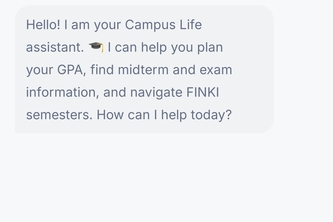
Self-reported purpose: A mobile app to help students organize their academic and campus life by aggregating faculty news, grades tracking, map navigation, and an AI assistant.
Key change: The project evolved from a clunky prototype into a more polished version using Kotlin, Jetpack Compose, and GPT-5.6 for map rendering and AI integration.
Single most important open question: Is there evidence of actual student adoption or usage beyond the author’s own faculty (FCSE Skopje), and what is the path to scaling beyond one university?
This analysis is based entirely on the self-reported project description provided by the author. No third-party verification, traction data, revenue, or customer information is available.
What The Product Actually Is
The description states that Campus Life is a mobile application built for students at FCSE Skopje. It aggregates faculty news, calendar events, and academic information such as grades and subjects. It includes an offline map with GeoJSON rendering and an AI assistant powered by the Nemotron 3 Ultra model via OpenCode API.
- The app supports grade tracking and GPA calculation.
- It provides a centralized platform for student life information.
- It uses Kotlin, Jetpack Compose, and Material 3 UI.
- The AI assistant is implemented using Markwon markdown rendering for chat display.
Inference: The app appears to be a prototype or early-stage product focused on one university’s needs. It is not described as having a marketplace or multi-university functionality.
Positioning & Claim Evolution
The author claims that the app was inspired by the lack of information available to freshmen, particularly around academic and campus logistics. The goal was to ease the transition for new students and help organize older students' journeys.
- The app is positioned as a "Campus orientation and Student Life companion."
- It aims to reduce friction in accessing information scattered across multiple platforms.
- The author notes that the prototype was clunky and disorganized, suggesting an iterative development process.
Inference: The positioning evolved from a personal solution to a more generalizable tool. However, no evidence of market validation or user feedback beyond the author’s own experience is provided.
Target Customer & ICP
The description states that the app targets students at FCSE Skopje, with a focus on helping freshmen and older students navigate academic life.
- The primary users are described as students within one faculty.
- There is no mention of other universities or broader student demographics.
- The app includes features like map navigation and study group tools, suggesting it’s aimed at students who need logistical support.
Inference: The ICP appears to be limited to a single university (FCSE Skopje), with no evidence of expansion plans or targeting other institutions.
Business Model & Pricing Evidence
There is no mention of pricing, monetization, or business model in the description. The app is described as a personal project built during a hackathon and not yet commercialized.
Inference: No evidence exists to suggest any revenue stream or pricing strategy. It may be intended for internal use only or as a prototype for future development.
Technical & Delivery Signals
The app was built using:
- Kotlin
- Jetpack Compose
- Material 3 UI
- GeoJSON rendering for offline maps
- OpenCode API with Nemotron 3 Ultra model from NVIDIA
- Markwon markdown rendering for chat interface
- The map was improved using GPT-5.6.
- It supports offline functionality, which is critical in environments with limited data access.
Inference: The technical stack suggests a modern Android development approach with AI integration and offline-first design. However, no evidence of scalability or deployment beyond the prototype stage.
Traction & Maturity Signals
The project was submitted to a hackathon (OpenAI 2026) and is described as an evolved version of a previous clunky prototype.
- No mention of user adoption, retention, or usage metrics.
- The app is said to be optimized for FCSE Skopje students first, with plans to expand.
- There is no evidence of customer feedback, beta testing, or product-market fit.
Inference: The project is at a very early stage. It lacks traction indicators such as user numbers, engagement data, or market validation.
Competitive Context
The description does not mention any direct competitors. However, the idea of aggregating student life information and integrating AI assistance is common in educational apps and platforms.
- No evidence of existing solutions in this space.
- The app’s focus on one university suggests a niche solution rather than a broad platform.
Inference: There is no clear competitive landscape described. It may be an unoccupied or underserved segment, but no evidence supports that claim.
Open Questions & Risks
- Single-university focus: No evidence of scalability beyond FCSE Skopje.
- No revenue or monetization strategy: The app is not commercialized.
- Prototype nature: The project was described as a hackathon submission and an evolved prototype.
- Limited user feedback: No data on how students actually use or respond to the app.
- AI integration details missing: While AI is mentioned, no evidence of its effectiveness or performance.
Inference: The risk of failure is high if the app does not gain traction beyond one university or if it fails to address broader student needs.
Questions the description leaves open
- What specific feedback did you get from students at FCSE Skopje during development?
- How do you plan to scale the app beyond one university?
- Are there any plans for monetization or user onboarding beyond the prototype stage?
- What are the technical limitations of the current AI assistant, and how is it being improved?
- Have you considered integrating with existing university systems or platforms?
Overall Assessment
Not evidenced: There is no evidence of traction, revenue, or customer adoption to support a commercial due-diligence read.
The project appears to be an early-stage prototype developed for a hackathon and tailored to one university’s needs. It lacks any indication of market validation, scalability, or monetization strategy.
Confidence level: Low — based on self-reported evidence only, with no external data or user feedback.
User Stories BotA demo video on every pull request
Get a demo video on every new feature
GitHub App that watches your pull requests and records a narrated, captioned demo.
Save time on demo prep and make informed decisions faster with a video walkthrough of every new feature.
Source
Submitted to the OpenAI 2026 hackathon on Devpost. Project home on Devpost. Back to the full gallery on Devpost.
This competitive analysis was produced by top-founders.com (opens in a new tab)
Generated by a language model from this project's public Devpost page — its tagline, the author's own write-up and any built-with tags listed there — as captured in August 2026. Short quotations are the author's words. It is an opinion on the idea as a business, not on the people behind it, and it reflects the description as published then. If the project has moved on, request a correction below. The analysis is not independent research and contains no verified traction, revenue or customer data.
An independent guide by KFG International LLC — not affiliated with, endorsed by, or connected to Devpost or OpenAI.