

Archive position — measured, not model output
0 likes on Devpost
2,263 of the 7,850 archived projects have more likes, and 5,587 share exactly 0 — so this project's #3,106 place in the like-ranked listing is a tie-break inside that group, not a ranking.
Projects (log scale)
Likes on Devpost. ▲ marks this project's group.
Show the figures
| Likes | Projects | Share of archive |
|---|---|---|
| 0 | 5,587 | 71.2% |
| 1 | 1,758 | 22.4% |
| 2 | 284 | 3.6% |
| 3–4 | 132 | 1.7% |
| 5–9 | 75 | 1.0% |
| 10+ | 14 | 0.2% |
 User Stories BotA demo video on every pull request
Get a demo video on every new feature
GitHub App that watches your pull requests and records a narrated, captioned demo.
Save time on demo prep and make informed decisions faster with a video walkthrough of every new feature.
Executive Summary
Company: CanadianBankNews AI
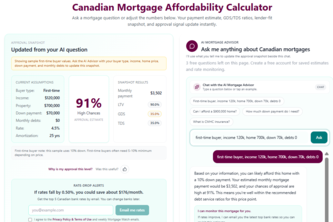
Self-reported purpose: A production-ready AI banking assistant that combines conversational reasoning with real financial data to help Canadians navigate mortgages, credit cards, and personal finance with confidence.
Evidence basis: The description is entirely self-reported and unverified, based on a Devpost submission for the OpenAI 2026 hackathon. No revenue, customers, traction or operational details are provided.
Key open question: What is the actual product functionality, and how does it differ from existing financial AI tools?
What The Product Actually Is
The description states that CanadianBankNews AI is “a production-ready AI banking assistant” that combines “conversational reasoning with real financial data.” It is positioned to help Canadians navigate mortgages, credit cards, and personal finance.
Evidence: The author describes the product as an AI banking assistant.
Inference: Based on the technology stack (e.g., OpenAI API, Vertex AI, GPT-5.6), it likely uses large language models for conversational interfaces.
Confidence: Low — no functional demonstration or detailed architecture provided.
Positioning & Claim Evolution
The tagline positions CanadianBankNews AI as a tool that helps Canadians navigate financial products with confidence by combining conversational reasoning and real-time data.
Evidence: The tagline states the product is for “Canadians” and aims to help with “mortgages, credit cards, and personal finance.”
Inference: The positioning implies a consumer-facing, financial advisory tool that uses AI to simplify complex financial decisions.
Confidence: Low — no evidence of prior positioning or evolution in claims.
Target Customer & ICP
The description states the product is intended for “Canadians” and targets those navigating mortgages, credit cards, and personal finance.
Evidence: The tagline identifies the audience as Canadians and the use case as financial navigation.
Inference: The target customer appears to be individual consumers seeking financial guidance.
Confidence: Low — no evidence of segmentation or customer validation.
Business Model & Pricing Evidence
No information is provided about pricing, monetization, or business model.
Evidence: Not evidenced.
Confidence: Very low — the description does not mention any commercial aspects.
Technical & Delivery Signals
The author declares that the product was built using a range of technologies including:
- Cloud SQL
- Codex
- Docker
- Google Cloud Run
- Next.js
- Node.js
- OpenAI API
- PostgreSQL
- React
- Tailwind
- TypeScript
- Vertex AI
Evidence: The author lists these tools under “Built with.”
Inference: The product likely uses a modern web stack, possibly hosted on Google Cloud and integrated with AI APIs.
Confidence: Medium — the technology stack is self-reported and does not confirm delivery or production readiness.
Traction & Maturity Signals
No evidence of traction, adoption, or maturity is provided.
Evidence: Not evidenced.
Confidence: Very low — no mention of users, revenue, or product usage.
Competitive Context
The description does not provide any information about competitors or the competitive landscape.
Evidence: Not evidenced.
Confidence: Very low — no indication of market positioning or competitive differentiation.
Open Questions & Risks
- Unverified claims: The product is described as “production-ready” but no evidence of this exists.
- Lack of traction: No customers, revenue, or usage metrics are provided.
- Unclear differentiation: No indication of how it differs from existing financial AI tools.
- Single-founder team: The team size is listed as one member, which may signal limited execution capacity.
- Hackathon project: The product was submitted to a hackathon, suggesting early-stage development.
Confidence: Medium — these are inferred risks based on the lack of evidence and self-reporting.
Questions the description leaves open
- What is the actual functionality of the AI assistant?
- How does it access and process real financial data?
- Is there a prototype or demo available for review?
- How does this product differ from existing financial AI tools in the market?
- What are the plans for monetization and customer acquisition?
- Are there any partnerships or integrations with financial institutions?
Overall Assessment
Not evidenced — The description provides no information on commercial viability, traction, or strategic fit.
Confidence: Very low — this is a self-reported hackathon submission with no evidence of product-market fit, revenue, or customer validation.
Inference: If the project were to mature, it could potentially address a gap in Canadian financial advisory tools, but current evidence does not support that conclusion.
User Stories BotA demo video on every pull request
Get a demo video on every new feature
GitHub App that watches your pull requests and records a narrated, captioned demo.
Save time on demo prep and make informed decisions faster with a video walkthrough of every new feature.
Source
Submitted to the OpenAI 2026 hackathon on Devpost. Project home on Devpost. Back to the full gallery on Devpost.
This competitive analysis was produced by top-founders.com (opens in a new tab)
Generated by a language model from this project's public Devpost page — its tagline and any built-with tags listed there, since the author published no write-up — as captured in August 2026. Short quotations are the author's words. It is an opinion on the idea as a business, not on the people behind it, and it reflects the description as published then. If the project has moved on, request a correction below. The analysis is not independent research and contains no verified traction, revenue or customer data.
An independent guide by KFG International LLC — not affiliated with, endorsed by, or connected to Devpost or OpenAI.