

Archive position — measured, not model output
0 likes on Devpost
2,263 of the 7,850 archived projects have more likes, and 5,587 share exactly 0 — so this project's #7,029 place in the like-ranked listing is a tie-break inside that group, not a ranking.
Projects (log scale)
Likes on Devpost. ▲ marks this project's group.
Show the figures
| Likes | Projects | Share of archive |
|---|---|---|
| 0 | 5,587 | 71.2% |
| 1 | 1,758 | 22.4% |
| 2 | 284 | 3.6% |
| 3–4 | 132 | 1.7% |
| 5–9 | 75 | 1.0% |
| 10+ | 14 | 0.2% |
 User Stories BotA demo video on every pull request
Get a demo video on every new feature
GitHub App that watches your pull requests and records a narrated, captioned demo.
Save time on demo prep and make informed decisions faster with a video walkthrough of every new feature.
Executive Summary
What the company appears to be
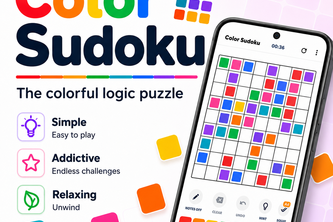
A solo-developer project named Color Sudoku, a mobile puzzle game built with React Native and AWS Lambda, that allows players to solve Sudoku puzzles using either numbers or colors. It includes classic Sudoku, variants like Star Sudoku, daily challenges, offline support, and multilingual features.
What changed
The author reports evolving from an initial version built with GPT-5.5 into a more polished product using GPT-5.6 Sol for the Star Sudoku mode. The project moved from a basic playable prototype to a platform that supports multiple puzzle modes and user preferences.
Single most important open question
Is there any evidence of user adoption, revenue, or monetization strategies beyond the author's own development efforts?
This analysis is based solely on the self-reported description provided by the author. No external verification or historical data is available. All claims are treated as stated by the author and not proven.
What The Product Actually Is
The description states that Color Sudoku is a mobile logic puzzle game where players can solve Sudoku puzzles using either colors or numbers. It includes:
- Classic Sudoku
- Multiple Sudoku variants (e.g., Star Sudoku)
- Daily challenges
- Saved progress
- Offline fallback for simple 9x9 puzzles
- A new mode called Star Sudoku with infinite generated boards and multiple difficulty levels
The app was built as a React Native Expo app, with puzzle generation handled by an AWS Lambda Python backend.
This is the author’s own description of the product. No independent confirmation or demonstration of functionality exists beyond this account.
Positioning & Claim Evolution
The author claims that Color Sudoku started as a simple idea to make Sudoku feel fresh again by allowing players to use colors instead of only numbers. The initial version, built with Codex GPT-5.5, was described as “okay” but not standout.
Later, the author used GPT-5.6 Sol to improve the Star Sudoku generator and solver, which led to a more polished and reliable implementation.
The positioning evolved from a basic Sudoku game into a platform that supports multiple puzzle modes and user preferences such as color vs. number, difficulty levels, and replayability.
These are claims made by the author about product evolution and intent. No evidence of actual market reception or user feedback is provided.
Target Customer & ICP
The description does not clearly define a specific customer segment or ideal customer profile (ICP). It implies that the target audience includes players who enjoy logic puzzles and want something more colorful, flexible, and replayable than traditional Sudoku.
It also suggests support for different preferences like color vs. number usage, which may appeal to casual or niche puzzle enthusiasts.
No explicit targeting or segmentation data is available in the description.
Business Model & Pricing Evidence
There is no evidence of a business model or pricing strategy in the description. The author mentions ads integration and plans for leaderboards, achievements, and statistics, but does not describe how these would monetize the app.
No mention of subscriptions, in-app purchases, freemium models, or other revenue streams.
Not evidenced.
Technical & Delivery Signals
The project was built using:
- React Native Expo
- AWS Lambda (Python backend)
- Codex GPT-5.5 and GPT-5.6 Sol for development
- Android and iOS support
- Offline mode
- Dark mode
- Internationalization
- Puzzle generation logic
- Solver logic
The author notes that the first version was built with GPT-5.5, while later improvements used GPT-5.6 Sol to enhance puzzle generation and solving reliability.
These are technical claims made by the author; no independent validation or performance metrics are included.
Traction & Maturity Signals
There is no evidence of user traction, customer base, or adoption beyond the author’s own development work. The project is described as a solo effort with one team member (Manjaka RAKOTOARISOA), and no data on downloads, retention, engagement, or usage is provided.
The author mentions an Android version available for testing via Google Play, but does not confirm whether it has been released publicly or how many users have accessed it.
Not evidenced.
Competitive Context
The description references modern puzzle games like Mewdoku as inspiration, suggesting a competitive landscape that includes logic-based mobile games with fast play and satisfying logic mechanics.
However, no direct competitors are named, nor is there any indication of market share, pricing, or differentiation from existing Sudoku or puzzle apps.
Not evidenced.
Open Questions & Risks
- Solo development risk: The project is built by a single developer, raising concerns about scalability, maintenance, and long-term viability.
- Unproven commercial traction: No evidence of users, revenue, or monetization strategy.
- AI dependency: Heavy reliance on AI tools (Codex GPT-5.5, GPT-5.6 Sol) for core functionality raises questions about reproducibility, control, and future availability.
- Lack of clarity around monetization: While features like ads and leaderboards are mentioned, no clear path to revenue is described.
These are inferences based on the limited information provided.
Questions the description leaves open
- What is your plan for monetizing the app beyond advertising?
- Have you released the app publicly or tested it with real users?
- How do you intend to scale beyond a solo developer model?
- Can you provide any data on how many people have played or engaged with the game so far?
- Are there plans to integrate with app stores or third-party platforms for distribution?
- What are the risks associated with relying on AI models like GPT-5.6 Sol for core puzzle generation?
These questions aim to probe areas where the description lacks clarity.
Overall Assessment
There is insufficient evidence to assess whether this project warrants investment or partnership consideration at this stage. The author describes a functional prototype with some improvements made using AI tools, but there is no indication of traction, revenue, or commercial viability.
The product appears to be in early development and lacks any demonstrated market presence or monetization strategy.
Not evidenced. This is a solo project without verified users, revenue, or scalable business model.
User Stories BotA demo video on every pull request
Get a demo video on every new feature
GitHub App that watches your pull requests and records a narrated, captioned demo.
Save time on demo prep and make informed decisions faster with a video walkthrough of every new feature.
Source
Submitted to the OpenAI 2026 hackathon on Devpost. Project home on Devpost. Back to the full gallery on Devpost.
This competitive analysis was produced by top-founders.com (opens in a new tab)
Generated by a language model from this project's public Devpost page — its tagline, the author's own write-up and any built-with tags listed there — as captured in August 2026. Short quotations are the author's words. It is an opinion on the idea as a business, not on the people behind it, and it reflects the description as published then. If the project has moved on, request a correction below. The analysis is not independent research and contains no verified traction, revenue or customer data.
An independent guide by KFG International LLC — not affiliated with, endorsed by, or connected to Devpost or OpenAI.