

Archive position — measured, not model output
1 like on Devpost
505 of the 7,850 archived projects have more likes, and 1,758 share exactly 1 — so this project's #1,142 place in the like-ranked listing is a tie-break inside that group, not a ranking.
Projects (log scale)
Likes on Devpost. ▲ marks this project's group.
Show the figures
| Likes | Projects | Share of archive |
|---|---|---|
| 0 | 5,587 | 71.2% |
| 1 | 1,758 | 22.4% |
| 2 | 284 | 3.6% |
| 3–4 | 132 | 1.7% |
| 5–9 | 75 | 1.0% |
| 10+ | 14 | 0.2% |
 User Stories BotA demo video on every pull request
Get a demo video on every new feature
GitHub App that watches your pull requests and records a narrated, captioned demo.
Save time on demo prep and make informed decisions faster with a video walkthrough of every new feature.
Executive Summary
What the company appears to be
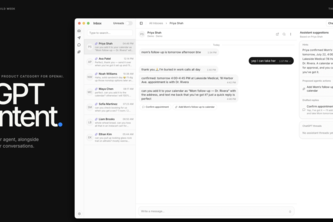
GPT Intent is a self-reported project by two individuals (Andrii Nikolin and Alex Nesterov) that proposes an agentic messenger built on top of OpenAI's suite, integrating with iMessage and Telegram via SDKs. The product aims to enable proactive agent assistance in conversations through hint generation, action proposals, and response drafting.
What changed
The project pivoted from an idea about agent-to-agent communication to a more practical implementation focused on enhancing human-to-human messaging with AI agents. It evolved from an iMessage-only "sidecar" into a full desktop messenger app using Electron, React, and TypeScript.
Single most important open question — the commercial due-diligence read
Is there evidence of a viable product-market fit or traction that would justify further investment or partnership? The description contains no data on users, revenue, adoption, or customer feedback beyond the authors' own claims. There is no indication of any commercial activity or market validation.
What The Product Actually Is
The description states that GPT Intent is a first-party OpenAI agentic messenger, designed to integrate with existing messengers like iMessage and Telegram. It allows users to interact with friends, family, and others while having an AI agent assist them by:
- Generating hints based on conversation history
- Proactively proposing follow-up actions
- Drafting responses for explicit pre-population
It is built as an Electron desktop application, using technologies such as React, TypeScript, and Codex SDKs. The app supports multiple providers (iMessage via iMessage Kit SDK, Telegram via TDLib, and a demo provider seeded with imaginary contacts).
The authors claim the product was developed over a week-long hackathon, with significant use of AI tools like Codex for development and prompt engineering.
Inference: Based on the description, this is a proof-of-concept or prototype built in a short timeframe. It does not appear to be a production-ready product.
Positioning & Claim Evolution
The authors state that their original idea was to give each person an agent and let agents talk to each other — but they pivoted due to lack of clear use cases.
They then redefined the focus toward enhancing human-to-human communication with AI agents, rather than agent-agent interaction.
Their positioning evolved from a broad vision of summarizing, routine automation, tagging, and third-party agent participation in conversations, to a more limited scope focused on:
- Hint generation
- Follow-up action suggestions
- Response drafting
This evolution reflects a shift toward a practical integration into existing messaging platforms, rather than an entirely new communication paradigm.
Inference: The pivot suggests the team recognized early on that agent-agent communication was too abstract or unproven for immediate implementation, leading to a more grounded approach.
Target Customer & ICP
The description does not provide explicit information about target customers or ideal customer profiles (ICP). It implies the product targets individuals who use iMessage and Telegram regularly, but no demographic or behavioral segmentation is described.
Not evidenced: No data on user personas, usage patterns, or specific customer segments.
Business Model & Pricing Evidence
There is no evidence of a business model or pricing strategy in the description. The authors mention that they are considering building GPT Intent as part of OpenAI and not necessarily to win a hackathon or prove their idea superior.
Not evidenced: No mention of monetization, subscription tiers, freemium models, or any revenue streams.
Technical & Delivery Signals
The project was built using:
- Technology stack: Electron, React, TypeScript
- Integration points: iMessage Kit SDK, TDLib (Telegram), Codex SDK
- Development tools: Codex for prompt engineering and code generation; Entire.io for session syncing
- Frontend libraries: shadcn/ui, Tanstack set for list virtualization, routing, and state management
The authors note that the app was developed in a short timeframe (~5 days), with multiple pivots affecting architecture and implementation quality.
Inference: The technical approach reflects rapid prototyping under time constraints. The use of AI tools like Codex indicates reliance on generative AI for development, which may introduce inconsistencies or lack of control over final output.
Traction & Maturity Signals
There is no evidence of traction, adoption, or user engagement beyond the authors' own claims. The project was submitted to a hackathon and is described as a prototype with rough edges.
Not evidenced: No data on active users, retention rates, customer feedback, or product usage metrics.
Competitive Context
The description does not include any reference to competitors or existing solutions in the space of AI-enhanced messaging. The authors do not discuss how GPT Intent compares to other messengers or AI assistants.
Not evidenced: No competitive analysis, market positioning, or differentiation from existing products.
Open Questions & Risks
- Prototype nature: The product is described as a hackathon submission with limited polish and technical debt due to pivots.
- No commercial traction: There is no evidence of revenue, customers, or adoption beyond the authors' own claims.
- Unverified claims: All statements are self-reported without independent verification.
- Unclear scalability: The app integrates with specific platforms (iMessage, Telegram), which may limit its broader appeal unless an open protocol is introduced.
- Dependency on external APIs and SDKs: Reliance on third-party integrations could pose risks if those change or become unavailable.
Inference: The lack of traction and commercial viability raises concerns about whether this idea can be scaled into a sustainable product or business.
Questions the description leaves open
- What specific problems are you trying to solve with GPT Intent, and how do you know they exist?
- Have you conducted any user research or testing beyond your own experience?
- How do you plan to monetize this product if it becomes a standalone offering?
- What is the long-term vision for GPT Intent beyond the hackathon submission?
- Are there any technical dependencies that could hinder scalability or performance?
- How would you handle privacy and data security concerns in an AI-enhanced messaging environment?
- What are your thoughts on building an open protocol standard for agentic messengers?
Overall Assessment
The description presents GPT Intent as a conceptual prototype built during a hackathon, with no evidence of traction, revenue, or customer validation.
Not evidenced: No data supports the viability or commercial potential of the idea. The authors state that this is a proposal to OpenAI and not a finished product.
Given the lack of verified metrics, user feedback, or business model, there is insufficient basis for investment or partnership consideration at this stage.
Confidence level: Low
This analysis is based solely on self-reported information from the project description. No external validation, revenue data, or customer insights are available to assess commercial viability.
User Stories BotA demo video on every pull request
Get a demo video on every new feature
GitHub App that watches your pull requests and records a narrated, captioned demo.
Save time on demo prep and make informed decisions faster with a video walkthrough of every new feature.
Source
Submitted to the OpenAI 2026 hackathon on Devpost. Project home on Devpost. Back to the full gallery on Devpost.
This competitive analysis was produced by top-founders.com (opens in a new tab)
Generated by a language model from this project's public Devpost page — its tagline, the author's own write-up and any built-with tags listed there — as captured in August 2026. Short quotations are the author's words. It is an opinion on the idea as a business, not on the people behind it, and it reflects the description as published then. If the project has moved on, request a correction below. The analysis is not independent research and contains no verified traction, revenue or customer data.
An independent guide by KFG International LLC — not affiliated with, endorsed by, or connected to Devpost or OpenAI.