

Archive position — measured, not model output
0 likes on Devpost
2,263 of the 7,850 archived projects have more likes, and 5,587 share exactly 0 — so this project's #7,011 place in the like-ranked listing is a tie-break inside that group, not a ranking.
Projects (log scale)
Likes on Devpost. ▲ marks this project's group.
Show the figures
| Likes | Projects | Share of archive |
|---|---|---|
| 0 | 5,587 | 71.2% |
| 1 | 1,758 | 22.4% |
| 2 | 284 | 3.6% |
| 3–4 | 132 | 1.7% |
| 5–9 | 75 | 1.0% |
| 10+ | 14 | 0.2% |
 User Stories BotA demo video on every pull request
Get a demo video on every new feature
GitHub App that watches your pull requests and records a narrated, captioned demo.
Save time on demo prep and make informed decisions faster with a video walkthrough of every new feature.
Executive Summary
Project: STUDY VIA COMICS
Self-reported basis: The entire analysis is based on a single author-supplied description, submitted as part of a hackathon project on Devpost. No independent verification, archived evidence, or third-party data are available.
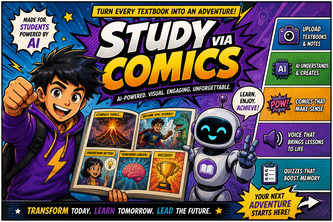
The description states that STUDY VIA COMICS is an AI-powered platform that transforms textbook pages into interactive learning experiences using comics, narration, and quizzes. It was built in a hackathon by one person (Marinkie Thupi), using GPT-5.6, Codex, Next.js, Supabase, OCR, and other tools.
What changed: The project is a proof-of-concept built during a hackathon. No commercial traction or product-market fit has been demonstrated.
Single most important open question: Is there evidence that the platform can scale beyond a hackathon prototype to deliver real value in educational settings?
What The Product Actually Is
The description states that STUDY VIA COMICS is a tool that allows students to upload textbook pages and receive:
- Extracted content
- Educational comics
- AI-generated illustrations
- Voice narration
- Adaptive quizzes
- Study packs for revision
It is described as transforming learning from memorization into storytelling.
Inference: The product appears to be an AI-powered educational platform that uses OCR, GPT, and generative tools to create interactive study materials. It is not a standalone SaaS offering but rather a prototype built for a hackathon.
Positioning & Claim Evolution
The author states that the platform was inspired by student struggles with text-heavy textbooks and aims to make learning more visual, memorable, and fun through AI-powered storytelling.
Claim: The product positions itself as an educational tool that improves retention by turning lessons into comic adventures.
Inference: The positioning is rooted in a common pain point (student disengagement) and a proposed solution (AI-enhanced storytelling). It does not yet demonstrate traction or market validation.
Target Customer & ICP
The description states that STUDY VIA COMICS targets students who struggle with text-heavy textbooks and want more engaging learning experiences.
Inference: The primary customer is likely K-12 or college-level students, but no specific demographic or segment data is provided. No evidence of a defined ICP beyond "students."
Business Model & Pricing Evidence
The description does not state any business model or pricing strategy. It only describes the platform's functionality.
Not evidenced: No information on monetization, subscription tiers, or customer acquisition costs.
Technical & Delivery Signals
The author states that the platform was built using:
- GPT-5.6
- Codex
- Next.js
- Supabase
- OCR
- AI image generation and text-to-speech tools
It was developed in a hackathon timeframe, with challenges around workflow design and user experience.
Inference: The technical stack suggests a modern, AI-integrated web application. However, the prototype is not described as production-ready or scalable.
Traction & Maturity Signals
The description states that this is a hackathon project built by one person (Marinkie Thupi). No evidence of users, customers, revenue, or product adoption is provided.
Not evidenced: No traction data, user metrics, or commercial activity beyond the hackathon submission.
Competitive Context
The description does not mention any competitors. It does not state whether similar platforms exist in the market.
Not evidenced: No competitive landscape analysis or differentiation strategy is provided.
Open Questions & Risks
- The platform is a hackathon prototype, with no evidence of commercial viability.
- No revenue model or pricing structure is described.
- The use of GPT-5.6 and Codex implies reliance on AI tools that may not be scalable or cost-effective at scale.
- The single-person team suggests limited capacity for product development or market expansion.
- No mention of user testing, feedback loops, or iterative improvements beyond the hackathon.
Questions the description leaves open
- What is your plan to validate the educational effectiveness of the platform?
- How do you intend to monetize this product, and what is your pricing model?
- Have you tested the platform with actual students or educators?
- What are the technical limitations or scalability concerns of using GPT-5.6 and Codex at scale?
- Are there any partnerships or institutional ties that could support product development or adoption?
Overall Assessment
Not evidenced: No commercial data, traction, or financials are available to assess investment or partnership viability.
The project is a hackathon prototype with no demonstrated market traction, revenue, or customer base. The author's claims about educational impact and AI integration are self-reported and unverified.
Confidence level: Very low — based on a single unverified description with no supporting data.
User Stories BotA demo video on every pull request
Get a demo video on every new feature
GitHub App that watches your pull requests and records a narrated, captioned demo.
Save time on demo prep and make informed decisions faster with a video walkthrough of every new feature.
Source
Submitted to the OpenAI 2026 hackathon on Devpost. Project home on Devpost. Back to the full gallery on Devpost.
This competitive analysis was produced by top-founders.com (opens in a new tab)
Generated by a language model from this project's public Devpost page — its tagline, the author's own write-up and any built-with tags listed there — as captured in August 2026. Short quotations are the author's words. It is an opinion on the idea as a business, not on the people behind it, and it reflects the description as published then. If the project has moved on, request a correction below. The analysis is not independent research and contains no verified traction, revenue or customer data.
An independent guide by KFG International LLC — not affiliated with, endorsed by, or connected to Devpost or OpenAI.