

Archive position — measured, not model output
0 likes on Devpost
2,263 of the 7,850 archived projects have more likes, and 5,587 share exactly 0 — so this project's #3,087 place in the like-ranked listing is a tie-break inside that group, not a ranking.
Projects (log scale)
Likes on Devpost. ▲ marks this project's group.
Show the figures
| Likes | Projects | Share of archive |
|---|---|---|
| 0 | 5,587 | 71.2% |
| 1 | 1,758 | 22.4% |
| 2 | 284 | 3.6% |
| 3–4 | 132 | 1.7% |
| 5–9 | 75 | 1.0% |
| 10+ | 14 | 0.2% |
 User Stories BotA demo video on every pull request
Get a demo video on every new feature
GitHub App that watches your pull requests and records a narrated, captioned demo.
Save time on demo prep and make informed decisions faster with a video walkthrough of every new feature.
Executive Summary
What the company appears to be
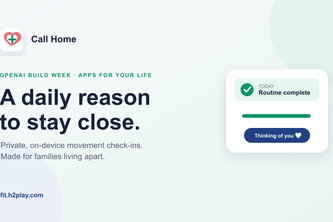
Call Home is a mobile-first family connection product that uses gentle movement routines as a recurring conversation starter between parents and adult children who live apart. The author states it is not a medical or diagnostic tool but a privacy-first ritual designed to reduce friction in daily contact.
What changed
The project evolved from an initial prototype into a full-stack, deployed product during OpenAI Build Week 2026. It includes mobile coaching with automatic counting, family linking, encouragement messaging, and PWA push notifications. The author used Codex and GPT-5.6 to accelerate development and iterate on user feedback.
Single most important open question
Is there evidence of real-world usage or adoption beyond the single developer’s prototype? The description does not indicate any customers, revenue, or traction data — only a self-reported build process and technical implementation.
What The Product Actually Is
The description states that Call Home is a mobile application designed to help families living apart stay connected through daily movement rituals. It allows parents to perform guided exercises (e.g., chair stands, arm raises) while children can monitor progress, send encouragement, and initiate calls naturally.
Key features include:
- Mobile camera-based coaching with visual guidance
- Automatic counting of repetitions using MediaPipe Pose Landmarker
- Local processing of camera frames (no upload or storage)
- Family code or invitation link for child connection
- Encouragement messages sent from children to parents
- Web Push notifications and evening check-in reminders
- PWA support with native sharing in Apps in Toss
The system uses React, TypeScript, Vite, Node.js, SQLite, and integrates Gemini 3.1 Flash TTS for voice prompts.
Inference This is a privacy-first, low-friction family engagement tool built around movement as a communication mechanism.
Positioning & Claim Evolution
The author claims that Call Home is not a medical or diagnostic product but a family connection product. It aims to remove the awkwardness of initiating contact by turning exercise into a natural reason for conversation.
It positions itself as:
- A daily ritual, not a health tracker
- A privacy-first solution, with all camera processing done locally
- A low-pressure communication tool, using encouragement instead of surveillance
The project evolved from an idea focused on “frictionless contact” to a full-stack product that supports both parent and child roles across devices.
Inference The positioning reflects a shift from emotional intent to technical execution, with the author emphasizing usability and inclusivity over performance metrics.
Target Customer & ICP
The description states that Call Home targets families where parents and adult children live apart, particularly those seeking ways to maintain regular contact without feeling monitored or obligated.
It is designed for:
- Parents who want to stay connected but avoid awkward reporting
- Children who wish to encourage their parents without interrogating them
- Older adults, as the author notes: “design mobile-first for older adults”
No specific demographics or user segments beyond this general family dynamic are mentioned.
Inference The ICP appears to be centered on intergenerational family dynamics and emotional connection rather than a defined market segment or persona.
Business Model & Pricing Evidence
There is no evidence of pricing, monetization strategy, or business model in the description. The author does not mention subscriptions, freemium tiers, advertising, or any revenue streams.
Inference The product appears to be a personal project or hackathon prototype with no commercial model described.
Technical & Delivery Signals
- Built using React, TypeScript, Vite, Node.js, and SQLite
- Uses MediaPipe Pose Landmarker for local pose detection
- Implements adaptive movement thresholds based on individual range of motion
- Includes PWA support with Web Push notifications
- Deployed via Apps in Toss and web version at fit.h2play.com
- Voice prompts generated using Gemini 3.1 Flash TTS
- Mobile-first design optimized for older adults
The author reports using Codex and GPT-5.6 to accelerate development, debug issues, and refine product decisions.
Inference Technical delivery shows strong engineering effort and iterative improvement, though no production-scale deployment or infrastructure details are provided.
Traction & Maturity Signals
There is no evidence of traction, including:
- No customers
- No revenue
- No usage data
- No user base
- No product adoption metrics
The description indicates that the project was built during a hackathon and deployed as a prototype, not yet in production use.
Inference This is an early-stage prototype with no demonstrated market traction or maturity.
Competitive Context
There are no mentions of competitors or similar products. The author does not reference existing tools for family communication, elder care, or movement tracking.
Inference No competitive landscape is described; the project may be unique in its approach to combining movement and emotional connection.
Open Questions & Risks
- Single developer team: Only one member listed (현기 홍), which raises concerns about scalability and long-term maintenance.
- No commercial traction or revenue: The product has not been validated in the market.
- Unverified claims: All descriptions are self-reported and unverified.
- Limited audience: The target is narrow — families living apart — which may limit growth potential.
- Platform-specific challenges: Issues with WebView speech synthesis suggest possible scalability problems.
Inference The risk of failure is high due to lack of validation, limited team size, and absence of a clear path to monetization or user adoption.
Questions the description leaves open
- What real-world feedback have you received from users?
- How do you plan to scale beyond one developer?
- Have you tested the product with actual families?
- Are there any plans for monetization or commercial partnerships?
- What are the technical limitations of the current architecture that might prevent scaling?
Overall Assessment
Not evidenced: There is no evidence of revenue, customers, traction, or a clear business model to support an investment or partnership decision.
The project is described as a personal prototype, built during a hackathon, with no indication of commercial viability or market validation. It is not yet a product in production use.
Confidence level: Low — based entirely on self-reported claims and technical implementation details without external corroboration or usage data.
Assessment: Not ready for investment or partnership consideration at this stage.
User Stories BotA demo video on every pull request
Get a demo video on every new feature
GitHub App that watches your pull requests and records a narrated, captioned demo.
Save time on demo prep and make informed decisions faster with a video walkthrough of every new feature.
Source
Submitted to the OpenAI 2026 hackathon on Devpost. Project home on Devpost. Back to the full gallery on Devpost.
This competitive analysis was produced by top-founders.com (opens in a new tab)
Generated by a language model from this project's public Devpost page — its tagline, the author's own write-up and any built-with tags listed there — as captured in August 2026. Short quotations are the author's words. It is an opinion on the idea as a business, not on the people behind it, and it reflects the description as published then. If the project has moved on, request a correction below. The analysis is not independent research and contains no verified traction, revenue or customer data.
An independent guide by KFG International LLC — not affiliated with, endorsed by, or connected to Devpost or OpenAI.