

Archive position — measured, not model output
0 likes on Devpost
2,263 of the 7,850 archived projects have more likes, and 5,587 share exactly 0 — so this project's #7,005 place in the like-ranked listing is a tie-break inside that group, not a ranking.
Projects (log scale)
Likes on Devpost. ▲ marks this project's group.
Show the figures
| Likes | Projects | Share of archive |
|---|---|---|
| 0 | 5,587 | 71.2% |
| 1 | 1,758 | 22.4% |
| 2 | 284 | 3.6% |
| 3–4 | 132 | 1.7% |
| 5–9 | 75 | 1.0% |
| 10+ | 14 | 0.2% |
 User Stories BotA demo video on every pull request
Get a demo video on every new feature
GitHub App that watches your pull requests and records a narrated, captioned demo.
Save time on demo prep and make informed decisions faster with a video walkthrough of every new feature.
Executive Summary
What the company appears to be
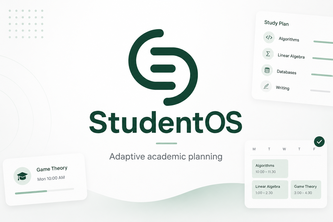
StudentOS is a self-reported academic planning tool built by one developer (SynthetIQ Poddar) that aims to consolidate fragmented student information—courses, schedules, assignments, materials, and assessments—into an adaptive daily study plan. It uses AI to generate personalized learning paths, manage academic context, and support recovery from disruptions in the study plan.
What changed
The project was submitted as part of the OpenAI 2026 hackathon. The author states that it evolved from a personal need to reduce cognitive load around academic planning and task management into a system with an Adaptive Recovery Engine designed to respond dynamically to changes in student performance or availability.
Single most important open question
Is there any evidence of actual student usage, adoption, or feedback beyond the self-reported description? The author describes extensive technical capabilities but does not provide any data on real-world impact or user behavior.
What The Product Actually Is
The description states that StudentOS is a tool that:
- Consolidates academic information from multiple sources (e.g., Google Classroom, syllabi, notes, assignments).
- Uses AI to generate a daily study plan based on:
- Timetable and availability
- Academic performance
- Study preferences (e.g., focus/break rhythms)
- Topic mastery levels
- Provides features such as:
- Topic-by-topic note generation
- Assessment testing with feedback
- Integration with Google Classroom (read-only OAuth)
- Adaptive recovery engine for plan adjustments
It is described as having a frontend built with HTML/CSS/JS and a Node.js backend, using Supabase for authentication and data storage, and integrating with AI providers like Groq, Gemini, and Pollinations AI.
Evidence
- The author describes the architecture and components in detail.
- The system includes PDF upload handling, semantic search, and AI-powered planning.
- It uses Zod schemas to validate AI outputs before applying them to plans.
Inference The product appears to be a prototype or early-stage tool built for personal use rather than a commercial offering. No evidence of revenue, pricing, or customer base is provided.
Positioning & Claim Evolution
The author positions StudentOS as an academic workspace that:
- Reduces planning burden by consolidating fragmented information.
- Offers adaptive planning that evolves with student performance and availability.
- Provides personalized learning support through AI-generated notes and assessments.
Claims
- The system knows the entire semester syllabus, exam dates, and study preferences.
- It adapts to academic changes in real time.
- It generates a step-by-step TO-DO list each morning.
- It integrates with Google Classroom but does not modify it directly.
Evolution of claims
The author evolved from describing a simple planner to one that includes:
- An Adaptive Recovery Engine
- AI-driven note generation and assessment
- Integration with multiple AI providers
- Voice and visual capabilities (planned)
Evidence All claims are self-reported by the author. No external validation or market positioning data is provided.
Target Customer & ICP
The description states that StudentOS targets students who:
- Have fragmented academic information across platforms.
- Struggle with analysis paralysis or procrastination.
- Want a tool to manage their study plan without manual effort.
- Prefer adaptive planning that responds to performance and availability.
ICP
Based on the author's own experience, the target is likely:
- Undergraduate or high school students
- Using Google Classroom or similar platforms
- Seeking structured academic support
Evidence The description focuses on a single developer’s personal use case. No evidence of market segmentation, user personas, or customer interviews.
Business Model & Pricing Evidence
There is no evidence provided about:
- Revenue streams
- Pricing models
- Monetization strategy
- Customer acquisition costs
- Sales process or go-to-market approach
Evidence The author describes the tool as a personal project submitted to a hackathon. No indication of commercial intent or business model.
Technical & Delivery Signals
The system is described as:
- Built with HTML/CSS/JS frontend and Node.js backend.
- Uses Supabase for authentication, data storage, and file handling.
- Integrates with AI providers (Groq, Gemini, Pollinations) via adapters.
- Implements Zod schema validation for AI outputs.
- Includes background job infrastructure, Playwright tests, and migration verification.
- Hosted on Cloudflare and Azure Container Apps.
Evidence The author provides a detailed technical breakdown of the architecture and components. However, no evidence of production deployment or scalability data is given.
Traction & Maturity Signals
There is no evidence of:
- User base
- Revenue
- Customer adoption
- Product usage metrics
- Market traction
Evidence The project is described as a hackathon submission by one person. No data on user engagement, retention, or product maturity is provided.
Competitive Context
No competitive analysis or market positioning is included in the description.
Evidence The author does not name competitors or describe how StudentOS compares to existing academic tools or AI-powered planners.
Open Questions & Risks
- Single-person development: The system is built by one developer, raising questions about scalability and long-term maintenance.
- No user data or feedback: No evidence of real-world usage or performance metrics.
- Unverified AI integration: While the system integrates with multiple AI providers, it does not use OpenAI’s direct API—this may limit its capabilities or introduce compatibility issues.
- Planned features not implemented: Several features (e.g., voice communication, image generation) are listed as future plans but not yet functional.
- No commercialization strategy: The tool is presented as a personal project with no indication of monetization or business model.
Evidence All risks stem from the lack of external validation and user data in the self-reported description.
Questions the description leaves open
- What specific academic challenges do students face that StudentOS solves, and how did you identify these?
- How many students have used this tool so far, and what feedback have they given?
- Are there any plans to integrate with major LMS platforms beyond Google Classroom?
- How does the system handle edge cases or failures in AI outputs?
- What is the current level of automation in the planning process, and how much manual input is required?
- Is there a plan for monetization or commercial deployment?
- What are the technical limitations of the current architecture that could affect scalability?
Overall Assessment
Not evidenced.
The description provides no information on:
- Financials
- Market size
- Competitive landscape
- Customer traction
- Commercial viability
This is a self-reported, unverified project submitted as a hackathon entry by one individual. It lacks any evidence of product-market fit, revenue, or customer adoption.
Confidence level Low The author describes an ambitious and technically complex system, but there is no external validation of its utility or traction. The tool appears to be in early development with no clear path to commercialization or user engagement.
User Stories BotA demo video on every pull request
Get a demo video on every new feature
GitHub App that watches your pull requests and records a narrated, captioned demo.
Save time on demo prep and make informed decisions faster with a video walkthrough of every new feature.
Source
Submitted to the OpenAI 2026 hackathon on Devpost. Project home on Devpost. Back to the full gallery on Devpost.
This competitive analysis was produced by top-founders.com (opens in a new tab)
Generated by a language model from this project's public Devpost page — its tagline, the author's own write-up and any built-with tags listed there — as captured in August 2026. Short quotations are the author's words. It is an opinion on the idea as a business, not on the people behind it, and it reflects the description as published then. If the project has moved on, request a correction below. The analysis is not independent research and contains no verified traction, revenue or customer data.
An independent guide by KFG International LLC — not affiliated with, endorsed by, or connected to Devpost or OpenAI.