

Archive position — measured, not model output
1 like on Devpost
505 of the 7,850 archived projects have more likes, and 1,758 share exactly 1 — so this project's #1,118 place in the like-ranked listing is a tie-break inside that group, not a ranking.
Projects (log scale)
Likes on Devpost. ▲ marks this project's group.
Show the figures
| Likes | Projects | Share of archive |
|---|---|---|
| 0 | 5,587 | 71.2% |
| 1 | 1,758 | 22.4% |
| 2 | 284 | 3.6% |
| 3–4 | 132 | 1.7% |
| 5–9 | 75 | 1.0% |
| 10+ | 14 | 0.2% |
 User Stories BotA demo video on every pull request
Get a demo video on every new feature
GitHub App that watches your pull requests and records a narrated, captioned demo.
Save time on demo prep and make informed decisions faster with a video walkthrough of every new feature.
Executive Summary
What the company appears to be
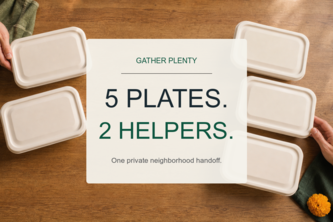
Gather Plenty is a self-reported neighborhood-based food-sharing platform built as a proof-of-concept for a hackathon project. The author describes it as an installable Progressive Web App (PWA) that allows neighbors to request or offer dinner portions without publishing personal need stories or exposing addresses. It supports partial fulfillment of requests by multiple helpers and includes privacy-scoped location release, transactional logic, and deterministic scenario testing.
What changed
The project was submitted to the OpenAI 2026 hackathon. The author reports building it over a short development period using AI tools like Codex and GPT-5.6, with no prior revenue or customer data.
Single most important open question — the commercial due-diligence read
Is there evidence of real-world traction, user adoption, or a path to monetization beyond the synthetic demo? The description states that all functionality is currently synthetic and free, and no production-ready version exists yet.
What The Product Actually Is
- The description states that Gather Plenty is an installable React and TypeScript PWA.
- It uses Supabase, PostgreSQL, PostGIS, Cloudflare, and other technologies.
- The product allows neighbors to ask for or share one to five dinner portions.
- It supports partial fulfillment of requests by multiple helpers.
- Matching logic coordinates quantities, timing, alerts, privacy, and handoff.
- The public demo uses a deterministic scenario engine; the alpha version uses invite-only authentication with Supabase and PostgreSQL.
- It models consent, expiration, cancellation, protected location release, notification failures, incident holds, and reason-coded operational exceptions.
Inference The product appears to be a prototype built for demonstration purposes rather than production use. The author emphasizes that it is currently synthetic and not yet ready for real-world activation.
Positioning & Claim Evolution
- The description states the goal is to treat “asking” and “sharing” as ordinary parts of a neighborhood system.
- It aims to reduce stigma around food need by avoiding public need stories or exposed addresses.
- The author claims that multiple neighbors can combine partial help to complete one request.
- The product is positioned as a tool for coordinating food abundance and need within a few streets of each other.
Inference The positioning reflects a social impact or community-building intent, but no evidence exists of actual market traction or user feedback beyond the author’s own claims.
Target Customer & ICP
- The description states that the target is “neighbors” who may want to ask for or offer dinner portions.
- It assumes users are located near each other and willing to participate in a partial-sharing model.
- No specific demographic, geographic, or behavioral segmentation is provided.
- The system supports both requesters and helpers equally.
Inference The ICP seems to be local community members with access to smartphones and internet, but no data on actual users or their behavior is presented.
Business Model & Pricing Evidence
- The description states that the product remains “free and synthetic” until real-world safety and legal work is complete.
- No pricing information, monetization strategy, or revenue model is described.
- There is no mention of paid features, subscriptions, or transaction fees.
Inference There is no evidence of a business model beyond the current synthetic demo. The project has not moved into any commercial phase.
Technical & Delivery Signals
- Built with React, TypeScript, PWA architecture, Supabase, PostgreSQL, PostGIS, Cloudflare.
- Uses Codex and GPT-5.6 as primary engineering partners during development.
- Includes deterministic scenario engine for testing.
- Has a public no-account demo route at gatherplenty.org.
- Transactional commands prevent over-allocation; row-level security restricts location visibility.
- The release checks cover participant flows, partial-allocation races, database permissions, PWA packaging, responsive layouts, and dependency health.
Inference The technical stack suggests a modern, scalable approach, but the delivery is limited to synthetic and non-production use cases. No evidence of live deployment or performance metrics exists.
Traction & Maturity Signals
- The project is described as a hackathon submission.
- A public scenario lab is available for judges without account creation.
- The alpha version uses invite-only authentication.
- The author reports that five people will complete twelve synthetic end-to-end sessions before opening an invitation-only synthetic neighborhood cell.
- No real-world users, customers, or adoption data are mentioned.
Inference There is no evidence of traction or user engagement beyond the author’s own testing and synthetic scenarios. The project remains in early-stage prototyping.
Competitive Context
- Not evidenced.
Inference No mention of competitors or existing solutions in the food-sharing or neighborhood coordination space is provided. No competitive analysis can be drawn from this description.
Open Questions & Risks
- The product is described as synthetic, not real-world.
- No evidence of legal, food-safety, insurance, or operational readiness for real activation.
- The author notes that the hard part was making complex behaviors (partial portions, role changes, private locations) behave coherently while keeping the experience simple.
- The project has no revenue, customers, or traction data.
- The use of AI tools like Codex and GPT-5.6 raises questions about whether the codebase is fully under human control or if it introduces risks related to AI-generated content.
Inference The lack of real-world testing, legal validation, and user feedback makes this a high-risk, unproven concept. The project is not yet ready for production or commercial use.
Questions the description leaves open
- What are the key assumptions about user behavior that have not been validated?
- How does the system handle edge cases like failed notifications, cancellation disputes, or expired commitments?
- Has any legal review been conducted regarding food safety, liability, or insurance implications?
- What is the timeline for moving from synthetic to real-world activation?
- Are there any plans to collect user feedback or data beyond the current synthetic tests?
- How does the author plan to scale beyond a single developer’s work?
Overall Assessment
- Not evidenced.
Inference There is insufficient evidence to assess whether this project is suitable for investment or partnership. The description indicates that it is still in early-stage prototyping and not yet ready for real-world deployment or commercialization. No financials, traction, or clear path to monetization are evident.
User Stories BotA demo video on every pull request
Get a demo video on every new feature
GitHub App that watches your pull requests and records a narrated, captioned demo.
Save time on demo prep and make informed decisions faster with a video walkthrough of every new feature.
Source
Submitted to the OpenAI 2026 hackathon on Devpost. Project home on Devpost. Back to the full gallery on Devpost.
This competitive analysis was produced by top-founders.com (opens in a new tab)
Generated by a language model from this project's public Devpost page — its tagline, the author's own write-up and any built-with tags listed there — as captured in August 2026. Short quotations are the author's words. It is an opinion on the idea as a business, not on the people behind it, and it reflects the description as published then. If the project has moved on, request a correction below. The analysis is not independent research and contains no verified traction, revenue or customer data.
An independent guide by KFG International LLC — not affiliated with, endorsed by, or connected to Devpost or OpenAI.