

Archive position — measured, not model output
0 likes on Devpost
2,263 of the 7,850 archived projects have more likes, and 5,587 share exactly 0 — so this project's #5,044 place in the like-ranked listing is a tie-break inside that group, not a ranking.
Projects (log scale)
Likes on Devpost. ▲ marks this project's group.
Show the figures
| Likes | Projects | Share of archive |
|---|---|---|
| 0 | 5,587 | 71.2% |
| 1 | 1,758 | 22.4% |
| 2 | 284 | 3.6% |
| 3–4 | 132 | 1.7% |
| 5–9 | 75 | 1.0% |
| 10+ | 14 | 0.2% |
 User Stories BotA demo video on every pull request
Get a demo video on every new feature
GitHub App that watches your pull requests and records a narrated, captioned demo.
Save time on demo prep and make informed decisions faster with a video walkthrough of every new feature.
Executive Summary
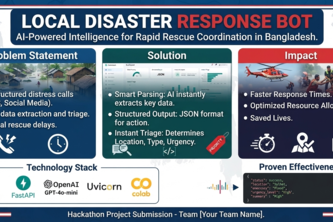
The description states that Local Disaster Response Bot is an AI-powered backend system designed to parse unstructured distress messages into structured JSON for emergency coordination. The author claims it uses FastAPI, OpenAI's GPT-4o-mini, and Pydantic for data validation. It is presented as a prototype built for a hackathon, with no evidence of revenue, customers or operational use.
The single most important open question is: What is the actual scale or scope of emergency communication this system is intended to handle, and how does it plan to integrate into existing rescue coordination workflows?
This project appears to be a proof-of-concept prototype submitted for a hackathon. The description provides no evidence of traction, revenue, customer adoption, or operational deployment.
What The Product Actually Is
- The description states the product is an AI-powered emergency coordination backend.
- It parses unstructured distress messages into structured JSON data using OpenAI's GPT-4o-mini model.
- It includes an API endpoint (
/process-emergency) built with FastAPI. - It extracts location, emergency type, urgency level, and summary from input text.
- The system uses Pydantic models for data validation and enforces JSON response formatting from the LLM.
Not evidenced: whether this is a working API, how many messages it can process, or if it has been tested in real-world conditions.
Positioning & Claim Evolution
- The author states the product aims to bridge the gap between victims and rescue coordinators during natural disasters.
- It positions itself as an intelligent backend system that automates manual triage of emergency communications.
- The claim evolution shows a progression from problem identification (chaotic communication) to solution (structured data extraction).
- The description implies this is a humanitarian technology application focused on improving response times.
Not evidenced: prior versions, market positioning beyond the hackathon submission, or competitive differentiation.
Target Customer & ICP
- The description states that the system targets rescue teams and coordinators who receive distress messages during disasters.
- It is intended for use in regions like Bangladesh where floods or cyclones occur.
- The system is designed to help with rapid dispatch of rescue operations by providing structured data.
Not evidenced: specific customer segments beyond general emergency responders, user personas, or deployment locations.
Business Model & Pricing Evidence
- Not evidenced. The description does not mention any pricing model, monetization strategy, or business model.
Technical & Delivery Signals
- Built with FastAPI for performance and documentation.
- Uses Pydantic for data validation.
- Integrates OpenAI API (gpt-4o-mini) with enforced JSON output.
- Developed using Google Colab, Uvicorn, and TestClient for testing.
- The system is described as a backend API endpoint only.
Not evidenced: deployment infrastructure, scalability plans, or integration capabilities beyond the prototype stage.
Traction & Maturity Signals
- Not evidenced. There is no mention of users, customers, revenue, or product usage metrics.
- The project was submitted to a hackathon and is described as a prototype.
- No evidence of operational use or live deployment.
Competitive Context
- Not evidenced. The description does not reference existing tools or platforms in the emergency coordination space.
- No comparison with competitors or similar solutions.
Open Questions & Risks
- Prototype-only status: The system is presented as a hackathon submission, not a production-ready tool.
- Limited scope: Only one team member worked on it (Sreeja Ghosh).
- No evidence of integration into existing systems or workflows.
- LLM dependency: Reliance on OpenAI's API introduces potential cost and availability risks.
- Lack of real-world testing or feedback from emergency responders.
Questions the description leaves open
- What specific disaster scenarios have you tested this system against?
- How does the system handle multilingual inputs, especially in local dialects?
- Has there been any evaluation with actual rescue coordinators or emergency response teams?
- What are your plans for integrating real-time databases and dashboards?
- How do you intend to scale beyond a single prototype?
Overall Assessment
Not evidenced. The description provides no information on valuation, funding rounds, or investment interest.
The project is described as a hackathon submission with no evidence of traction, revenue, or customer adoption. It appears to be an early-stage idea or proof-of-concept rather than a developed product or service. Any commercial viability remains unproven and unverified.
User Stories BotA demo video on every pull request
Get a demo video on every new feature
GitHub App that watches your pull requests and records a narrated, captioned demo.
Save time on demo prep and make informed decisions faster with a video walkthrough of every new feature.
Source
Submitted to the OpenAI 2026 hackathon on Devpost. Project home on Devpost. Back to the full gallery on Devpost.
This competitive analysis was produced by top-founders.com (opens in a new tab)
Generated by a language model from this project's public Devpost page — its tagline, the author's own write-up and any built-with tags listed there — as captured in August 2026. Short quotations are the author's words. It is an opinion on the idea as a business, not on the people behind it, and it reflects the description as published then. If the project has moved on, request a correction below. The analysis is not independent research and contains no verified traction, revenue or customer data.
An independent guide by KFG International LLC — not affiliated with, endorsed by, or connected to Devpost or OpenAI.