

Archive position — measured, not model output
0 likes on Devpost
2,263 of the 7,850 archived projects have more likes, and 5,587 share exactly 0 — so this project's #7,006 place in the like-ranked listing is a tie-break inside that group, not a ranking.
Projects (log scale)
Likes on Devpost. ▲ marks this project's group.
Show the figures
| Likes | Projects | Share of archive |
|---|---|---|
| 0 | 5,587 | 71.2% |
| 1 | 1,758 | 22.4% |
| 2 | 284 | 3.6% |
| 3–4 | 132 | 1.7% |
| 5–9 | 75 | 1.0% |
| 10+ | 14 | 0.2% |
 User Stories BotA demo video on every pull request
Get a demo video on every new feature
GitHub App that watches your pull requests and records a narrated, captioned demo.
Save time on demo prep and make informed decisions faster with a video walkthrough of every new feature.
Executive Summary
StudioLite is a self-reported AI media studio that runs entirely on local hardware, using open-source diffusion models like SDXL and Whisper for video and audio processing. The author describes it as an interface to automate workflows that would otherwise require multiple subscriptions, with no cloud upload or metering. It supports text-to-video, photo editing, transcription, and basic video editing functions, all within a local environment.
The project is built by one person (Pawan Rama Mali), using FastAPI, Node.js, Python, and Streamlit/Next.js for UIs. The author reports that it uses Codex for development assistance and has undergone license audits to avoid open-source compliance issues.
There is no evidence of revenue, customers, or traction beyond the self-reported description. The project is open-sourced under MIT and submitted to an OpenAI hackathon.
The single most important open question
Is there any evidence that users are actually adopting this tool, or that it has achieved meaningful usage or impact beyond the author's own development?
What The Product Actually Is
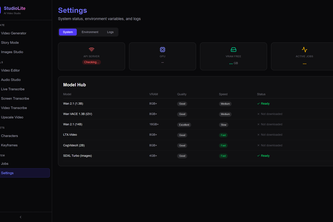
The description states that StudioLite is a full-featured AI media studio designed to run entirely on local hardware. It supports:
- Text or image to video generation using local diffusion models
- Story Mode for planning multi-scene films with narration and music
- ReelForge for short-form video pipelines (script, images, TTS, subtitles, ducked background music)
- Images Studio for SDXL generation, editing, upscaling, and background removal
- A transcription suite that handles audio/video files, live microphone input, and continuous OCR of screen content
- Basic video editing functions such as trim, merge, compress, speed, GIF, thumbnail, stabilize, blur face, overlay logo
All operations are performed on the user's local machine. No data leaves the device, no account is required, and there is no metering.
It also includes a transcription suite that handles audio/video files, live microphone input, and continuous OCR of screen content.
Evidence The author’s own write-up describes these features in detail.
Inference The product appears to be a local-first AI media tool built around open-source models, with an emphasis on avoiding cloud-based services or subscription fees.
Positioning & Claim Evolution
The author positions StudioLite as a solution to the inefficiencies of fragmented workflows across multiple SaaS tools. They claim that:
- Existing tools are expensive ($15–30/month each)
- Each tool requires uploading content to their servers
- Experimentation is costly due to per-minute billing
- Open-source models can be run locally but lack user-friendly interfaces
The core value proposition is that StudioLite provides a unified interface for running open-source AI models on local hardware, eliminating the need for cloud uploads or subscriptions.
Evidence The author’s write-up explicitly frames this as a response to existing tool fragmentation and cost inefficiencies.
Inference This positioning suggests a shift from traditional SaaS media tools toward decentralized, local-first solutions — though there is no evidence of market adoption or competitive traction.
Target Customer & ICP
The description does not clearly define the target customer or ideal customer profile (ICP). However, based on the author’s framing:
- Users who own a GPU and want to experiment with AI media tools
- Developers or power users comfortable with Python environments
- People dissatisfied with current SaaS offerings for video/audio editing
- Individuals looking to avoid paying monthly fees for AI tools
The author notes that setup assumes familiarity with Python environments, which may limit adoption among non-technical users.
Evidence The author mentions the need for Python environment knowledge and the presence of a Streamlit UI that was kept despite being less elegant.
Inference The ICP likely includes technically proficient individuals or small teams who already have access to GPUs and are willing to invest time in setup.
Business Model & Pricing Evidence
There is no evidence of a business model or pricing structure. The author states:
- StudioLite is MIT licensed and open source
- No account, key, or metering required
- All operations happen locally without data leaving the machine
The project was submitted to a hackathon, suggesting it may be in early development or experimental phase.
Evidence The author explicitly says there is no subscription or payment model.
Inference If this were ever commercialized, it would likely rely on either freemium features, enterprise licensing, or direct sales of hardware/software bundles — but none are mentioned.
Technical & Delivery Signals
The project is built with:
- FastAPI backend
- Next.js frontend
- Streamlit UI (initially used for rapid prototyping)
- Python engines handling heavy operations
- Codex used for development assistance, including issue tracking and batch implementation across stacks
- Verification loop involving real-world execution of FFmpeg workers
The author notes that:
- Heavy operations run as background jobs to avoid blocking requests
- VRAM management is handled automatically based on available memory
- License compliance audits were conducted to avoid open-source issues
- The tool detects available VRAM and adjusts rendering strategies accordingly
Evidence The author describes technical architecture, development practices, and system-level optimizations.
Inference The delivery approach shows awareness of performance constraints and developer experience trade-offs, but lacks evidence of scalability or production deployment.
Traction & Maturity Signals
There is no evidence of traction, revenue, or customer adoption. The project is described as:
- Built by a single individual (Pawan Rama Mali)
- Submitted to an OpenAI hackathon
- MIT licensed and open-sourced
- Not yet fully integrated between UIs (Streamlit and Next.js)
The author mentions that the two frontends are not yet unified, and that an installer is planned for future release.
Evidence The project is self-reported as a hackathon submission with no external validation or usage metrics.
Inference This indicates a very early-stage product with limited maturity. No signs of user engagement or market traction.
Competitive Context
The author does not name competitors, but implies that the product addresses gaps in existing SaaS tools for AI media creation:
- Tools that charge per minute
- Services requiring cloud uploads
- Fragmented workflows across multiple platforms
They reference open-source models like SDXL, Whisper, and others, suggesting they are competing with or building upon these.
Evidence The author contrasts StudioLite with fragmented SaaS offerings.
Inference The competitive landscape includes traditional AI media tools (e.g., Runway, Pika Labs, Descript) and open-source alternatives. However, no direct comparison or market positioning is provided.
Open Questions & Risks
Key risks and open questions include:
- Single-person development: No team behind the project raises concerns about long-term maintenance and scalability.
- No revenue or traction: The absence of any evidence of monetization or user base suggests a lack of commercial viability.
- Limited UI integration: Two separate frontends (Streamlit + Next.js) indicate incomplete product maturity.
- Open-source compliance risks: Though audits were done, the presence of AGPL and GPL dependencies raises potential legal exposure.
- Technical complexity for end-users: Setup assumes familiarity with Python environments, which may limit mainstream adoption.
Evidence The author acknowledges the need for an installer and ongoing UI unification.
Inference Without a clear path to monetization or user growth, this remains a prototype rather than a viable business.
Questions the description leaves open
- What is your plan for scaling beyond one developer?
- Have you tested the tool with real users outside of yourself?
- How do you intend to handle open-source license compliance at scale?
- Are there any plans for monetization or commercial partnerships?
- What are the performance limitations on different hardware configurations?
- How do you plan to integrate the two UIs (Streamlit and Next.js)?
- Is there any interest from potential users or early adopters?
Overall Assessment
Not evidenced.
The project is described as a self-developed hackathon submission with no evidence of revenue, customers, traction, or commercial viability. It is open-sourced under MIT and built by one person.
There is no indication that this represents a scalable business opportunity or a product ready for investment or partnership.
Inference Based on the lack of any measurable impact, user engagement, or monetization strategy, this appears to be an experimental tool in early development rather than a commercial proposition.
User Stories BotA demo video on every pull request
Get a demo video on every new feature
GitHub App that watches your pull requests and records a narrated, captioned demo.
Save time on demo prep and make informed decisions faster with a video walkthrough of every new feature.
Source
Submitted to the OpenAI 2026 hackathon on Devpost. Project home on Devpost. Back to the full gallery on Devpost.
This competitive analysis was produced by top-founders.com (opens in a new tab)
Generated by a language model from this project's public Devpost page — its tagline, the author's own write-up and any built-with tags listed there — as captured in August 2026. Short quotations are the author's words. It is an opinion on the idea as a business, not on the people behind it, and it reflects the description as published then. If the project has moved on, request a correction below. The analysis is not independent research and contains no verified traction, revenue or customer data.
An independent guide by KFG International LLC — not affiliated with, endorsed by, or connected to Devpost or OpenAI.