

Archive position — measured, not model output
0 likes on Devpost
2,263 of the 7,850 archived projects have more likes, and 5,587 share exactly 0 — so this project's #6,987 place in the like-ranked listing is a tie-break inside that group, not a ranking.
Projects (log scale)
Likes on Devpost. ▲ marks this project's group.
Show the figures
| Likes | Projects | Share of archive |
|---|---|---|
| 0 | 5,587 | 71.2% |
| 1 | 1,758 | 22.4% |
| 2 | 284 | 3.6% |
| 3–4 | 132 | 1.7% |
| 5–9 | 75 | 1.0% |
| 10+ | 14 | 0.2% |
 User Stories BotA demo video on every pull request
Get a demo video on every new feature
GitHub App that watches your pull requests and records a narrated, captioned demo.
Save time on demo prep and make informed decisions faster with a video walkthrough of every new feature.
Executive Summary
What the company appears to be
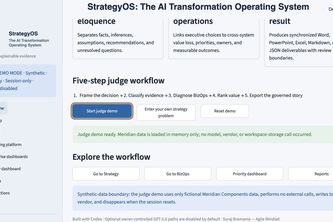
StrategyOS is described as an AI-powered transformation operating system that connects strategy, operational evidence, and AI to turn complex business problems into governed priorities, executable plans, and measurable value. It is a self-contained tool for structuring strategic decision-making with deterministic controls over AI use and human accountability.
What changed
The author reports a substantial expansion of an initial foundation into a working application during a hackathon, including the implementation of AI intake and research agents, deterministic analysis engines, connector architecture, dashboards, and synchronized exports. The system was built using Streamlit and integrates with generative AI (GPT-5.6) in bounded roles.
Single most important open question
Is there any evidence that StrategyOS has been used by real clients or validated through pilot programs beyond the synthetic judge experience?
What The Product Actually Is
The description states that StrategyOS is a system designed to connect fragmented strategic and operational workflows. It allows users to:
- Frame business decisions with scope, stakeholders, constraints, and success measures.
- Classify supporting information as facts, inferences, assumptions, recommendations, or unresolved questions.
- Identify required review gates across financial, workforce, privacy, security, legal, and technology domains.
- Connect strategy to evidence from delivery, engineering, testing, incidents, customers, finances, and collaboration systems.
- Rank improvement opportunities by customer impact, operational risk, target gap, and estimated value at stake.
- Create executable implementation plans with owners, measures, governance, and outcome tracking.
- Generate synchronized Markdown, JSON, Word, Excel, and PowerPoint deliverables from one governed result.
It is built using Streamlit and integrates generative AI (GPT-5.6) in limited roles, such as converting unstructured input into structured fields or conducting optional industry research. The deterministic engine handles evidence classification, priority scoring, planning, and export generation.
Positioning & Claim Evolution
The author positions StrategyOS as a tool that bridges the gap between strategy and execution by connecting fragmented decision-making processes. It is described as a "governed transformation package" that uses AI to structure content while maintaining human accountability and control.
Key claims include:
- The system prevents unsupported recommendations from appearing authoritative.
- AI is used in bounded roles, not for independent decision-making.
- Human approval is required for material decisions.
- Every exported format represents the same underlying result.
- The product emphasizes transparency about AI usage, model identification, and evidence support.
There is no evidence of prior positioning or evolution beyond this single self-reported version. No external marketing claims, customer testimonials, or historical positioning data are provided.
Target Customer & ICP
The description does not name specific customers or personas. However, it implies that StrategyOS targets:
- Business leaders or executives who need to make complex strategic decisions.
- Transformation teams working across multiple domains (delivery, engineering, finance, etc.).
- Organizations seeking to govern AI use in strategy and execution workflows.
It is positioned for enterprise-level users who require accountability, provenance, and structured governance over AI-generated outputs and operational evidence.
Business Model & Pricing Evidence
There is no evidence of a business model or pricing structure. The author describes the system as a self-contained tool built during a hackathon, with no mention of monetization, subscription tiers, licensing, or sales channels.
Technical & Delivery Signals
The system uses:
- Streamlit for interface
- GPT-5.6 in bounded roles (intake and optional research)
- Python-based backend with modules like StrategyOSAgent, IndustryResearchAgent, PipelineBuilderAgent, etc.
- Docker, GitHub Actions, OpenAI APIs, OAuth 2.0, REST APIs, SQLite, Pandas, Pytest, Markdown, JSON, Excel, Word, PowerPoint exports
- 13 transformation modules, 7 dashboard families, 12 value-ranked signals, 5 export formats, 48 connector contracts
The system includes:
- Deterministic engines for evidence classification and planning
- AI agents with defined roles and boundaries
- Read-only connectors with contract-tested but not live-certified integrations
- Session-only, read-only public judge experience
- Automated tests (298 passing)
- Integrity validation (10,000-event validation)
Traction & Maturity Signals
The description states that the system is a release candidate built during a hackathon. It includes:
- 298 automated tests
- 13 modules and 7 dashboard families
- 48 connector contracts (contract-tested but not live-certified)
- A synthetic judge experience with no credentials required
- No external validation, customer outcomes, or live vendor certification
There is no evidence of revenue, customers, or adoption beyond the author’s own development and demonstration.
Competitive Context
The description does not provide any information about competitors. It does not name similar tools or platforms in the AI strategy, transformation, or operational planning space.
Open Questions & Risks
- Unvalidated claims: The system is described as a "governed transformation package" but lacks evidence of real-world use or pilot validation.
- No customer data: No evidence of revenue, customers, or traction beyond the author’s own development and synthetic demo.
- Limited integration maturity: 48 connector contracts are contract-tested but not live-certified, suggesting a gap between design and implementation.
- Public demonstration only: The judge experience is read-only and session-only, with no external access or real-world validation.
- Self-reported maturity: All evidence points to internal development and testing; no third-party validation or independent review.
Questions the description leaves open
- Has StrategyOS been tested in any real-world pilot engagements?
- What is the current status of connector certifications with live vendor systems?
- Are there any plans for monetization or go-to-market strategy?
- How does the system handle data privacy and compliance in enterprise environments?
- What are the key assumptions behind the priority scoring and evidence classification logic?
- Has the author considered how to scale beyond a single-person development effort?
Overall Assessment
Not evidenced.
There is no evidence of revenue, customers, traction, or validated market demand. The system is described as a prototype built during a hackathon with no external validation or commercial deployment. While the technical architecture and design are detailed, there is no indication that StrategyOS has moved beyond the concept or early development stage.
The author’s claims about governance, accountability, and AI control are compelling but unverified in real-world use. Without evidence of pilot programs, customer feedback, or market traction, this remains a speculative product idea rather than a validated business opportunity.
User Stories BotA demo video on every pull request
Get a demo video on every new feature
GitHub App that watches your pull requests and records a narrated, captioned demo.
Save time on demo prep and make informed decisions faster with a video walkthrough of every new feature.
Source
Submitted to the OpenAI 2026 hackathon on Devpost. Project home on Devpost. Back to the full gallery on Devpost.
This competitive analysis was produced by top-founders.com (opens in a new tab)
Generated by a language model from this project's public Devpost page — its tagline, the author's own write-up and any built-with tags listed there — as captured in August 2026. Short quotations are the author's words. It is an opinion on the idea as a business, not on the people behind it, and it reflects the description as published then. If the project has moved on, request a correction below. The analysis is not independent research and contains no verified traction, revenue or customer data.
An independent guide by KFG International LLC — not affiliated with, endorsed by, or connected to Devpost or OpenAI.