

Archive position — measured, not model output
0 likes on Devpost
2,263 of the 7,850 archived projects have more likes, and 5,587 share exactly 0 — so this project's #3,063 place in the like-ranked listing is a tie-break inside that group, not a ranking.
Projects (log scale)
Likes on Devpost. ▲ marks this project's group.
Show the figures
| Likes | Projects | Share of archive |
|---|---|---|
| 0 | 5,587 | 71.2% |
| 1 | 1,758 | 22.4% |
| 2 | 284 | 3.6% |
| 3–4 | 132 | 1.7% |
| 5–9 | 75 | 1.0% |
| 10+ | 14 | 0.2% |
 User Stories BotA demo video on every pull request
Get a demo video on every new feature
GitHub App that watches your pull requests and records a narrated, captioned demo.
Save time on demo prep and make informed decisions faster with a video walkthrough of every new feature.
Executive Summary
What the company appears to be
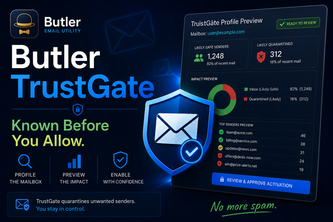
Butler TrustGate - Known Before Allowed is a self-reported email utility that uses a pre-activation profiling system to analyze historical mailbox data before enabling automated trust-based quarantine and classification. The project is presented as an extension of an existing multi-user email trust system, with a focus on making automation safer and more accountable by showing users likely impacts before activation.
What changed
The author states that the Build Week contribution added a new pre-activation Trust Profile for mature mailboxes. This profile analyzes historical inbox and sent headers to reconstruct correspondent relationships, simulate three different TrustGate postures, and produce an impact report without altering the mailbox.
Single most important open question
Is there any evidence of actual product usage or adoption beyond this proof-of-concept? The description indicates that the system is in pre-alpha development and that the demonstration was run on a disabled mailbox — no commercial traction or user feedback is evident.
What The Product Actually Is
The description states:
- Butler is an existing multi-user email trust, quarantine, classification, and routing system currently in pre-alpha development.
- The Build Week contribution is a new pre-activation Trust Profile for mature mailboxes.
- The Trust Profile analyzes historical mailbox headers (Inbox and Sent), reconstructs correspondent relationships, compares three TrustGate postures (Conservative, Balanced, Expanded Review), forecasts quarantine outcomes, and produces a readable impact report.
- It leaves the mailbox unchanged and uses deterministic PHP, MySQL, and IMAP operations for read-only analysis.
Evidence
- The system is described as having production-ready components including TrustGate, quarantine, sender validation, classification, routing, onboarding, and multi-user capabilities before Build Week.
- The new component is an isolated profiling layer that observes existing trust behavior before runtime activation.
- It does not read message bodies or attachments, move/copy/delete messages, or activate TrustGate.
Inference The product appears to be a tool for safer email automation through pre-activation review and evidence-based decision-making.
Positioning & Claim Evolution
The description states:
- The inspiration behind Butler is that email automation often asks users to trust the system before it understands their mailbox — especially risky for mature inboxes.
- It aims to make email automation “safer, more understandable, and more accountable.”
- The key principle is: “Butler should not begin by acting on your inbox. It should begin by showing you what is likely to happen.”
- The tagline is: “Butler is an email utility that uses TrustGate to quarantine unwanted senders. This POC profiles a mailbox, identifies likely safe senders, and previews the impact before user approval - no more SPAM.”
Evidence
- The positioning centers on trust-first automation and pre-activation mailbox profiling.
- It emphasizes safety, accountability, and informed activation over blind trust.
Inference The project positions itself as a solution to the tension between user caution and automated email protection — a niche in email management tools where transparency is key.
Target Customer & ICP
The description states:
- The system targets users with mature inboxes who are cautious about giving automated systems control over their mail.
- It is designed for those who want protection from spam, phishing, unwanted senders, and inbox overload but are wary of blind activation.
Evidence
- The focus is on users who already have complex email relationships (family contacts, vendors, newsletters, etc.) and are concerned about disruption from automation.
- The system is described as useful for “people who want protection” but also “understandably cautious.”
Inference The target customer likely includes professionals or power users with large, established inboxes who value control and transparency.
Business Model & Pricing Evidence
Not evidenced
There is no mention of pricing, monetization strategy, or business model in the description. The project is presented as a proof-of-concept for a hackathon submission.
Technical & Delivery Signals
The description states:
- The profiler uses deterministic PHP, MySQL, and IMAP operations.
- It opens mailboxes read-only and requests headers only — no message body or attachment reading.
- It does not move, copy, delete, or alter messages.
- It uses a staging table approach to isolate profiling from runtime behavior.
- The system is built with GPT-5.6 and Codex for development, but these are not part of the runtime.
Evidence
- The implementation is described as read-only, deterministic, and isolated.
- It avoids risk by using a disabled mailbox and staging tables.
- Development was supported by institutional memory systems like DougLLM and persistent project history.
Inference The technical architecture suggests a cautious, low-risk approach to email automation with strong separation between profiling and execution layers.
Traction & Maturity Signals
The description states:
- The system is in pre-alpha development.
- A frozen proof run was conducted using a real, disabled mailbox containing 3,715 messages.
- It analyzed 500 messages (197 Inbox + 303 Sent) across three bounded executions with zero missing or duplicate records and no processing failures.
- The results were consistent across all three TrustGate postures.
Evidence
- There is a demonstration of functionality, including reconciliation and simulation logic.
- No commercial users or revenue are mentioned.
Inference The system has been tested in a controlled environment but lacks evidence of real-world adoption or user feedback.
Competitive Context
The description states:
- Many email tools begin by classifying messages after they arrive.
- Butler begins with trust, using TrustGate to challenge unknown senders and quarantine until relationship is resolved.
- The Build Week Trust Profile extends this backward into mailbox history.
Evidence
- It positions itself as different from traditional email classification tools.
- It emphasizes pre-activation profiling and historical relationship evidence.
Inference Butler competes in the space of email automation, trust management, and spam/phishing protection — with a unique focus on user control and transparency.
Open Questions & Risks
The description states:
- The system is in pre-alpha development.
- It was tested only on a disabled mailbox.
- No real-world usage or feedback is reported.
- The development relies heavily on human judgment, AI tools, and institutional memory — not yet scalable or production-ready.
Evidence
- No revenue, customers, or traction data are provided.
- The system has not been deployed in live environments.
- It is described as a proof-of-concept, not a finished product.
Inference The biggest risk is that the project may not scale beyond this prototype or gain user trust without real-world validation.
Questions the description leaves open
- What are the key assumptions made about user behavior and trust in email automation?
- How does Butler plan to handle larger mailboxes or edge cases beyond the current test data?
- Is there a roadmap for moving from pre-alpha to production-ready status?
- What is the long-term vision for monetization or product commercialization?
- How will the system evolve if users do not approve activation after seeing the impact report?
- Are there any known limitations in how the TrustGate simulations map to actual user needs?
Overall Assessment
Not evidenced
There is no evidence of funding, valuation, or commercial traction. The project is described as a hackathon submission and is in pre-alpha development.
The description states:
- It was submitted to the OpenAI 2026 hackathon on Devpost.
- No revenue, customer data, or business model details are provided.
- The system is not yet in production or commercial use.
Inference This project is a proof-of-concept with potential for further development but lacks any indication of investment readiness or commercial viability at this stage.
User Stories BotA demo video on every pull request
Get a demo video on every new feature
GitHub App that watches your pull requests and records a narrated, captioned demo.
Save time on demo prep and make informed decisions faster with a video walkthrough of every new feature.
Source
Submitted to the OpenAI 2026 hackathon on Devpost. Project home on Devpost. Back to the full gallery on Devpost.
This competitive analysis was produced by top-founders.com (opens in a new tab)
Generated by a language model from this project's public Devpost page — its tagline, the author's own write-up and any built-with tags listed there — as captured in August 2026. Short quotations are the author's words. It is an opinion on the idea as a business, not on the people behind it, and it reflects the description as published then. If the project has moved on, request a correction below. The analysis is not independent research and contains no verified traction, revenue or customer data.
An independent guide by KFG International LLC — not affiliated with, endorsed by, or connected to Devpost or OpenAI.