

Archive position — measured, not model output
0 likes on Devpost
2,263 of the 7,850 archived projects have more likes, and 5,587 share exactly 0 — so this project's #6,988 place in the like-ranked listing is a tie-break inside that group, not a ranking.
Projects (log scale)
Likes on Devpost. ▲ marks this project's group.
Show the figures
| Likes | Projects | Share of archive |
|---|---|---|
| 0 | 5,587 | 71.2% |
| 1 | 1,758 | 22.4% |
| 2 | 284 | 3.6% |
| 3–4 | 132 | 1.7% |
| 5–9 | 75 | 1.0% |
| 10+ | 14 | 0.2% |
 User Stories BotA demo video on every pull request
Get a demo video on every new feature
GitHub App that watches your pull requests and records a narrated, captioned demo.
Save time on demo prep and make informed decisions faster with a video walkthrough of every new feature.
Executive Summary
What the company appears to be
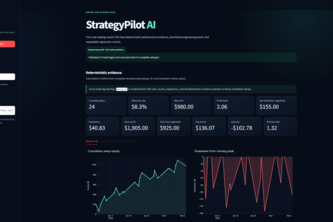
StrategyPilot AI is a self-reported tool that converts raw trading-result CSVs into deterministic, setup-level engineering audits. The author states it helps developers convert trading-result exports into reproducible evidence for testing and software improvements.
What changed
The project was submitted as part of the OpenAI 2026 hackathon. It includes a public Streamlit deployment and GitHub repository with a deterministic audit workflow that reconstructs setups from multi-leg exits, calculates performance metrics, and generates prioritized engineering tasks.
Single most important open question
Is there any evidence of actual usage or adoption beyond the author's own testing and demo deployment?
The description states this is a self-reported project submitted to a hackathon. No revenue, customers, or traction data are provided. The tool appears to be a proof-of-concept with a deterministic architecture that separates verified calculations from optional AI interpretation.
What The Product Actually Is
The description states StrategyPilot AI converts raw trading-result CSVs into deterministic, setup-level engineering audits. It includes:
- Validation of trade rows
- Reconstruction of complete setups from multi-leg exits
- Calculation of setup-level performance metrics (win rate, net profit, profit factor, expectancy, gross profit, gross loss, drawdown, average winner, average loser, win/loss ratio)
- Visualization of cumulative setup equity and drawdown
- Analysis by direction and trading session
- Evidence-backed engineering findings
- Prioritized engineering tasks and regression checks
- Export as Markdown report
The architecture separates deterministic evidence from model interpretation. Python performs validation, reconstruction, grouping, chronological equity calculations, and all verified performance metrics. GPT audit path receives aggregate evidence JSON rather than raw trade rows.
Positioning & Claim Evolution
The description states the tool was inspired by the need for a disciplined audit workflow that separates verified calculations from AI interpretation. The goal is not to predict trades but to help developers convert trading-result exports into reproducible evidence that can guide testing and software improvements.
The author claims this addresses the problem of trading strategy reports counting every partial exit as an independent trade, which distorts performance metrics. StrategyPilot AI aims to reconstruct complete setups before calculating performance.
The positioning evolved from a hackathon submission to a demonstration of a deterministic architecture that separates verified calculations from optional AI interpretation.
Target Customer & ICP
Not evidenced.
The description does not identify specific target customers or personas. It states the tool helps developers convert trading-result exports into reproducible evidence for testing and software improvements, but does not specify what type of developers or organizations would use it.
Business Model & Pricing Evidence
Not evidenced.
The description does not contain any information about pricing, revenue model, or monetization strategy. It only describes a public demo deployment that runs without requiring an API key.
Technical & Delivery Signals
The description states the application was built with:
- api, codex, github, gpt-5.6, openai, pandas, plotly, pytest, python, streamlit
- Python 3.10 or later on Windows, macOS, and Linux
- Streamlit interface
- Pandas for data processing
- Plotly for visualization
- Pytest for automated testing
The architecture separates deterministic evidence from model interpretation:
- Python performs validation, reconstruction, grouping, chronological equity calculations, and all verified performance metrics
- GPT audit path receives aggregate evidence JSON rather than raw trade rows
- The public deployment runs safely in offline Demo Audit mode without requiring an API key
Traction & Maturity Signals
The description states:
- 20 passing automated tests
- Deterministic reconstruction of 31 sample legs into 24 setups
- Setup-level metrics and diagnostic charts
- Evidence-backed engineering findings
- Prioritized development tasks
- Regression checks
- Markdown audit export
- Public Streamlit deployment
- Public GitHub repository
- No embedded secrets or private trading data
The project was submitted to the OpenAI 2026 hackathon. The author states the deterministic audit workflow is complete and publicly testable.
Competitive Context
Not evidenced.
The description does not provide information about competitors, market positioning, or competitive landscape in the trading analytics or strategy development space.
Open Questions & Risks
- No evidence of traction: The project appears to be a hackathon submission with no revenue, customers, or adoption data
- Limited scope: Only 1 team member (BK 74) is mentioned
- Self-reported only: All claims are unverified self-descriptions without external corroboration
- Unclear commercial viability: No pricing model, monetization strategy, or business model described
- Single-person development: The project was built by one person, raising questions about scalability and ongoing maintenance
Questions the description leaves open
- What is the actual market need this addresses beyond the author's own use case?
- How does this differ from existing trading analytics tools or backtesting platforms?
- What specific feedback have you received from potential users or developers?
- Is there any plan to commercialize this beyond the current demo deployment?
- What are the technical limitations of the deterministic approach versus full AI interpretation?
- How would you scale this for larger datasets or enterprise use cases?
Overall Assessment
Not evidenced.
The description provides no information about funding rounds, valuations, or investment history. It is unclear whether this represents a commercial opportunity or remains a hackathon project with no commercial traction or viability. The author states the deterministic audit workflow is complete and publicly testable, but there is no evidence of actual usage or adoption beyond the demo deployment.
User Stories BotA demo video on every pull request
Get a demo video on every new feature
GitHub App that watches your pull requests and records a narrated, captioned demo.
Save time on demo prep and make informed decisions faster with a video walkthrough of every new feature.
Source
Submitted to the OpenAI 2026 hackathon on Devpost. Project home on Devpost. Back to the full gallery on Devpost.
This competitive analysis was produced by top-founders.com (opens in a new tab)
Generated by a language model from this project's public Devpost page — its tagline, the author's own write-up and any built-with tags listed there — as captured in August 2026. Short quotations are the author's words. It is an opinion on the idea as a business, not on the people behind it, and it reflects the description as published then. If the project has moved on, request a correction below. The analysis is not independent research and contains no verified traction, revenue or customer data.
An independent guide by KFG International LLC — not affiliated with, endorsed by, or connected to Devpost or OpenAI.