

Archive position — measured, not model output
6 likes on Devpost
35 of the 7,850 archived projects have more likes, and 19 share exactly 6 — so this project's #50 place in the like-ranked listing is a tie-break inside that group, not a ranking.
Projects (log scale)
Likes on Devpost. ▲ marks this project's group.
Show the figures
| Likes | Projects | Share of archive |
|---|---|---|
| 0 | 5,587 | 71.2% |
| 1 | 1,758 | 22.4% |
| 2 | 284 | 3.6% |
| 3–4 | 132 | 1.7% |
| 5–9 | 75 | 1.0% |
| 10+ | 14 | 0.2% |
 User Stories BotA demo video on every pull request
Get a demo video on every new feature
GitHub App that watches your pull requests and records a narrated, captioned demo.
Save time on demo prep and make informed decisions faster with a video walkthrough of every new feature.
Executive Summary
What the company appears to be
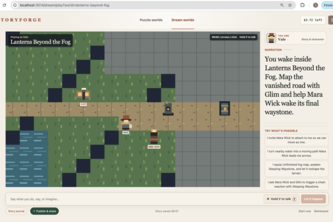
The project described as "Storyforge — Living Pixel Worlds" is a self-reported AI-powered creative tool that allows users to generate persistent, playable pixel worlds from natural language prompts. The author describes it as an experimental platform for storytelling and world-building using generative AI, with features like Dream mode (open-ended play) and Puzzle mode (guided objectives), supported by a shared authoritative world engine.
What changed
The project is presented as a hackathon submission to the OpenAI 2026 hackathon. It was built over a short timeframe using a combination of AI tools, including GPT-5.6 for prototyping and Codex for development. The author states that it uses Next.js, React, Supabase, Groq, OpenAI API, and other technologies to implement a persistent world engine with voice interaction, character animation, and narrative consequence.
Single most important open question
Is there any evidence of user adoption, revenue, or traction beyond the author’s own development efforts?
Note: This analysis is based entirely on the self-reported project description provided by the caller. No external verification or historical data is available. All claims are treated as stated by the author and not proven.
What The Product Actually Is
- The description states that Storyforge turns an ordinary-language idea into a persistent, playable pixel world.
- It supports two modes: Dream mode (open-ended story play) and Puzzle mode (guided objectives).
- The system uses a shared authoritative world engine to validate actions such as movement, dialogue, inventory, terrain, effects, and relationships.
- Interaction occurs through natural language, voice (via Whisper), and HTML-based pixel art animations.
- Google authentication, Postgres-backed storage, and world-credit accounting are used for persistence and ownership.
- The product is built with Next.js, React, Supabase, Groq, OpenAI API, and other web technologies.
Inference: The product appears to be a prototype or proof-of-concept rather than a commercial offering. It lacks evidence of monetization, customer base, or production deployment beyond the author’s own development.
Positioning & Claim Evolution
- The author positions Storyforge as an alternative to traditional AI storytelling experiences that only describe change without evolving the world itself.
- It claims to enable users to reshape worlds through natural language, voice, and believable actions.
- The product is described as a hybrid of narrative design and interactive world-building, with both open-ended and structured modes.
Inference: This positioning suggests an experimental approach to AI-driven creative tools, possibly targeting early adopters or developers interested in generative storytelling. There is no evidence of market positioning beyond the author’s own description.
Target Customer & ICP
- The description does not identify a specific customer segment.
- It implies use by individuals who want to create and interact with persistent pixel worlds using AI.
- The product supports both creators (who build worlds) and players (who explore them).
- No explicit mention of enterprise, education, or gaming audiences.
Not evidenced: No clear identification of target personas, buyer personas, or ideal customer profile beyond the author’s own use case.
Business Model & Pricing Evidence
- The description does not include any information about pricing, monetization, or business model.
- It mentions world-credit accounting and public snapshots but does not describe how these might be monetized.
- There is no indication of paid features, subscriptions, or revenue streams.
Not evidenced: No evidence of a defined business model or pricing strategy.
Technical & Delivery Signals
- Built with Next.js 16 App Router, React 19, TypeScript 5.9, Node.js, HTML, CSS.
- Uses NextAuth.js with Google OAuth for authentication.
- Supabase Postgres for data storage, with localStorage and IndexedDB recovery caches.
- Groq-hosted language models for runtime world/reaction planning; Whisper Large V3 Turbo for transcription.
- OpenAI API models for character anchors, sprite sheets, motion planning, and gpt-image-2.
- Structured JSON contracts, schema validation, and an authoritative PixelWorldState reducer.
- Web Animations API, HTML pixel recipes, Sharp, Playwright, and Vercel configuration.
Inference: The stack indicates a modern web-based application with AI integration. However, there is no evidence of scalability, performance metrics, or production deployment beyond the prototype stage.
Traction & Maturity Signals
- The project was submitted to the OpenAI 2026 hackathon.
- A README exists with setup guidance and two demonstrations (Dream and Puzzle UI/state/animation paths).
- The repository is currently private and must be shared for testing.
- No evidence of user feedback, adoption, or usage statistics.
Not evidenced: No data on traction, customer engagement, or product maturity beyond the author’s own development efforts.
Competitive Context
- The description does not reference competitors or similar products.
- It positions itself as a novel approach to AI storytelling and world-building.
- No mention of existing tools in the space such as AI game engines, narrative design platforms, or interactive fiction systems.
Not evidenced: No competitive analysis or positioning relative to existing solutions.
Open Questions & Risks
- The project is presented as a hackathon submission with no evidence of commercial viability.
- The repository is private and requires access for testing, indicating limited transparency.
- There is no evidence of user feedback, product-market fit, or monetization strategy.
- The use of GPT-5.6 in prototyping but not runtime raises questions about scalability and consistency.
- No mention of security, privacy, or data governance practices.
Inference: High risk due to lack of traction, unclear business model, and limited public access.
Questions the description leaves open
- What is the intended path from prototype to commercial product?
- How does the team plan to monetize this platform?
- Are there any users or early adopters beyond the author?
- What are the technical limitations of scaling this world engine?
- How will user-generated content be moderated or managed?
- Is there a long-term roadmap for features, performance, and deployment?
Overall Assessment
- The project is presented as an experimental hackathon submission with no evidence of traction, revenue, or customer adoption.
- It lacks commercial viability indicators such as pricing, monetization, or user engagement.
- The author’s own description indicates a prototype built in a short timeframe using AI tools for prototyping and development.
Assessment: Not ready for investment or partnership at this stage. Requires further evidence of traction, product-market fit, and business model before evaluation.
User Stories BotA demo video on every pull request
Get a demo video on every new feature
GitHub App that watches your pull requests and records a narrated, captioned demo.
Save time on demo prep and make informed decisions faster with a video walkthrough of every new feature.
Source
Submitted to the OpenAI 2026 hackathon on Devpost. Project home on Devpost. Back to the full gallery on Devpost.
This competitive analysis was produced by top-founders.com (opens in a new tab)
Generated by a language model from this project's public Devpost page — its tagline, the author's own write-up and any built-with tags listed there — as captured in August 2026. Short quotations are the author's words. It is an opinion on the idea as a business, not on the people behind it, and it reflects the description as published then. If the project has moved on, request a correction below. The analysis is not independent research and contains no verified traction, revenue or customer data.
An independent guide by KFG International LLC — not affiliated with, endorsed by, or connected to Devpost or OpenAI.