

Archive position — measured, not model output
0 likes on Devpost
2,263 of the 7,850 archived projects have more likes, and 5,587 share exactly 0 — so this project's #6,975 place in the like-ranked listing is a tie-break inside that group, not a ranking.
Projects (log scale)
Likes on Devpost. ▲ marks this project's group.
Show the figures
| Likes | Projects | Share of archive |
|---|---|---|
| 0 | 5,587 | 71.2% |
| 1 | 1,758 | 22.4% |
| 2 | 284 | 3.6% |
| 3–4 | 132 | 1.7% |
| 5–9 | 75 | 1.0% |
| 10+ | 14 | 0.2% |
 User Stories BotA demo video on every pull request
Get a demo video on every new feature
GitHub App that watches your pull requests and records a narrated, captioned demo.
Save time on demo prep and make informed decisions faster with a video walkthrough of every new feature.
Executive Summary
What the company appears to be
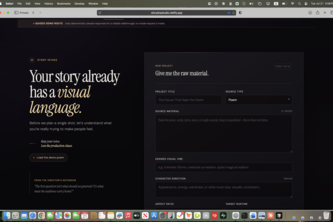
StoryDNA Studio is an AI-powered creative direction tool for solo AI filmmakers. The author states it helps creators turn a story or concept into a production-ready visual plan using AI, with emphasis on preserving creator voice and reducing chaos in production workflows.
What changed
The project description reflects a self-built MVP that implements a structured creative workflow from story intake to production planning and feedback. It is described as a single-developer effort built for a specific niche (solo AI filmmakers) using React, OpenAI models, and other tools.
Single most important open question
Is there evidence of actual adoption or traction by solo AI filmmakers? The description contains no data on usage, revenue, customers, or product-market fit beyond the author’s own claims.
Note: This analysis is based entirely on the self-reported project description provided by the caller. No external verification, archived history, or third-party sources are available. All statements reflect the author's own account and should be treated as unverified claims.
What The Product Actually Is
The description states that StoryDNA Studio is an AI creative director for solo AI filmmakers. It operates through a staged workflow:
- Story intake: Creator inputs project title, source material, visual vibe, character direction, aspect ratio, target runtime, and preferred tools.
- StoryDNA analysis: Identifies emotional truth, themes, symbols, visual language, sensory direction, interpretation risks, and an initial scene count estimate (without generating scenes).
- Three adaptive questions: Asks clarifying questions to resolve ambiguities that could change the film.
- Confirmed creative brief: Converts interpretation and creator decisions into an editable brief.
- Editable scene outline: Generates ordered scene plan with story beat, narrative purpose, emotional intention, visual description, shot type, duration, transition.
- Image direction: Provides detailed image prompts per scene, including alternate framing, negative instructions, aspect ratio, continuity anchors.
- Motion direction: For each scene, allows selection of still images, addition of motion notes, and generation of editable image-to-video plans.
- Production estimate: Calculates minimum, expected, and high-retry ranges based on scene count, duration, attempts, and shot difficulty.
- Production export: Exports complete project as Markdown or JSON.
- Director’s Commentary: Allows uploading a finished clip and comparing visual evidence with source, brief, emotional arc, scene plan, motion plans.
The MVP does not generate images or videos directly; it focuses on planning and direction. It also does not store projects in the cloud or analyze audio.
Claimed functionality is self-reported — no independent verification of performance or accuracy.
Positioning & Claim Evolution
The author positions StoryDNA Studio as an AI creative director for solo AI filmmakers who use tools like image generators, Higgsfield, Kling, Runway, Veo, ElevenLabs, Suno, and CapCut.
The tagline is:
“An AI creative director that turns a creator’s story and clarified intention into a production-ready visual plan. Keep your voice. Lose the production chaos.”
This positioning emphasizes:
- Creator control: The system preserves the creator's voice.
- Workflow orchestration: It streamlines complex creative processes.
- Intentional clarity: Clarification is prioritized over instant generation.
The evolution of the claim appears to be from a personal need (the author being an AI filmmaker) to a tool that supports others in similar roles. The product evolves from a simple prompt generator to a structured, traceable creative loop with approval gates and editable outputs.
Inference: The positioning suggests a niche market for solo creators who want to maintain control while leveraging AI for production planning.
Target Customer & ICP
The description states that the primary user is a solo AI filmmaker. These users are described as:
- Using tools such as image generators, Higgsfield, Kling, Runway, Veo, ElevenLabs, Suno, and CapCut.
- Working with poems, scripts, songs, stories, or rough concepts.
The ICP is not explicitly defined beyond this user group. No segmentation into different types of creators (e.g., writers vs. visual artists) is evident.
Not evidenced: There is no mention of customer personas, buyer personas, or any targeting beyond the single-user archetype.
Business Model & Pricing Evidence
There is no evidence in the description of a business model or pricing structure.
The author states:
- The MVP does not directly generate images or videos.
- No current platform pricing is hardcoded.
- Production estimates appear only when the creator supplies a sample rate.
- Credit estimates are shown only if a sample rate is provided.
Not evidenced: No mention of monetization, subscriptions, freemium tiers, or revenue streams.
Technical & Delivery Signals
The project was built with:
- Frontend: React (single-page application)
- State management: Zustand
- Backend routing: Shared server router for local Vite middleware and Netlify Function
- AI models: OpenAI (codex, etc.)
- Deployment: Netlify
- Tools used: GitHub, React
Key technical features include:
- Separation of AI responsibilities into distinct operations with validated response schemas.
- Approval states and provenance tracking to prevent silent rewriting of earlier choices.
- Stable IDs for scenes and prompts to allow isolated regeneration without rebuilding unaffected work.
- Deterministic demo mode for reliability.
- Local storage persistence (no authentication or database required).
- Frame sampling for Director’s Commentary (not full video analysis).
Inference: The architecture suggests a focus on traceability, control, and deterministic behavior over generative automation.
Traction & Maturity Signals
There is no evidence of traction or maturity beyond the MVP stage:
- The team size is listed as 1.
- No mention of users, customers, revenue, or usage metrics.
- The product is described as a hackathon submission.
- No production data, user feedback, or performance benchmarks are included.
Not evidenced: No signs of adoption, growth, or market validation beyond the author’s own account.
Competitive Context
The description does not reference competitors or competitive positioning. It does not discuss:
- Similar tools in the AI creative space.
- How StoryDNA Studio compares to existing workflows or platforms for solo creators.
- Market size or competitive landscape.
Absence of evidence: No competitive analysis, market share, or differentiation strategy is provided.
Open Questions & Risks
- Single-person development: With only one team member, scalability and long-term maintenance are uncertain.
- No traction or adoption: The product has not been tested in real-world usage beyond the author’s own workflow.
- Limited scope: The MVP excludes direct generation, cloud storage, audio analysis, and full video understanding.
- Unverified assumptions: The tool assumes creators will use specific tools (e.g., Higgsfield, Kling), but no evidence of compatibility or integration exists.
- Demo mode dependency: The application includes a guided-demo mode, suggesting possible instability in live API usage.
These risks are inferred from the lack of real-world testing and limited scope of the MVP.
Questions the description leaves open
- What is your actual experience as a solo AI filmmaker? How did you identify this problem?
- Have you tested StoryDNA Studio with other creators beyond yourself?
- Are there any existing users or early adopters who have provided feedback?
- What are the key assumptions about how creators interact with AI tools in practice?
- How do you plan to scale beyond a single developer and MVP?
- Do you have plans for integrating with specific AI generation platforms (e.g., Runway, ElevenLabs)?
- Is there any intention to monetize or build a sustainable business model?
- What are the technical challenges in moving from local storage to cloud-based project management?
Overall Assessment
Not evidenced: There is no evidence of revenue, customer traction, or market validation to assess investment potential.
The product is described as a single-developer MVP, built for a specific niche (solo AI filmmakers), with strong architectural design around control and traceability. However, without real-world usage, adoption data, or business model clarity, it cannot be evaluated for investment or partnership readiness.
Confidence level: Low — based on thin evidence and self-reported claims only.
Next step: Further due diligence would require user testing, market validation, and product-market fit confirmation.
User Stories BotA demo video on every pull request
Get a demo video on every new feature
GitHub App that watches your pull requests and records a narrated, captioned demo.
Save time on demo prep and make informed decisions faster with a video walkthrough of every new feature.
Source
Submitted to the OpenAI 2026 hackathon on Devpost. Project home on Devpost. Back to the full gallery on Devpost.
This competitive analysis was produced by top-founders.com (opens in a new tab)
Generated by a language model from this project's public Devpost page — its tagline, the author's own write-up and any built-with tags listed there — as captured in August 2026. Short quotations are the author's words. It is an opinion on the idea as a business, not on the people behind it, and it reflects the description as published then. If the project has moved on, request a correction below. The analysis is not independent research and contains no verified traction, revenue or customer data.
An independent guide by KFG International LLC — not affiliated with, endorsed by, or connected to Devpost or OpenAI.