

Archive position — measured, not model output
0 likes on Devpost
2,263 of the 7,850 archived projects have more likes, and 5,587 share exactly 0 — so this project's #6,977 place in the like-ranked listing is a tie-break inside that group, not a ranking.
Projects (log scale)
Likes on Devpost. ▲ marks this project's group.
Show the figures
| Likes | Projects | Share of archive |
|---|---|---|
| 0 | 5,587 | 71.2% |
| 1 | 1,758 | 22.4% |
| 2 | 284 | 3.6% |
| 3–4 | 132 | 1.7% |
| 5–9 | 75 | 1.0% |
| 10+ | 14 | 0.2% |
 User Stories BotA demo video on every pull request
Get a demo video on every new feature
GitHub App that watches your pull requests and records a narrated, captioned demo.
Save time on demo prep and make informed decisions faster with a video walkthrough of every new feature.
Executive Summary
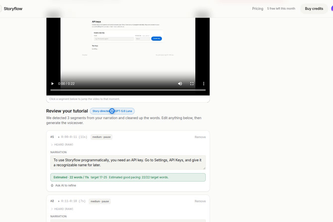
What the company appears to be: StoryFlow is a self-reported tool that converts screen recordings into narrated tutorials. It offers two modes: auto mode for recordings with existing voiceovers (cleans speech and synchronizes with visuals), and manual mode for silent recordings (allows users to write narration, then renders it with voice synthesis). The product is built using AWS services, OpenAI APIs, and various developer tools.
What changed: The author states this was developed as part of the OpenAI 2026 hackathon. No indication of prior development or commercial activity exists in the description.
Single most important open question: Is there any evidence of product-market fit or early traction? Not evidenced.
What The Product Actually Is
The description states that StoryFlow turns screen recordings into narrated tutorials. It has two modes:
- Auto mode: For recordings with existing voiceovers, it extracts audio, transcribes with word-level timestamps (via ElevenLabs Scribe), identifies pauses and scene cuts, samples frames per segment, cleans speech using GPT-5.6 Luna, and synthesizes a synchronized voiceover.
- Manual mode: For silent recordings, users write narration for each segment, StoryFlow estimates spoken length against the interval, and renders with a professional voice.
Both modes use a "honest" rendering process where synthesized speech is timed against its slot and rewritten if it overruns. Output languages include English, Mandarin (Mainland and Malaysian), Malay, and Indonesian.
Evidence: Self-reported by author; no independent verification or demonstration beyond the project write-up.
Positioning & Claim Evolution
The author claims StoryFlow addresses two distinct situations:
- When someone talks through a recording — so words exist but are filled with rambling.
- When someone records silently — so no words exist and only the user knows what’s on screen.
It positions itself as an alternative to tools that replace real footage with avatars or substitute robot voices, instead keeping the original product footage and the speaker's own words, fixing only delivery.
The project also emphasizes:
- Honest failure states (e.g., visible errors vs. silent degradation).
- Review before payment.
- Measured timing over estimation.
- A demo that proves rather than asserts.
Evidence: Self-reported claims; no external validation or market positioning data provided.
Target Customer & ICP
The description does not explicitly define a target customer or ideal customer profile (ICP). It implies use cases for product teams, support staff, enablement personnel who need to create walkthroughs repeatedly. However, no explicit segmentation or persona details are given.
Evidence: Not evidenced; the author does not describe specific buyer types or user roles beyond general “someone doing product walkthroughs.”
Business Model & Pricing Evidence
There is no evidence of a business model or pricing structure in the description. The project mentions Stripe for credits and Clerk for identity, but nothing about monetization, subscription tiers, usage-based billing, or revenue streams.
Evidence: Not evidenced; no mention of how the product will be sold or priced.
Technical & Delivery Signals
The system is built using:
- Frontend: Next.js 15 on Vercel
- Backend: AWS Lambda, SQS, S3, Terraform for infrastructure
- AI/ML: GPT-5.6 Luna via OpenAI Responses API, ElevenLabs Scribe, Whisper
- Tools: Playwright (for demo), Codex (for implementation), Convex (state management)
- Auth: Clerk
- Payments: Stripe
It includes features like:
- Sanitized trace logging for LLM calls
- A/B testing of models in production
- Live UAT harness and automation
- Review step before generation costs nothing
- Voiceover timing measured against actual synthesis, not estimates
Evidence: Self-reported technical architecture and implementation details; no evidence of deployment scale or performance metrics.
Traction & Maturity Signals
There is no evidence of traction, revenue, customers, or adoption. The project was submitted to a hackathon and has no indication of prior usage or market presence.
Evidence: Not evidenced; the description does not include any data on users, sales, or product usage.
Competitive Context
The author does not provide any information about competitors or competitive landscape. No mention is made of existing tools in this space.
Evidence: Not evidenced; no comparison to other products or market positioning.
Open Questions & Risks
Several potential risks are implied by the description:
- Failure states that are hard to detect: Silent degradation due to credential failures was only caught after A/B testing.
- Configuration drift: Dead config from past migrations caused silent failures.
- Demo as test suite: The team learned that filming a product is like running a test suite, suggesting early-stage instability or lack of robustness.
- No commercial traction: Submitted to a hackathon with no evidence of prior business development.
Inference: These issues suggest the project may be in an early stage and lacks mature operational practices.
Questions the description leaves open
- What is your plan for monetization? How do you intend to charge customers?
- Have you validated demand for this tool with potential users or partners?
- Can you describe how you would scale the LLM-based processing pipeline?
- What are the key assumptions behind your product design and user workflows?
- How do you handle edge cases in voice synthesis, especially around translation or multi-language support?
- Are there any known limitations in the current version that might impact usability at scale?
Overall Assessment
Based on the self-reported project description alone, there is no evidence of commercial traction, revenue, customers, or a clear business model. The product appears to be a hackathon submission with technical sophistication but no demonstrated market validation.
Confidence level: Low — this analysis is based entirely on unverified self-reporting.
Assessment: Not ready for investment or partnership consideration without further evidence of traction, customer feedback, or commercial viability.
User Stories BotA demo video on every pull request
Get a demo video on every new feature
GitHub App that watches your pull requests and records a narrated, captioned demo.
Save time on demo prep and make informed decisions faster with a video walkthrough of every new feature.
Source
Submitted to the OpenAI 2026 hackathon on Devpost. Project home on Devpost. Back to the full gallery on Devpost.
This competitive analysis was produced by top-founders.com (opens in a new tab)
Generated by a language model from this project's public Devpost page — its tagline, the author's own write-up and any built-with tags listed there — as captured in August 2026. Short quotations are the author's words. It is an opinion on the idea as a business, not on the people behind it, and it reflects the description as published then. If the project has moved on, request a correction below. The analysis is not independent research and contains no verified traction, revenue or customer data.
An independent guide by KFG International LLC — not affiliated with, endorsed by, or connected to Devpost or OpenAI.