

Archive position — measured, not model output
2 likes on Devpost
221 of the 7,850 archived projects have more likes, and 284 share exactly 2 — so this project's #474 place in the like-ranked listing is a tie-break inside that group, not a ranking.
Projects (log scale)
Likes on Devpost. ▲ marks this project's group.
Show the figures
| Likes | Projects | Share of archive |
|---|---|---|
| 0 | 5,587 | 71.2% |
| 1 | 1,758 | 22.4% |
| 2 | 284 | 3.6% |
| 3–4 | 132 | 1.7% |
| 5–9 | 75 | 1.0% |
| 10+ | 14 | 0.2% |
 User Stories BotA demo video on every pull request
Get a demo video on every new feature
GitHub App that watches your pull requests and records a narrated, captioned demo.
Save time on demo prep and make informed decisions faster with a video walkthrough of every new feature.
Executive Summary
What the company appears to be
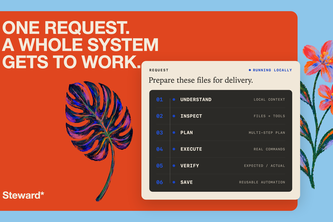
Steward is a self-reported macOS tool that uses AI agents (specifically GPT-5.6-Sol via Codex) to turn file-processing tasks into verified one-click recipes that run locally without model calls. It claims to leverage existing CLI tools like FFmpeg, yt-dlp, and others, but abstracts their use through an agent that plans, executes, verifies, and saves workflows as reusable "recipes".
What changed
The author describes a shift from a small, playful project into something more structured — with a frozen plan schema, repair loops, security audits, and a full custom UI. The tool evolved beyond its initial scope to include features like live WebSocket UI streaming, saved-command reruns, and a security posture.
Single most important open question
Is there any evidence of real-world usage or adoption beyond the author’s own development environment? The description states no revenue, customers, or traction data are available — only self-reported claims about functionality and development process.
What The Product Actually Is
The description states that Steward is a local macOS agent built using GPT-5.6-Sol via Codex CLI. It turns file tasks (e.g., video compression, format conversion, OCR) into verified one-click recipes that run locally with zero model calls after initial planning.
It includes:
- A live WebSocket UI streaming plan → execute → verify → save
- Saved-command reruns proven to make zero model calls
- A security posture with two independently-found critical issues closed
The core rule is: the recipe is the plan — code added does not augment what the model declared.
Not evidenced:
- Whether the tool actually works outside of the author’s development setup
- If any real-world users or customers exist
- Any actual product delivery or distribution mechanism beyond a hackathon submission
Positioning & Claim Evolution
The description states that Steward's thesis is:
"Your computer already knows how to do these things. The internet just charges you rent for them."
It positions itself as an abstraction layer over existing CLI tools, allowing users to perform complex file operations via a one-click interface without needing to know the underlying commands.
Evolution from playful idea:
- Started as a personal solution to lost CLI knowledge
- Grew into a system with parallel agents, workspaces (git worktrees), UI design, security audits, and batch processing constraints
Inference:
The evolution suggests a move from prototype to structured tooling — though no evidence of user feedback or iteration beyond the author’s own development.
Not evidenced:
- How the product is positioned in the market
- Whether it competes with existing tools like Automator, Keyboard Maestro, or CLI-based automation platforms
- Any marketing or branding beyond the hackathon submission
Target Customer & ICP
The description states that the inspiration came from:
- The author losing track of CLI commands
- Friends being “floored” by simple CLI automations
- Dad’s friends reacting positively to small automations built for him
Inferred target customer:
- Tech-savvy individuals who use CLI tools regularly but struggle with remembering or reusing them
- People looking for a GUI abstraction over command-line workflows
- Users of macOS who want to automate file tasks without deep technical knowledge
Not evidenced:
- Specific personas or segments
- Customer interviews or usage data
- Any evidence of actual users beyond the author
Business Model & Pricing Evidence
The description does not state anything about pricing, monetization, or business model.
Inference:
Given that this is a hackathon submission and no revenue or customer data are mentioned, it appears to be a proof-of-concept or prototype with no commercial model at this stage.
Not evidenced:
- Revenue streams
- Pricing tiers or models
- Any indication of monetization plans
Technical & Delivery Signals
The description states that the tool was built using:
- GPT-5.6-Sol via Codex CLI
- Tools like FFmpeg, yt-dlp, whisper.cpp, pandoc, imagemagick, libreoffice, etc.
- Technologies: bash, bun, CSS, HTML, JavaScript, Svelte, TypeScript, Vite, WebSocket, macOS
Key technical elements:
- Local execution engine that never touches the shell during plan execution
- Model only produces a plan — never executes code directly
- Recipes are saved as verified plans with no model calls on rerun
- Security measures include token generation, output confinement, and flag restrictions
- UI built via Codex with parallel workspaces (git worktrees)
Not evidenced:
- Performance benchmarks or scalability data
- Any production deployment or infrastructure details
- Whether the tool supports other platforms beyond macOS
Traction & Maturity Signals
The description states that this is a working local macOS agent submitted to the OpenAI 2026 hackathon.
It includes:
- Recipes for video compression, format conversion, audio loudness, document conversion, OCR, and subtitles
- Live WebSocket UI streaming plan → execute → verify → save
- Saved-command reruns proven to make zero model calls
Not evidenced:
- Any user adoption or feedback
- Customer base or revenue
- Product roadmap or future development plans
- Metrics on usage frequency or retention
Competitive Context
The description does not mention any competitors.
Inference:
- Steward appears to be positioned in the space of local automation tools or CLI workflow abstraction platforms
- It may compete with tools like:
- Automator (macOS)
- Keyboard Maestro
- CLI-based automation frameworks
- AI agents that generate scripts or workflows
Not evidenced:
- Direct competitors
- Market size or competitive positioning
- Any differentiation strategy beyond the “recipe” abstraction
Open Questions & Risks
- No traction or adoption evidence — The tool is described as a hackathon submission with no real-world usage.
- Dependency on AI tools (Codex, GPT-5.6-Sol) — Reliance on proprietary models may pose long-term sustainability risks.
- Limited platform support — Only works on macOS; no indication of cross-platform plans.
- Unverified claims about execution and verification — The description states that verification checks results with real evidence, but there is no independent validation or testing data.
- Self-reported security posture — Claims of closed security holes are not independently verified.
Not evidenced:
- Any risk mitigation strategies
- Product roadmap or scalability plans
Questions the description leaves open
- What is the actual user base or adoption rate beyond your own use?
- How does Steward handle edge cases or failures in execution?
- Are there any known performance bottlenecks or limitations with the current architecture?
- Is there a plan to support other operating systems beyond macOS?
- What are the long-term plans for monetization or product evolution?
- Can you provide more details on how the verification process works in practice?
- How do you ensure that the recipes remain stable over time as underlying tools evolve?
Overall Assessment
The description states this is a working local macOS agent submitted to a hackathon, with no evidence of traction, revenue, or customer data.
Inference:
- This appears to be a proof-of-concept prototype, not a mature product.
- It has potential for further development but lacks commercial viability or market validation at this stage.
- The author’s technical approach is interesting and shows some depth in AI-agent integration and local execution, but no evidence of real-world utility or scalability.
Not evidenced:
- Any financials or valuation
- Strategic partnerships or investor interest
- Product-market fit or user feedback
Assessment Not ready for investment or partnership. This is a technical demonstration with no commercial traction. Further development and validation are required before any strategic move can be considered.
User Stories BotA demo video on every pull request
Get a demo video on every new feature
GitHub App that watches your pull requests and records a narrated, captioned demo.
Save time on demo prep and make informed decisions faster with a video walkthrough of every new feature.
Source
Submitted to the OpenAI 2026 hackathon on Devpost. Project home on Devpost. Back to the full gallery on Devpost.
This competitive analysis was produced by top-founders.com (opens in a new tab)
Generated by a language model from this project's public Devpost page — its tagline, the author's own write-up and any built-with tags listed there — as captured in August 2026. Short quotations are the author's words. It is an opinion on the idea as a business, not on the people behind it, and it reflects the description as published then. If the project has moved on, request a correction below. The analysis is not independent research and contains no verified traction, revenue or customer data.
An independent guide by KFG International LLC — not affiliated with, endorsed by, or connected to Devpost or OpenAI.