

Archive position — measured, not model output
0 likes on Devpost
2,263 of the 7,850 archived projects have more likes, and 5,587 share exactly 0 — so this project's #2,437 place in the like-ranked listing is a tie-break inside that group, not a ranking.
Projects (log scale)
Likes on Devpost. ▲ marks this project's group.
Show the figures
| Likes | Projects | Share of archive |
|---|---|---|
| 0 | 5,587 | 71.2% |
| 1 | 1,758 | 22.4% |
| 2 | 284 | 3.6% |
| 3–4 | 132 | 1.7% |
| 5–9 | 75 | 1.0% |
| 10+ | 14 | 0.2% |
 User Stories BotA demo video on every pull request
Get a demo video on every new feature
GitHub App that watches your pull requests and records a narrated, captioned demo.
Save time on demo prep and make informed decisions faster with a video walkthrough of every new feature.
Executive Summary
What the company appears to be
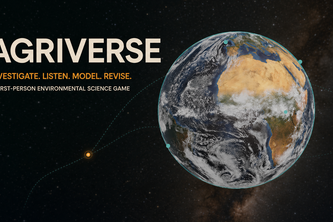
AgriVerse is a self-reported first-person 3D environmental science game designed for education, built as a hackathon project using Unity, C#, TypeScript, Express.js, and OpenAI's GPT-5.6. The product simulates real-world environmental crises in the Mekong Delta, allowing students to investigate evidence, interact with AI stakeholders, make decisions, and observe consequences over five years.
What changed
This is a self-reported educational game prototype built for a hackathon. It does not appear to have launched commercially or gained traction beyond its submission context.
The single most important open question
Is there any evidence of commercial viability, customer adoption, or revenue generation from AgriVerse? The description contains no data on usage, sales, or monetization.
What The Product Actually Is
The description states that AgriVerse is a first-person 3D environmental science simulation. It includes:
- An interactive globe with field missions.
- Water testing at three locations.
- Interviews with stakeholders (farmer, researcher, official).
- A decision-making framework involving coverage, financial support, training, infrastructure, and timeline choices.
- A five-year consequence simulator.
- Feedback mechanisms identifying weaknesses in decisions.
- A policy-brief generator.
It is described as a game-based learning tool, not a chatbot or static educational resource. The author notes that the goal is to teach students about evidence, tradeoffs, uncertainty, and revision—not to find one perfect answer.
Evidence Self-reported by the author; no external validation provided.
Positioning & Claim Evolution
The author positions AgriVerse as an alternative to traditional environmental science education, which they describe as "static readings, charts, and predetermined answers." The core claim is that students should not receive answers from a chatbot but instead gather evidence and learn through revising their own decisions.
Key claims include:
- Students investigate real crises.
- Stakeholders have different knowledge, priorities, and hidden concerns.
- The system teaches revision as part of the learning process.
- Consequences are shown over time to reinforce understanding.
- AI systems power core educational mechanics (stakeholder agents, consequence simulator, feedback grader, policy brief generator).
Evidence Self-reported; no third-party validation or performance metrics.
Target Customer & ICP
The author identifies students as the primary users of AgriVerse. The game is framed as an educational tool for environmental science instruction.
There is no mention of:
- Teachers or educators as direct customers.
- Schools, districts, or institutions.
- Institutional licensing or bulk purchases.
- Age groups or grade levels beyond general student use.
The focus is on individual learners, not institutional buyers.
Evidence Self-reported; no data on target demographics or customer segments.
Business Model & Pricing Evidence
There is no evidence of a business model or pricing structure in the description. The author does not state whether AgriVerse will be sold, licensed, offered free to schools, or funded through grants.
The project was submitted as a hackathon entry and lacks any indication of monetization plans, subscription models, or revenue streams.
Evidence Not evidenced.
Technical & Delivery Signals
The technical stack includes:
- Unity 6 with C# and Universal Render Pipeline.
- TypeScript/Express.js backend connected to OpenAI APIs.
- GPT-5.6 used for stakeholder agents, consequence simulation, feedback grading, and policy brief generation.
- Codex reportedly accelerated development.
- Backend hosted via Render, with server-side API key management.
The author mentions:
- Structured outputs validated with schemas (Zod).
- Factual claims checked against a cited Mekong Delta evidence corpus.
- Prompt versioning instead of hardcoded strings.
- Automated tests for Unity and backend systems.
- Secure hosting with rate limits, concurrency controls, and spending caps.
Evidence Self-reported; no independent verification or performance data.
Traction & Maturity Signals
There is no evidence of traction, including:
- No customer base.
- No revenue or monetization.
- No public launch or distribution.
- No usage statistics or engagement metrics.
- No institutional partnerships or pilot programs.
The project was submitted to a hackathon and remains a prototype. It includes a macOS build, source repository, and automated tests, but these are not indicators of product maturity or market readiness.
Evidence Not evidenced.
Competitive Context
There is no mention of competitors in the description. The author does not reference existing educational games, simulation tools, or AI-powered learning platforms.
The project appears to be a standalone concept without comparison to other products or services in the edtech or environmental science space.
Evidence Not evidenced.
Open Questions & Risks
Several risks and open questions are present:
- Unverified claims: All descriptions are self-reported, with no external validation.
- Prototype status: AgriVerse is a hackathon project, not a commercial product.
- No revenue or traction: No evidence of monetization, customers, or adoption.
- AI dependency: Heavy reliance on GPT-5.6 raises concerns about scalability and cost without clear pricing or infrastructure plans.
- Limited scope: The author chose to complete one scenario (Vietnam) rather than expand globally, suggesting limited product breadth.
- Single-person team: A solo developer may limit execution capacity for future development or scaling.
Evidence Inferred from self-reported description; not independently verified.
Questions the description leaves open
- What is the intended path to market? Is there a plan to commercialize AgriVerse?
- How will the AI systems be scaled beyond the current prototype?
- Are there any pilot schools or educational institutions interested in testing the product?
- Has the team considered how to integrate teacher-facing tools or classroom management features?
- What are the long-term plans for content expansion (e.g., global scenarios)?
- How will the project handle data privacy and security, especially with student interactions?
- Is there any plan to reduce dependency on GPT-5.6 or explore alternative AI models?
Overall Assessment
There is no evidence of a viable business or commercial opportunity at this time. AgriVerse is a hackathon prototype with no demonstrated traction, revenue, or customer base.
The product shows potential as an educational tool but lacks:
- Market validation.
- A clear monetization strategy.
- Institutional adoption.
- Scalable infrastructure.
It may be worth exploring further if the team intends to build out a full product and demonstrate early traction. However, based on the current self-reported description alone, there is insufficient evidence to support investment or partnership interest.
Confidence level Low — grounded solely in unverified self-reporting.
User Stories BotA demo video on every pull request
Get a demo video on every new feature
GitHub App that watches your pull requests and records a narrated, captioned demo.
Save time on demo prep and make informed decisions faster with a video walkthrough of every new feature.
Source
Submitted to the OpenAI 2026 hackathon on Devpost. Project home on Devpost. Back to the full gallery on Devpost.
This competitive analysis was produced by top-founders.com (opens in a new tab)
Generated by a language model from this project's public Devpost page — its tagline, the author's own write-up and any built-with tags listed there — as captured in August 2026. Short quotations are the author's words. It is an opinion on the idea as a business, not on the people behind it, and it reflects the description as published then. If the project has moved on, request a correction below. The analysis is not independent research and contains no verified traction, revenue or customer data.
An independent guide by KFG International LLC — not affiliated with, endorsed by, or connected to Devpost or OpenAI.