

Archive position — measured, not model output
0 likes on Devpost
2,263 of the 7,850 archived projects have more likes, and 5,587 share exactly 0 — so this project's #2,439 place in the like-ranked listing is a tie-break inside that group, not a ranking.
Projects (log scale)
Likes on Devpost. ▲ marks this project's group.
Show the figures
| Likes | Projects | Share of archive |
|---|---|---|
| 0 | 5,587 | 71.2% |
| 1 | 1,758 | 22.4% |
| 2 | 284 | 3.6% |
| 3–4 | 132 | 1.7% |
| 5–9 | 75 | 1.0% |
| 10+ | 14 | 0.2% |
 User Stories BotA demo video on every pull request
Get a demo video on every new feature
GitHub App that watches your pull requests and records a narrated, captioned demo.
Save time on demo prep and make informed decisions faster with a video walkthrough of every new feature.
Executive Summary
What the company appears to be
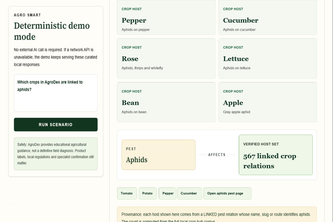
AgroDex is an AI-powered agricultural knowledge platform that organizes fragmented agricultural information into structured relationships. The project was built as a demonstration for OpenAI Build Week and includes a prototype called "Agro Smart" showing how AI can reason over structured agricultural data.
What changed
The author states they started with an idea in June 2026, developed it rapidly using modern AI tools, and evolved from a "joke" into an obsession. No evidence of prior development or commercial traction is provided.
Single most important open question
Is there any evidence of actual agricultural knowledge being organized or validated beyond the author's own claims?
What The Product Actually Is
The description states that AgroDex is:
- An AI-powered agricultural knowledge platform
- Designed to organize fragmented agricultural information into structured relationships
- Built using modern web technologies and OpenAI models
- Includes a demonstration called "Agro Smart" for OpenAI Build Week
- Intended to connect crops, diseases, pests, symptoms, cultivation practices, climate, scientific references, images, and related entities
The author claims it organizes agricultural information into relationships that AI can reason over, rather than treating it as isolated articles.
Positioning & Claim Evolution
The description states:
- The platform aims to solve the problem of fragmented agricultural knowledge
- It positions itself as building "the knowledge AI could actually trust"
- The goal is not to replace agronomists but to help people access trustworthy agricultural knowledge more naturally
- The author emphasizes that "AI is only as good as the knowledge behind it"
- The platform is described as a "knowledge layer" in a three-layer ecosystem vision
The positioning evolved from an idea about organizing fragmented knowledge into a working demonstration, with no evidence of prior commercial development or market validation.
Target Customer & ICP
Not evidenced. The description does not specify:
- Who the actual customers are
- What specific user personas exist
- Whether there's any customer research or feedback
- How the platform would be used in practice beyond the demo
Business Model & Pricing Evidence
Not evidenced. The description does not contain:
- Any information about pricing models
- Revenue streams
- Monetization strategy
- Customer acquisition costs
- Unit economics
Technical & Delivery Signals
The description states:
- Built with: codex, css, gpt-5.6, next.js, node.js, openai, postgresql, react, tailwind, typescript
- Uses OpenAI models for organizing and exploring structured agricultural knowledge
- Created a dedicated interactive demonstration (Agro Smart)
- Uses real agricultural relationships from their knowledge base instead of artificial demo data
- Built a stable demonstration designed specifically for live presentations
- Development started on June 9, 2026
Traction & Maturity Signals
Not evidenced. The description does not contain:
- Any revenue or customer data
- User adoption metrics
- Product usage statistics
- Market traction indicators
- Customer testimonials or feedback
- Product maturity indicators beyond the demo
Competitive Context
Not evidenced. The description does not contain:
- Information about competitors
- Market positioning relative to existing solutions
- Competitive advantages claimed
- Market size or growth data
- Differentiation from similar platforms
Open Questions & Risks
Inferences based on self-reported information:
- The project appears to be a prototype built for a hackathon with no evidence of commercial viability or traction
- The author states the biggest challenge was organizing knowledge into relationships, suggesting this is a significant technical hurdle that may not have been overcome
- No evidence of validation of the agricultural knowledge being organized
- The platform is described as only "the beginning" with a vision for future layers, indicating it's not yet fully developed
- The team size is listed as 1 person, which may limit development capacity
Questions the description leaves open
- What specific agricultural knowledge has been organized and validated beyond the author's own claims?
- How was the structured relationship data created and verified?
- What are the actual use cases for farmers or agronomists that this platform addresses?
- How does the platform plan to scale beyond a single-person development effort?
- What is the path from this prototype to commercial viability?
- Are there any partnerships with agricultural institutions or organizations?
- How will the platform be monetized?
- What are the technical challenges in organizing and maintaining such a knowledge base at scale?
Overall Assessment
Not evidenced. The description does not contain:
- Any financial data
- Revenue projections
- Customer acquisition metrics
- Market opportunity size
- Financial model or investment requirements
- Partnership opportunities or strategic fit indicators
The project appears to be a prototype built for a hackathon with no evidence of commercial traction, revenue, or customer validation. The author's own account suggests this is an early-stage idea that has not yet been proven in the market.
User Stories BotA demo video on every pull request
Get a demo video on every new feature
GitHub App that watches your pull requests and records a narrated, captioned demo.
Save time on demo prep and make informed decisions faster with a video walkthrough of every new feature.
Source
Submitted to the OpenAI 2026 hackathon on Devpost. Project home on Devpost. Back to the full gallery on Devpost.
This competitive analysis was produced by top-founders.com (opens in a new tab)
Generated by a language model from this project's public Devpost page — its tagline, the author's own write-up and any built-with tags listed there — as captured in August 2026. Short quotations are the author's words. It is an opinion on the idea as a business, not on the people behind it, and it reflects the description as published then. If the project has moved on, request a correction below. The analysis is not independent research and contains no verified traction, revenue or customer data.
An independent guide by KFG International LLC — not affiliated with, endorsed by, or connected to Devpost or OpenAI.