

Archive position — measured, not model output
0 likes on Devpost
2,263 of the 7,850 archived projects have more likes, and 5,587 share exactly 0 — so this project's #4,402 place in the like-ranked listing is a tie-break inside that group, not a ranking.
Projects (log scale)
Likes on Devpost. ▲ marks this project's group.
Show the figures
| Likes | Projects | Share of archive |
|---|---|---|
| 0 | 5,587 | 71.2% |
| 1 | 1,758 | 22.4% |
| 2 | 284 | 3.6% |
| 3–4 | 132 | 1.7% |
| 5–9 | 75 | 1.0% |
| 10+ | 14 | 0.2% |
 User Stories BotA demo video on every pull request
Get a demo video on every new feature
GitHub App that watches your pull requests and records a narrated, captioned demo.
Save time on demo prep and make informed decisions faster with a video walkthrough of every new feature.
Executive Summary
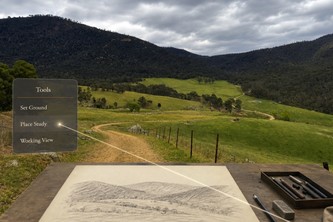
Groundglass Atelier is presented as an augmented optical instrument for artists, designed to cultivate observation rather than automate creation. The project is self-described as a prototype built in two days using AI tools like Codex and GPT-5.6, with no evidence of revenue, customers or product-market fit. It is positioned within a historical tradition of artistic optical instruments such as the camera obscura and camera lucida.
The author states that Groundglass Atelier registers reference images onto physical surfaces, supports proportional comparison and tonal study, and withdraws so attention returns to the subject rather than the technology. The interface is described as deliberately restrained, with features like "Veil" and "Show Study" intended to assist perception before disappearing.
Key commercial due-diligence question
Is there evidence of a viable market for this type of tool, or is this an experimental prototype without traction?
What The Product Actually Is
The description states that Groundglass Atelier is:
- An augmented optical instrument for artists
- Built using mixed reality technology
- Designed to register reference images onto physical surfaces
- Supports proportional comparison, tonal study, and mural transfer
- Intended to cultivate observation rather than automate creation
- Not designed to generate artwork; all creative decisions remain with the artist
The author describes it as a system—not an app attached to a specific device—but as an "artist's instrument" that can work across multiple platforms (phone, headset, future devices).
Inference The product appears to be a conceptual or prototypical tool for artistic study, not a commercial offering.
Positioning & Claim Evolution
The author positions Groundglass Atelier within a centuries-old tradition of optical instruments:
- Camera obscura
- Camera lucida
- Claude glass
- Ground-glass focusing screen
These historical tools are described as not replacing artistic judgment but helping artists look more carefully.
Claim
The project is not about AI replacing artistic practice, but about how AI might participate respectfully within existing traditions of observation, apprenticeship and craftsmanship.
The author also states:
- "Rather than asking how AI might create images, I wanted to ask a different question: Could AI help artists become better observers instead?"
- "The future of creative AI is not only about making images. It is also about cultivating the attention from which great art has always grown."
Inference The positioning is philosophical and aspirational, focusing on enhancing artistic process rather than delivering outputs.
Target Customer & ICP
The description states:
- Groundglass Atelier is for artists
- Specifically, those who value observation, apprenticeship, and craftsmanship
- Designed to support drawing, painting, and other visual arts practices
Inference The target customer appears to be individual artists or art students interested in improving their observational skills through technology.
There is no evidence of:
- Specific user personas
- Customer segments
- Market size
- Use cases beyond the prototype
Business Model & Pricing Evidence
The description does not contain any information about:
- Revenue streams
- Pricing models
- Monetization strategy
- Commercial partnerships or sales channels
Inference There is no evidence of a business model or pricing structure. The project is described as a prototype.
Technical & Delivery Signals
The author states that the system was built using:
- Android
- C#
- Codex
- Firefly
- GPT-5.6
- MetaQuest 3
- Microsoft Clipchamp
- Microsoft Visual Studio
- Unity
- Windows
It was developed in two days, with iterative cycles involving:
- Software engineering
- Interaction design
- Classical drawing practice
- Art history
- Mixed reality
Inference The technical stack and delivery process suggest a rapid prototyping approach using AI-assisted development tools.
Traction & Maturity Signals
The description states:
- This is a prototype
- Built in two days
- Submitted to the OpenAI 2026 hackathon
- No mention of users, customers, or adoption metrics
Inference There is no evidence of traction, revenue, or product-market fit. The project is described as experimental and not yet commercial.
Competitive Context
The description does not provide any information about:
- Competitors
- Market landscape
- Existing solutions in the space of augmented artistic tools or optical instruments
Inference No competitive analysis is available from the self-reported description.
Open Questions & Risks
Key risks and open questions include:
- No commercial traction: The project is a prototype with no evidence of users, revenue or adoption.
- Unproven market demand: There is no indication that artists are seeking this type of tool.
- Highly experimental nature: Built in two days, with many crashes reported.
- Unclear monetization path: No business model or pricing strategy described.
- Founder capacity: Only one team member (Ivy T) is mentioned.
Inference The project lacks commercial viability indicators and may be more of a conceptual exploration than a product ready for market.
Questions the description leaves open
- What specific problem in artistic observation are you trying to solve?
- Have you tested this concept with real artists or art students?
- Are there any early adopters or pilot users who have provided feedback?
- How do you plan to transition from a prototype to a scalable product?
- What is your long-term vision for monetization and market expansion?
- What are the technical limitations of the current prototype that would need to be overcome?
Overall Assessment
Not evidenced
There is no evidence of:
- Revenue
- Customers
- Product-market fit
- Traction
- Commercial viability
The project is described as a prototype built in two days, submitted to a hackathon, and not yet commercialized.
Inference Based on the self-reported description alone, there is insufficient evidence to support an investment or partnership decision. The project appears to be experimental and conceptual, with no demonstrated market need or path to monetization.
User Stories BotA demo video on every pull request
Get a demo video on every new feature
GitHub App that watches your pull requests and records a narrated, captioned demo.
Save time on demo prep and make informed decisions faster with a video walkthrough of every new feature.
Source
Submitted to the OpenAI 2026 hackathon on Devpost. Project home on Devpost. Back to the full gallery on Devpost.
This competitive analysis was produced by top-founders.com (opens in a new tab)
Generated by a language model from this project's public Devpost page — its tagline, the author's own write-up and any built-with tags listed there — as captured in August 2026. Short quotations are the author's words. It is an opinion on the idea as a business, not on the people behind it, and it reflects the description as published then. If the project has moved on, request a correction below. The analysis is not independent research and contains no verified traction, revenue or customer data.
An independent guide by KFG International LLC — not affiliated with, endorsed by, or connected to Devpost or OpenAI.