

Archive position — measured, not model output
1 like on Devpost
505 of the 7,850 archived projects have more likes, and 1,758 share exactly 1 — so this project's #1,991 place in the like-ranked listing is a tie-break inside that group, not a ranking.
Projects (log scale)
Likes on Devpost. ▲ marks this project's group.
Show the figures
| Likes | Projects | Share of archive |
|---|---|---|
| 0 | 5,587 | 71.2% |
| 1 | 1,758 | 22.4% |
| 2 | 284 | 3.6% |
| 3–4 | 132 | 1.7% |
| 5–9 | 75 | 1.0% |
| 10+ | 14 | 0.2% |
 User Stories BotA demo video on every pull request
Get a demo video on every new feature
GitHub App that watches your pull requests and records a narrated, captioned demo.
Save time on demo prep and make informed decisions faster with a video walkthrough of every new feature.
Executive Summary
What the company appears to be
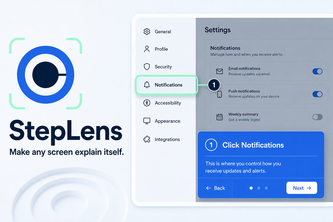
StepLens is a self-reported educational tool that uses AI to transform confusing screen interfaces into safe, interactive visual lessons. The product is described as a React + TypeScript frontend with an Express.js backend, powered by GPT-5.6 and structured outputs via Zod schema.
What changed
The author states they built this during the OpenAI 2026 hackathon, using Codex for implementation support. It was submitted to Devpost as a project demonstrating multimodal AI use in accessibility and education.
Single most important open question
Is there any evidence of real-world usage or traction beyond the hackathon submission?
What The Product Actually Is
The description states that StepLens turns screenshots into visual lessons using GPT-5.6. It includes:
- Visual targets placed over original screenshots
- Plain-language instructions
- Explanations for why a control is correct
- Confidence scores
- Risk-aware checkpoints before consequential actions
The system allows learners to advance at their own pace and hear steps aloud, without automating clicks or claiming actions complete.
Evidence The author describes the product's functionality in detail, including its use of GPT-5.6, structured outputs, SVG coordinates, and React/Express architecture.
Inference This is a proof-of-concept tool designed for accessibility and education, not a commercial product with users or revenue.
Positioning & Claim Evolution
The author positions StepLens as an educational solution for people who struggle with digital interfaces — such as older adults, first-time computer users, non-native speakers, and remote helpers.
It claims to address the gap where traditional help assumes interface understanding, which fails when learners cannot distinguish between similar controls like "billing preferences" vs. "payment methods."
Evidence The description explicitly frames the problem and solution in terms of accessibility and user confusion.
Inference The positioning reflects a niche market need but lacks evidence of adoption or validation beyond the hackathon context.
Target Customer & ICP
The author identifies four main groups as potential users:
- Older adults
- First-time computer users
- People working in a second language
- Family members helping remotely
Evidence These are listed directly in the project write-up under “What it does.”
Inference The target customer segment is clearly defined, but there is no evidence of actual user testing or engagement.
Business Model & Pricing Evidence
Not evidenced.
The description does not mention pricing models, monetization strategies, or any business model. It only describes the tool’s functionality and how it was built.
Evidence No data on revenue streams, subscriptions, licensing, or sales channels.
Technical & Delivery Signals
The product is built with:
- Frontend: React + TypeScript
- Backend: Express.js
- AI: GPT-5.6 via OpenAI Responses API
- Validation: Structured Outputs + Zod schema
- UI rendering: SVG, CSS, Web Speech API
- Development tools: Vite, Codex
It uses normalized spatial coordinates to map targets across responsive layouts and avoids generic chat interfaces in favor of a “moving StepLens spotlight.”
Evidence The author lists all technologies used and explains how they were applied.
Inference The technical stack suggests a prototype or MVP, not a production-grade system.
Traction & Maturity Signals
Not evidenced.
There is no mention of users, customers, revenue, usage metrics, or product adoption beyond the hackathon submission. No data on retention, engagement, or feedback from real-world use cases.
Evidence The project was submitted to a hackathon and includes a demo walkthrough but no evidence of ongoing traction.
Competitive Context
Not evidenced.
The description does not reference competitors, market size, or competitive positioning beyond stating the problem it solves. No comparison with existing tools for accessibility or digital education is made.
Evidence None provided.
Open Questions & Risks
- No commercial traction: The product exists only as a hackathon submission with no evidence of real-world usage.
- Unverified AI output safety: While the system uses structured outputs and validation, there is no independent verification of its safety or accuracy in practice.
- Single-founder team: The project was built by one person (Raximjon Raximov), which may limit scalability or execution capability.
- Limited scope: The demo only works with prepared examples; live uploads require an API key, suggesting limited accessibility for general users.
Evidence These are inferred from the lack of any user data, commercial activity, or scalable infrastructure.
Questions the description leaves open
- What is your plan to validate StepLens with actual users in the target segments?
- How do you intend to scale beyond a single developer's effort?
- Are there any plans for monetization or commercial partnerships?
- Has the product been tested outside of the hackathon environment?
- What are the risks associated with relying on GPT-5.6 for safety-critical interactions?
Overall Assessment
Not evidenced.
There is no evidence of revenue, customer base, traction, or commercial viability beyond the hackathon submission. The project appears to be a prototype or proof-of-concept rather than a viable business opportunity.
Evidence The description is self-reported and unverified; no data on performance, users, or market readiness.
Inference Based solely on this description, StepLens does not demonstrate sufficient commercial maturity for investment or partnership consideration.
User Stories BotA demo video on every pull request
Get a demo video on every new feature
GitHub App that watches your pull requests and records a narrated, captioned demo.
Save time on demo prep and make informed decisions faster with a video walkthrough of every new feature.
Source
Submitted to the OpenAI 2026 hackathon on Devpost. Project home on Devpost. Back to the full gallery on Devpost.
This competitive analysis was produced by top-founders.com (opens in a new tab)
Generated by a language model from this project's public Devpost page — its tagline, the author's own write-up and any built-with tags listed there — as captured in August 2026. Short quotations are the author's words. It is an opinion on the idea as a business, not on the people behind it, and it reflects the description as published then. If the project has moved on, request a correction below. The analysis is not independent research and contains no verified traction, revenue or customer data.
An independent guide by KFG International LLC — not affiliated with, endorsed by, or connected to Devpost or OpenAI.