

Archive position — measured, not model output
0 likes on Devpost
2,263 of the 7,850 archived projects have more likes, and 5,587 share exactly 0 — so this project's #5,917 place in the like-ranked listing is a tie-break inside that group, not a ranking.
Projects (log scale)
Likes on Devpost. ▲ marks this project's group.
Show the figures
| Likes | Projects | Share of archive |
|---|---|---|
| 0 | 5,587 | 71.2% |
| 1 | 1,758 | 22.4% |
| 2 | 284 | 3.6% |
| 3–4 | 132 | 1.7% |
| 5–9 | 75 | 1.0% |
| 10+ | 14 | 0.2% |
 User Stories BotA demo video on every pull request
Get a demo video on every new feature
GitHub App that watches your pull requests and records a narrated, captioned demo.
Save time on demo prep and make informed decisions faster with a video walkthrough of every new feature.
Executive Summary
What the company appears to be
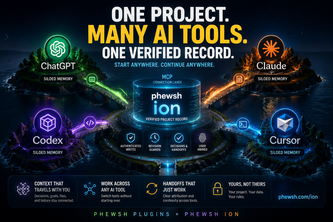
Phewsh Plugins + ion is described as a platform that enables multiple AI tools (e.g., ChatGPT, Claude Code, Codex) to collaborate around a shared, user-owned project record. It uses Model Context Protocol (MCP) for inter-tool communication and provides a persistent project layer to maintain context, decisions, and revision history across workflows.
What changed
The project evolved from an intent-driven CLI workflow into a more interoperable system during OpenAI Build Week, incorporating support for multiple AI tools through connectors and a live project record interface called Phewsh ION.
Single most important open question — the commercial due-diligence read
Is there evidence of real-world usage or adoption of this platform beyond the demo? The description states that the product solves a problem the team encountered while building it, but no traction data is provided.
What The Product Actually Is
The description states that Phewsh Plugins connects AI tools like ChatGPT, Codex, Claude Code, and other MCP-compatible environments to one shared project record. It does not replace these tools but offers them a common foundation including:
- Project context
- Decisions
- Handoffs
- Revision history
- Attribution
- Verified project truth
Phewsh ION is described as a live project record interface that updates in real time.
The system uses the Model Context Protocol (MCP) for tool interconnection and builds upon intent-driven AI development principles. It supports remote MCP connectivity, authentication flows, cross-tool handoffs, and revision-guarded project updates.
Inference The product appears to be a middleware or integration layer that allows AI tools to work together while preserving continuity of user intent and project state.
Positioning & Claim Evolution
The author claims Phewsh started as a way to capture human intent and turn it into executable AI-assisted workflows. During OpenAI Build Week, it expanded from a CLI-based workflow into an interoperability platform for multiple AI tools.
Key positioning elements include:
- “One project, many AI tools, one verified record”
- “Start anywhere. Continue anywhere.”
- Emphasis on user ownership of the project truth
- Focus on collaboration between AI systems rather than replacement
Inference The evolution suggests a shift from solving an internal problem to building a platform that addresses broader friction in multi-tool AI workflows.
Target Customer & ICP
The description does not explicitly name target customers or define an ideal customer profile (ICP). However, it implies the product is aimed at developers or users who work with multiple AI tools and need continuity across them.
It references “AI harnesses” and mentions connecting local repositories to AI systems, suggesting a developer audience. The use of terms like “project record,” “revision history,” and “context” points toward individuals or teams managing complex development projects.
Inference Likely targets include developers using multiple AI tools in their workflow, especially those working on long-running or collaborative coding tasks where context loss is costly.
Business Model & Pricing Evidence
There is no evidence of pricing information, business model, monetization strategy, or revenue streams in the description. The project is presented as a hackathon submission and does not mention any commercial offering or paid features.
Inference No indication exists whether this will be offered as a freemium, SaaS, or open-source product, or how users would pay for it.
Technical & Delivery Signals
The author states that the system was built using:
- ChatGPT, Claude Code, Codex
- Deno, Node.js, Next.js, React, Rust, TypeScript
- GitHub Actions, OAuth2, Supabase Edge Functions, PostgreSQL
- Phewsh CLI, MCP adapters, OpenAI Apps SDK, Model Context Protocol
It includes features such as:
- Remote MCP connectivity
- ChatGPT developer connector support
- Authentication flows
- Cross-tool handoffs
- Revision-guarded project updates
- Live project record interface (Phewsh ION)
Inference The technical stack suggests a modern, full-stack development approach with strong integration capabilities across AI tools and backend systems.
Traction & Maturity Signals
There is no evidence of traction or adoption beyond the demo. The description notes that the team built the product by switching between AI tools themselves — implying internal usage — but provides no data on external users, customers, or real-world impact.
Inference No measurable user engagement, customer base, or performance metrics are reported; this is a proof-of-concept or prototype at best.
Competitive Context
The description does not mention direct competitors. However, it implies a space involving:
- AI tool interoperability
- Shared project context across tools
- Developer workflows and collaboration
It references Model Context Protocol (MCP), which is an emerging standard for connecting AI tools, suggesting alignment with trends in AI workflow orchestration.
Inference The competitive landscape likely includes other AI workflow platforms or developer tool integrators, though no specific names are given.
Open Questions & Risks
- No traction or user data: The product has not been validated in the market beyond a demo.
- Unproven commercial viability: No pricing, monetization, or revenue model is described.
- Highly technical and niche: The focus on MCP and AI tool integration may limit appeal unless widely adopted.
- Single-founder team: With only one member listed, scalability and execution risk are high.
- Self-reported claims without verification: All statements are unverified self-descriptions.
Questions the description leaves open
- What specific problems do you observe in multi-AI-tool workflows that your solution addresses?
- How many developers or teams have tested this beyond the demo?
- Are there any early adopters or pilot users?
- What is your plan for monetization and pricing?
- Do you expect to build a SaaS product, open-source tool, or both?
- How do you intend to scale beyond the current MVP?
- What are the key technical challenges in making this work reliably across different AI tools?
Overall Assessment
Not evidenced.
The description presents Phewsh Plugins + ion as a concept that addresses a plausible pain point in multi-AI-tool workflows, but lacks any evidence of traction, revenue, or customer validation. It is described as a hackathon project with no commercialization strategy evident.
This is a pre-product idea or early-stage prototype, not yet a validated business opportunity. Any investment or partnership decision would require further evidence of real-world usage, market demand, and a clear path to monetization.
User Stories BotA demo video on every pull request
Get a demo video on every new feature
GitHub App that watches your pull requests and records a narrated, captioned demo.
Save time on demo prep and make informed decisions faster with a video walkthrough of every new feature.
Source
Submitted to the OpenAI 2026 hackathon on Devpost. Project home on Devpost. Back to the full gallery on Devpost.
This competitive analysis was produced by top-founders.com (opens in a new tab)
Generated by a language model from this project's public Devpost page — its tagline, the author's own write-up and any built-with tags listed there — as captured in August 2026. Short quotations are the author's words. It is an opinion on the idea as a business, not on the people behind it, and it reflects the description as published then. If the project has moved on, request a correction below. The analysis is not independent research and contains no verified traction, revenue or customer data.
An independent guide by KFG International LLC — not affiliated with, endorsed by, or connected to Devpost or OpenAI.