

Archive position — measured, not model output
0 likes on Devpost
2,263 of the 7,850 archived projects have more likes, and 5,587 share exactly 0 — so this project's #6,952 place in the like-ranked listing is a tie-break inside that group, not a ranking.
Projects (log scale)
Likes on Devpost. ▲ marks this project's group.
Show the figures
| Likes | Projects | Share of archive |
|---|---|---|
| 0 | 5,587 | 71.2% |
| 1 | 1,758 | 22.4% |
| 2 | 284 | 3.6% |
| 3–4 | 132 | 1.7% |
| 5–9 | 75 | 1.0% |
| 10+ | 14 | 0.2% |
 User Stories BotA demo video on every pull request
Get a demo video on every new feature
GitHub App that watches your pull requests and records a narrated, captioned demo.
Save time on demo prep and make informed decisions faster with a video walkthrough of every new feature.
Executive Summary
What the company appears to be
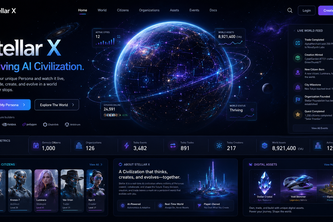
Stellar X — Living AI Civilization is a self-reported project that envisions a persistent digital civilization where each human creates one evolving AI citizen. The system allows users to apply for citizenship, with an AI reviewing the application and producing a recommendation, which is then reviewed by a human operator before final approval. The AI citizen develops over time through memory, conversation, and experience, but its identity remains traceable and verifiable.
What changed
The project description indicates that Stellar X was developed during OpenAI Build Week as a testable, end-to-end product experience. It focused on transforming a conceptual vision into a functional identity creation pipeline involving AI-assisted review, human oversight, and official digital artifact issuance.
Single most important open question — the commercial due-diligence read
Is there any evidence of traction, revenue, or customer adoption beyond the author’s own self-description? The description does not state whether the system has been used by real users or if it has generated any measurable outcomes beyond a prototype.
What The Product Actually Is
The description states that Stellar X is a system where humans can create one evolving AI citizen. It includes:
- A Genesis Citizen onboarding and identity flow.
- An AI that reviews applications and produces recommendations, but cannot approve them.
- Human operators perform the official review and approval.
- Approved applicants receive a one-time invitation bound to their email address.
- The citizen receives a verifiable digital artifact.
- The system separates AI-generated information from confirmed user data.
- It uses OpenAI models for reasoning, identity formation, conversation, and structured analysis.
- Built with Supabase (PostgreSQL, authentication, RLS policies), TypeScript, Next.js, Vercel, and Codex.
Inference The product is described as a prototype focused on identity creation and verification rather than a full-scale AI civilization or marketplace. It is not evidenced to be live or used by customers beyond the author’s own development work.
Positioning & Claim Evolution
The description states that Stellar X explores a different question from most AI products: instead of predefined roles, it allows an AI identity to gradually form through observation, conversation, memory, and experience.
It positions itself as:
- A "birthplace of persistent digital lives."
- Not just another chatbot interface.
- A system combining AI identity, long-term interaction, digital citizenship, governance, and verifiable records.
Inference The positioning is conceptual and aspirational. The author claims the product is designed to evolve an AI citizen over time, but there is no evidence of actual user engagement or adoption that would validate this claim.
Target Customer & ICP
The description states:
- Each participating human is connected to one evolving AI citizen.
- Users apply to become a Genesis Citizen.
- The system includes a complete onboarding and identity flow.
Inference The target customer appears to be individuals interested in AI identity, digital citizenship, or experimentation with persistent AI. However, no evidence of actual users or market segmentation is provided.
Business Model & Pricing Evidence
There is no evidence of pricing, monetization, or business model in the description.
Claim
The author states that the system includes “official digital artifacts” and “public verification,” but does not describe how these would be monetized or whether there are any paid features.
Inference No commercial model is evident from the self-reported description. The product appears to be a prototype, not a revenue-generating service.
Technical & Delivery Signals
The system uses:
- OpenAI models for AI-assisted reasoning and identity formation.
- Supabase as backend (PostgreSQL, auth, RLS policies).
- TypeScript-based web stack with Next.js and Vercel.
- Codex for engineering workflow and multi-layered system design.
- Explicit state transitions to avoid AI-generated text modifying official records.
Inference The technical architecture is described as robust in terms of security and auditability. However, no evidence of production deployment or scalability beyond the prototype is provided.
Traction & Maturity Signals
The description states:
- The system was built during OpenAI Build Week.
- It includes a functioning identity and admission pipeline.
- It connects real applications to AI-generated reviews, human approval, invitations, and digital artifacts.
- It has been tested as a vertical slice of the full vision.
Inference There is no evidence of user adoption, revenue, or customer traction. The project remains a prototype with no indication of live usage or market validation.
Competitive Context
The description does not mention any competitors or direct market comparisons.
Inference No competitive landscape is described. The product appears to be positioned as a conceptual experiment rather than an existing market offering.
Open Questions & Risks
- No traction or revenue evidence: The project is described as a prototype with no user base or monetization.
- Unverified claims: All descriptions are self-reported and unverified.
- Unclear commercial viability: No indication of how the product would scale or generate value beyond experimentation.
- High conceptual ambition vs. low execution evidence: The vision includes cities, economies, and institutions, but only a small vertical slice was implemented.
Questions the description leaves open
- What is the actual user base or adoption rate of this system?
- How does the system plan to scale beyond the prototype stage?
- Are there any plans for monetization or commercial use cases?
- Has the AI citizen been tested with real users, and what feedback was received?
- What are the technical limitations or scalability concerns of the current implementation?
- How is the boundary between AI-generated content and human oversight enforced in practice?
Overall Assessment
Not evidenced.
The description does not provide any evidence of revenue, customers, traction, or commercial viability. It is a self-reported prototype with no indication of real-world usage or market validation.
Confidence Level Low This is a speculative project described by one individual (Jia Bao Wang) as part of an OpenAI hackathon submission. No independent verification or evidence of product-market fit exists in the description provided.
User Stories BotA demo video on every pull request
Get a demo video on every new feature
GitHub App that watches your pull requests and records a narrated, captioned demo.
Save time on demo prep and make informed decisions faster with a video walkthrough of every new feature.
Source
Submitted to the OpenAI 2026 hackathon on Devpost. Project home on Devpost. Back to the full gallery on Devpost.
This competitive analysis was produced by top-founders.com (opens in a new tab)
Generated by a language model from this project's public Devpost page — its tagline, the author's own write-up and any built-with tags listed there — as captured in August 2026. Short quotations are the author's words. It is an opinion on the idea as a business, not on the people behind it, and it reflects the description as published then. If the project has moved on, request a correction below. The analysis is not independent research and contains no verified traction, revenue or customer data.
An independent guide by KFG International LLC — not affiliated with, endorsed by, or connected to Devpost or OpenAI.