

Archive position — measured, not model output
0 likes on Devpost
2,263 of the 7,850 archived projects have more likes, and 5,587 share exactly 0 — so this project's #3,028 place in the like-ranked listing is a tie-break inside that group, not a ranking.
Projects (log scale)
Likes on Devpost. ▲ marks this project's group.
Show the figures
| Likes | Projects | Share of archive |
|---|---|---|
| 0 | 5,587 | 71.2% |
| 1 | 1,758 | 22.4% |
| 2 | 284 | 3.6% |
| 3–4 | 132 | 1.7% |
| 5–9 | 75 | 1.0% |
| 10+ | 14 | 0.2% |
 User Stories BotA demo video on every pull request
Get a demo video on every new feature
GitHub App that watches your pull requests and records a narrated, captioned demo.
Save time on demo prep and make informed decisions faster with a video walkthrough of every new feature.
Executive Summary
What the company appears to be
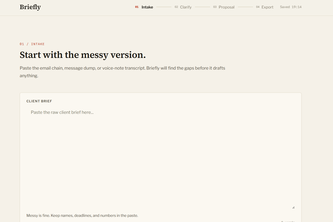
Briefly is a self-reported tool built by three recent graduates to help freelancers turn messy client briefs into professional proposals. The authors describe it as a product that reads unstructured input (e.g., WhatsApp messages, email chains) and generates structured, editable proposals using AI.
What changed
The project was submitted to the OpenAI 2026 hackathon by a team of three developers who claim they built it in parallel using a contract-first approach with AI agents. It is described as an experiment in AI-assisted development and client communication.
Single most important open question
Is there evidence that Briefly has been used or tested outside of the authors’ own use cases, or whether it has any traction or adoption beyond the hackathon submission?
What The Product Actually Is
The description states that Briefly turns messy client briefs (e.g., WhatsApp dumps, email chains) into professional proposals in four steps:
- Paste the chaos.
- Answer targeted questions.
- Get a real proposal.
- Send it.
It includes features such as:
- Live-streamed proposal generation
- Editable sections
- Out-of-scope section
- Pricing table with live total
- Regeneration of individual sections
- Pre-drafted cover email
The tool is built using Next.js, React, Tailwind, TypeScript, and Vercel. It uses GPT-5.6 for AI processing across three API routes: clarify (question generation), generate (proposal streaming), and refine (section regeneration).
Evidence
- The authors describe the functionality in detail.
- They state how it was built using a contract-first approach with stubs, AI agents, and Codex.
Inference The product is described as an internal tool for freelancers to improve client communication and reduce scope creep. It is not evidenced to be used by clients or have any revenue or customer base.
Positioning & Claim Evolution
The authors state that Briefly was built to address a gap in freelancing: the lack of experience in asking the right questions, scoping work, and pricing it correctly. They claim it helps users avoid common pitfalls like underselling or miscommunication.
They also describe their positioning as:
- A tool for inexperienced freelancers
- A way to protect against scope creep
- A solution that makes proposals professional and editable
Evidence
- The inspiration section explicitly frames the problem they are solving.
- The “What it does” section describes how the product addresses client communication issues.
Inference The positioning is self-reported and not validated by external data or customer feedback. It reflects the team’s own experience rather than market validation.
Target Customer & ICP
The description states that Briefly targets freelancers—specifically, recent graduates who lack experience in client work and deal closure.
Evidence
- The authors describe themselves as “fresh graduates” with no prior client work.
- They state the tool helps users avoid common freelancer pitfalls like underselling or miscommunication.
Inference The ICP is inferred to be early-career freelancers, but there is no evidence of actual customers or user testing beyond the team’s own use cases.
Business Model & Pricing Evidence
There is no evidence in the description of a business model or pricing structure. The authors do not mention monetization, subscriptions, or any revenue streams.
Evidence
- No mention of pricing, plans, or monetization.
- No indication of whether the tool will be sold or offered free.
Inference The business model is not described and cannot be inferred from the self-reported content.
Technical & Delivery Signals
The project was built using:
- Next.js App Router on Vercel
- React, Tailwind, TypeScript
- No database; state stored in React + localStorage
- Three API routes powered by GPT-5.6 with structured outputs
- A contract-first approach with stubs and AI agents
- AGENTS.md file to maintain consistency in AI coding
The authors claim they used a “contract-first” workflow, where types were defined before code, and that the AI was used for both development and content generation.
Evidence
- The “How we built it” section describes technical stack and process.
- They mention using Codex with rules-based workflows.
Inference The technical approach is described as experimental and efficient but not validated in production or at scale.
Traction & Maturity Signals
There is no evidence of traction, customers, revenue, or adoption beyond the authors’ own use cases. The project was submitted to a hackathon and has no external validation or usage data.
Evidence
- No mention of users, customers, or revenue.
- The only example of use is from one of the team members' prior job experience.
Inference The product is at an early stage and lacks any measurable traction or market validation.
Competitive Context
There is no evidence in the description of direct competitors. The authors do not reference existing tools for freelancers, proposal generation, or client communication.
Evidence
- No mention of competitors.
- No comparison to other tools or platforms.
Inference The competitive landscape is unknown and cannot be inferred from the self-reported content.
Open Questions & Risks
- No traction or adoption: The product has no evidence of being used beyond the authors’ own experience.
- Unverified claims: All descriptions are self-reported and unverified.
- No business model: No indication of how the tool will be monetized.
- Limited scope: The tool is described as a hackathon project, not a scalable product.
- AI dependency: Heavy reliance on AI (GPT-5.6) without evidence of robustness or control over outputs.
Evidence
- No revenue, customers, or usage data.
- No mention of monetization or business plan.
- The tool is described as a hackathon submission.
Inference The risks are high due to lack of external validation and unproven market demand.
Questions the description leaves open
- What specific client briefs have you tested Briefly with, and what were the outcomes?
- Have you validated your product with actual freelancers or clients outside the team?
- How do you plan to monetize this tool? Is there a business model in place?
- What are the limitations of the current AI implementation, especially around accuracy and control?
- Are there any plans for scaling beyond the current hackathon prototype?
Overall Assessment
Not evidenced.
There is no evidence to support any investment or partnership decision. The project is described as a hackathon submission with no traction, customers, or business model. It is not clear whether it has moved beyond the experimental phase.
Confidence Low The description is self-reported and unverified. No external validation, revenue, or adoption data exists to support any conclusion about its viability or potential for investment or partnership.
User Stories BotA demo video on every pull request
Get a demo video on every new feature
GitHub App that watches your pull requests and records a narrated, captioned demo.
Save time on demo prep and make informed decisions faster with a video walkthrough of every new feature.
Source
Submitted to the OpenAI 2026 hackathon on Devpost. Project home on Devpost. Back to the full gallery on Devpost.
This competitive analysis was produced by top-founders.com (opens in a new tab)
Generated by a language model from this project's public Devpost page — its tagline, the author's own write-up and any built-with tags listed there — as captured in August 2026. Short quotations are the author's words. It is an opinion on the idea as a business, not on the people behind it, and it reflects the description as published then. If the project has moved on, request a correction below. The analysis is not independent research and contains no verified traction, revenue or customer data.
An independent guide by KFG International LLC — not affiliated with, endorsed by, or connected to Devpost or OpenAI.