

Archive position — measured, not model output
0 likes on Devpost
2,263 of the 7,850 archived projects have more likes, and 5,587 share exactly 0 — so this project's #6,951 place in the like-ranked listing is a tie-break inside that group, not a ranking.
Projects (log scale)
Likes on Devpost. ▲ marks this project's group.
Show the figures
| Likes | Projects | Share of archive |
|---|---|---|
| 0 | 5,587 | 71.2% |
| 1 | 1,758 | 22.4% |
| 2 | 284 | 3.6% |
| 3–4 | 132 | 1.7% |
| 5–9 | 75 | 1.0% |
| 10+ | 14 | 0.2% |
 User Stories BotA demo video on every pull request
Get a demo video on every new feature
GitHub App that watches your pull requests and records a narrated, captioned demo.
Save time on demo prep and make informed decisions faster with a video walkthrough of every new feature.
Executive Summary
What the company appears to be
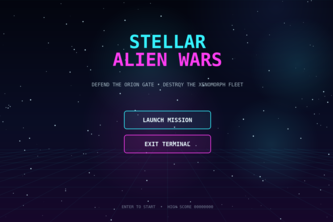
The description states that "Stellar Alien Wars: Sci-Fi Shooter" is a browser-based space shooter game built with HTML5, JavaScript, and related web technologies. It was developed as a solo project by Liam Sterling for the OpenAI 2026 hackathon.
What changed
No evidence of prior versions or evolution beyond this single self-reported project exists. The project appears to be an experimental or demonstration piece submitted to a hackathon.
Single most important open question
Is there any indication that this project has evolved into a commercial product, attracted users, or generated revenue? — Not evidenced.
What The Product Actually Is
The description states that Stellar Alien Wars is a browser-based sci-fi space shooter game built using:
- HTML5 Canvas
- JavaScript
- CSS
- Web Audio API
It includes features such as:
- Dynamic starfield effects
- Laser combat and projectile systems
- Energy shields and health management
- Quantum dash ability
- Combo-based scoring system
- Upgrade items and power-ups
- Multi-stage battles with a boss enemy
- Futuristic HUD interface and visual effects
The game was developed using a modular architecture including:
- Game Engine (real-time loop, physics, collision detection)
- Rendering System (canvas-based graphics, particle effects)
- Gameplay System (player control, AI, weapon system)
- Deployment System (GitHub Pages hosting, PWA support)
Inference The project is a technical demonstration of web-based game development using open-source tools and frameworks.
Positioning & Claim Evolution
The description states that the goal was to demonstrate:
- That modern web technologies can be used to create immersive real-time game experiences
- Without reliance on traditional commercial game engines
It positions itself as a proof-of-concept or demo project, not a commercial product. The author claims it shows how creativity and engineering can work together to build immersive digital experiences.
Inference This is a solo developer’s experimental project, likely intended for portfolio or hackathon submission purposes.
Target Customer & ICP
The description does not state any target customer or ideal customer profile (ICP). It only describes the game as a browser-based experience for players who enjoy sci-fi space shooters.
Inference No evidence of defined user personas, market segmentation, or buyer intent is present. The project appears to be a personal or educational endeavor.
Business Model & Pricing Evidence
There is no evidence in the description of any business model or pricing structure. The project is described as a hackathon submission and does not mention monetization, subscriptions, sales, or user acquisition strategies.
Inference No commercial intent or revenue-generating mechanism is evident from the self-reported content.
Technical & Delivery Signals
The description states that the game was built with:
- HTML5 Canvas
- JavaScript
- CSS
- Web Audio API
It includes:
- Real-time rendering using requestAnimationFrame
- Procedural graphics (starfields, particle effects)
- Collision detection algorithms
- Modular architecture with separate systems for engine, rendering, gameplay, and deployment
Deployment was done via:
- GitHub Pages
- Progressive Web App support
Inference The project shows technical competence in browser-based game development but lacks evidence of scalability or production-grade infrastructure.
Traction & Maturity Signals
There is no evidence of traction, adoption, or user engagement. The project is described as a solo effort submitted to a hackathon and does not include metrics like downloads, active users, or retention data.
Inference No signs of product-market fit, growth, or commercial viability are evident.
Competitive Context
The description does not mention any competitors or market positioning relative to other browser-based games or gaming platforms. It is framed as a standalone demo project without reference to existing products in the space.
Inference No competitive analysis or differentiation strategy is evident from the self-reported content.
Open Questions & Risks
- Solo development: The project was built by one person, raising questions about scalability and long-term maintenance.
- No commercial traction: No evidence of users, revenue, or monetization.
- Hackathon submission: Likely a prototype or experimental piece, not a mature product.
- No external validation: No third-party reviews, press coverage, or endorsements.
Inference The project is at an early stage and lacks any indication of commercial viability or market traction.
Questions the description leaves open
- What is the intended path from this prototype to a commercial product?
- Are there plans for monetization or user acquisition beyond the hackathon?
- Has the game been tested with real users or played by others outside of development?
- Is there any plan to expand into multiplayer, mobile, or other platforms?
- What are the long-term goals for this project beyond its current form?
Overall Assessment
Not evidenced.
There is no evidence that this project has evolved past a hackathon submission, nor is there any indication of traction, revenue, or commercial intent. The description presents it as an experimental technical demonstration with no signs of product-market fit or scalability.
Confidence Low — based entirely on self-reported content without external corroboration or data points.
User Stories BotA demo video on every pull request
Get a demo video on every new feature
GitHub App that watches your pull requests and records a narrated, captioned demo.
Save time on demo prep and make informed decisions faster with a video walkthrough of every new feature.
Source
Submitted to the OpenAI 2026 hackathon on Devpost. Project home on Devpost. Back to the full gallery on Devpost.
This competitive analysis was produced by top-founders.com (opens in a new tab)
Generated by a language model from this project's public Devpost page — its tagline, the author's own write-up and any built-with tags listed there — as captured in August 2026. Short quotations are the author's words. It is an opinion on the idea as a business, not on the people behind it, and it reflects the description as published then. If the project has moved on, request a correction below. The analysis is not independent research and contains no verified traction, revenue or customer data.
An independent guide by KFG International LLC — not affiliated with, endorsed by, or connected to Devpost or OpenAI.