

Archive position — measured, not model output
1 like on Devpost
505 of the 7,850 archived projects have more likes, and 1,758 share exactly 1 — so this project's #1,990 place in the like-ranked listing is a tie-break inside that group, not a ranking.
Projects (log scale)
Likes on Devpost. ▲ marks this project's group.
Show the figures
| Likes | Projects | Share of archive |
|---|---|---|
| 0 | 5,587 | 71.2% |
| 1 | 1,758 | 22.4% |
| 2 | 284 | 3.6% |
| 3–4 | 132 | 1.7% |
| 5–9 | 75 | 1.0% |
| 10+ | 14 | 0.2% |
 User Stories BotA demo video on every pull request
Get a demo video on every new feature
GitHub App that watches your pull requests and records a narrated, captioned demo.
Save time on demo prep and make informed decisions faster with a video walkthrough of every new feature.
Executive Summary
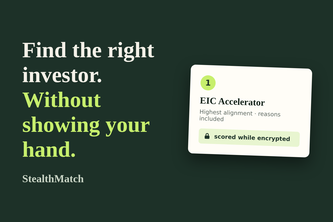
What the company appears to be: StealthMatch is a self-reported startup that builds an opportunity-matching app for founders. The app uses fully homomorphic encryption (FHE) to allow founders to input private numerical constraints and conflict signals into a public opportunity catalog, without revealing sensitive information before an NDA.
What changed: The project description shows development of a proof-of-concept prototype using FHE technology, with claims about privacy-preserving matching. It was submitted as a hackathon entry.
The single most important open question: Is there any evidence of traction, revenue, or customer adoption beyond the self-reported prototype and hackathon submission?
Analysis basis: This report is based entirely on the self-reported project description provided by the caller. No external verification or historical data are available. All claims in this document are stated by the author and not independently confirmed.
What The Product Actually Is
The description states that StealthMatch is "a secure opportunity-matching app for founders". It operates through a three-step process:
- Founder inputs private mandate locally: This includes six numerical constraints, optional named conflicts, and eligibility signals.
- Encryption and scoring: The founder's device encrypts the mandate using FHE (specifically CKKS), then sends ciphertext to a scoring service that evaluates against a public catalog and returns encrypted component scores.
- Local decryption and ranking: The founder’s device decrypts results locally, ranks them deterministically, and presents a shortlist with reasons, cautions, and official links.
The system uses:
- Fully Homomorphic Encryption (FHE) via Niobium DSL
- CKKS encryption scheme
- Client-side encryption/decryption
- SIMD packing for evaluation
- GPT-5.6 for design assistance
Claim: The app enables matching without requiring founders to upload confidential information before an NDA.
Evidence: Described in the write-up as a local encryption → blind scoring → local decryption workflow.
Positioning & Claim Evolution
The author positions StealthMatch as solving a problem in early-stage startup fundraising: "only a limited set of information can be shared safely before an NDA". The core claim is that existing public filters are insufficient because they cannot use private, sensitive data to determine fit.
Key claims:
- Founders should not have to disclose confidential facts like runway or capital position until after an NDA.
- Public filters alone lead to inefficient manual research.
- The app provides better matching and ranking without early disclosure.
- It uses FHE to ensure no plaintext information is ever seen by the scoring service.
Claim: StealthMatch enables secure, private matching between founders and opportunities.
Evidence: Described as a way to avoid uploading pitch decks or early disclosures during initial research.
Target Customer & ICP
The description identifies the primary user as "founders" who are seeking:
- Investors
- Accelerators
- Grants
- Pilot programs
These users are described as operating under constraints such as runway, capital position, and strategic conflicts — all of which are private but important for determining fit.
Claim: The target customer is early-stage founders researching funding and partnership opportunities.
Evidence: Explicitly stated in the inspiration section.
Business Model & Pricing Evidence
There is no evidence provided about pricing or business model. The description only mentions that the app works with a public opportunity catalog, and that future versions may allow partners (investors, accelerators) to encrypt their own confidential data.
Claim: No information on how StealthMatch intends to monetize or charge users.
Evidence: Not evidenced.
Technical & Delivery Signals
The project is built using:
- C++, CSS3, HTML5, JavaScript, JSON, Python
- GPT-5.6 for design and implementation assistance
- Niobium DSL for FHE operations
- CKKS encryption scheme
- SIMD packing for performance
- OpenFHE framework
It includes:
- Local encryption/decryption workflow
- Encrypted scoring service
- Deterministic output generation (reasons, cautions, links)
- Reproducible build system with pinned SDK and submodule support
Claim: The app uses advanced cryptography to enable secure matching.
Evidence: Described as a local encryption → blind score → local decryption flow using CKKS FHE.
Traction & Maturity Signals
There is no evidence of traction, revenue, or customer adoption beyond the hackathon submission. The project is described as a prototype built in a short timeframe (a hackathon), and no data on usage, users, or performance are included.
Claim: No evidence of product-market fit or real-world usage.
Evidence: Not evidenced.
Competitive Context
The author mentions that existing public filters "cannot responsibly use that private mandate", implying a gap in the market for privacy-preserving matching tools. However, there is no mention of competitors or how StealthMatch compares to existing solutions.
Claim: No known competitors are named or described.
Evidence: Not evidenced.
Open Questions & Risks
- Unproven commercial viability: The app exists only as a prototype and has not been tested in real-world conditions.
- Technical complexity without product discipline: While FHE is used, the description notes that verification must be part of development process — suggesting potential issues with usability or correctness.
- No revenue or customer data: No evidence of any monetization strategy or user base.
- Dependency on unverified tools: GPT-5.6 and Niobium DSL are referenced but not independently validated for production use.
- Limited scope: The current MVP only supports public catalogs; future expansion is speculative.
Inference: Without traction, revenue, or customer feedback, the likelihood of commercial success is low.
Evidence: Not evidenced.
Questions the description leaves open
- What specific metrics or KPIs are you tracking for product development?
- Have you conducted any user testing with actual founders?
- How do you plan to scale the opportunity catalog beyond a public list?
- Are there any regulatory or compliance concerns around FHE-based matching in your target markets?
- What is your roadmap for monetization and customer acquisition?
- Can you demonstrate how the current prototype handles real-world edge cases?
- How do you intend to onboard investors, accelerators, or grant programs into the system?
Overall Assessment
There is no evidence of traction, revenue, or customer adoption beyond a hackathon submission. The product is described as a proof-of-concept prototype using advanced cryptography (FHE), but there is no indication that it has moved past this stage.
Inference: At this point, StealthMatch appears to be an experimental idea with strong technical execution, but lacking commercial validation.
Evidence: Not evidenced.
User Stories BotA demo video on every pull request
Get a demo video on every new feature
GitHub App that watches your pull requests and records a narrated, captioned demo.
Save time on demo prep and make informed decisions faster with a video walkthrough of every new feature.
Source
Submitted to the OpenAI 2026 hackathon on Devpost. Project home on Devpost. Back to the full gallery on Devpost.
This competitive analysis was produced by top-founders.com (opens in a new tab)
Generated by a language model from this project's public Devpost page — its tagline, the author's own write-up and any built-with tags listed there — as captured in August 2026. Short quotations are the author's words. It is an opinion on the idea as a business, not on the people behind it, and it reflects the description as published then. If the project has moved on, request a correction below. The analysis is not independent research and contains no verified traction, revenue or customer data.
An independent guide by KFG International LLC — not affiliated with, endorsed by, or connected to Devpost or OpenAI.