

Archive position — measured, not model output
0 likes on Devpost
2,263 of the 7,850 archived projects have more likes, and 5,587 share exactly 0 — so this project's #3,953 place in the like-ranked listing is a tie-break inside that group, not a ranking.
Projects (log scale)
Likes on Devpost. ▲ marks this project's group.
Show the figures
| Likes | Projects | Share of archive |
|---|---|---|
| 0 | 5,587 | 71.2% |
| 1 | 1,758 | 22.4% |
| 2 | 284 | 3.6% |
| 3–4 | 132 | 1.7% |
| 5–9 | 75 | 1.0% |
| 10+ | 14 | 0.2% |
 User Stories BotA demo video on every pull request
Get a demo video on every new feature
GitHub App that watches your pull requests and records a narrated, captioned demo.
Save time on demo prep and make informed decisions faster with a video walkthrough of every new feature.
Executive Summary
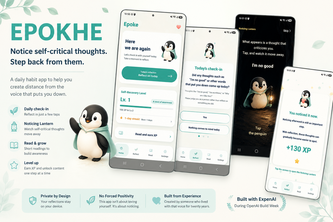
EPOKHE is a self-reported daily habit app for people who struggle with low self-esteem and recurring self-critical thoughts. The author states that the app helps users notice and step back from negative mental patterns without forcing positive thinking. It is built as a mobile application using React Native, Expo, and TypeScript, with support for both iOS and Android platforms.
The description indicates that EPOKHE was developed during a hackathon by a solo developer while raising two young children. The app includes features such as personalized self-critical phrases, daily reflection prompts, a lantern exercise, XP/streaks/levels, unlockable readings, and privacy controls. It is currently in early development, with the first public release planned in Japanese.
Key commercial due-diligence read: There is no evidence of revenue, customers, or traction beyond the author's own account. The app has not yet launched publicly to users outside of the developer’s own testing or feedback gathering. The business model and pricing are not described. The project appears to be a solo developer effort with limited team structure.
Most important open question: Is there any evidence of user engagement, retention, or monetization strategy beyond the author's personal development process?
What The Product Actually Is
The description states that EPOKHE is:
- A daily habit app for people who struggle with low self-esteem and recurring self-critical thoughts.
- Designed to help users notice and step back from negative mental patterns without forcing positive thinking.
- Built using React Native, Expo, and TypeScript for iOS and Android.
- Includes features such as:
- Personalized self-critical phrases
- Daily reflection prompts
- Lantern exercise practice
- XP, streaks, levels, and unlockable readings
- Privacy controls
It is described as a mobile app with onboarding, personalization, gamification elements (XP, streaks), and educational content.
Inference: The app appears to be an experimental or prototype tool based on psychological practices around mindfulness and cognitive behavioral techniques. It is not yet confirmed whether it has been tested with real users or scaled beyond the developer’s own use case.
Positioning & Claim Evolution
The author claims that EPOKHE:
- Helps people notice self-critical thoughts without forcing positive thinking.
- Is a quiet daily app for those who struggle with low self-esteem.
- Focuses on creating distance from negative thoughts rather than replacing them.
- Was inspired by the developer’s own experience with self-criticism over 20 years.
There is no indication of prior positioning or claims made before this submission. The project appears to be a new concept developed during a hackathon, and there is no evidence of prior branding, marketing, or product evolution beyond its initial build.
Inference: This is a first-time product idea, likely shaped by personal experience rather than market research or competitive analysis.
Target Customer & ICP
The description states that EPOKHE targets:
- People who struggle with low self-esteem.
- Individuals who experience recurring self-critical thoughts.
There is no further segmentation or definition of the target audience beyond these broad psychological conditions. No specific demographics, psychographics, or user personas are described.
Inference: The ICP (Ideal Customer Profile) is not defined beyond a general category of users with mental health challenges related to self-esteem and internal criticism.
Business Model & Pricing Evidence
There is no evidence in the description of:
- Revenue streams
- Pricing model
- Monetization strategy
- Subscription plans or in-app purchases
- Paid features or freemium structure
The author only mentions that the app includes gamification elements like XP, streaks, and unlockable readings but does not describe how these might be monetized.
Inference: The business model remains undefined. It is unclear if the product will be free-to-use, subscription-based, or otherwise monetized.
Technical & Delivery Signals
The description states that EPOKHE:
- Is built with React Native, Expo, and TypeScript.
- Supports both iOS and Android platforms.
- Was developed during a hackathon using Codex and GPT-5.6.
- Includes onboarding, personalized phrases, daily reflection, lantern practice, XP/streaks/levels, unlockable readings, and accessibility/privacy controls.
The author also notes that the app was built while raising two young children, suggesting a lean development process with limited resources.
Inference: The technical stack is standard for mobile apps. Development appears to have been rapid and resource-constrained, possibly indicating early-stage product development or MVP status.
Traction & Maturity Signals
The description indicates:
- The app was built during a hackathon.
- It includes a complete onboarding experience, personalization, daily reflection, lantern practice, XP/streaks/levels, unlockable readings, and privacy controls.
- The first public release will be in Japanese.
- The developer is currently gathering interest from English-speaking users.
There is no evidence of:
- Public user base or adoption
- Revenue or monetization
- Customer feedback or usage metrics
- Product maturity beyond prototype stage
Inference: The product is at an early stage, likely a prototype or MVP. No traction or market validation has been demonstrated.
Competitive Context
There is no mention in the description of:
- Competitors
- Market analysis
- Existing solutions in the mental health or habit-tracking space
- Differentiation from similar tools
The author does not reference any prior products or services that address self-criticism or mindfulness practices.
Inference: No competitive context is provided. It is unknown whether EPOKHE addresses a gap in the market or competes with existing solutions.
Open Questions & Risks
Key risks and open questions based on the description:
- The app has no verified users, revenue, or traction.
- The developer is solo, with no team size stated.
- No business model or pricing strategy described.
- The product appears to be in early development (MVP stage).
- The app is not yet publicly available beyond the developer’s own testing.
- The use of AI tools like Codex and GPT-5.6 may raise questions about scalability, control, and long-term viability.
Inference: The project lacks commercial readiness, market validation, or financial sustainability indicators.
Questions the description leaves open
- What is the current stage of development? Is it a working prototype or fully functional app?
- Have you gathered any feedback from users beyond your own testing?
- How do you plan to monetize the app? Is there a pricing model or revenue stream in mind?
- Are you planning to expand beyond Japanese and English markets?
- What is your long-term vision for EPOKHE, and how does it align with user needs?
- Do you have any plans for partnerships or collaborations in the mental health or wellness space?
- How do you intend to scale the product if there is interest?
Overall Assessment
There is no evidence of revenue, customers, or traction beyond the author’s own account. The app has not yet launched publicly and is described as a solo developer effort with limited team structure.
Assessment: Not ready for investment or partnership at this time. The project appears to be in early development with no commercial validation or business model confirmed. It requires further evidence of user engagement, market demand, and financial planning before any strategic move can be considered.
User Stories BotA demo video on every pull request
Get a demo video on every new feature
GitHub App that watches your pull requests and records a narrated, captioned demo.
Save time on demo prep and make informed decisions faster with a video walkthrough of every new feature.
Source
Submitted to the OpenAI 2026 hackathon on Devpost. Project home on Devpost. Back to the full gallery on Devpost.
This competitive analysis was produced by top-founders.com (opens in a new tab)
Generated by a language model from this project's public Devpost page — its tagline, the author's own write-up and any built-with tags listed there — as captured in August 2026. Short quotations are the author's words. It is an opinion on the idea as a business, not on the people behind it, and it reflects the description as published then. If the project has moved on, request a correction below. The analysis is not independent research and contains no verified traction, revenue or customer data.
An independent guide by KFG International LLC — not affiliated with, endorsed by, or connected to Devpost or OpenAI.