

Archive position — measured, not model output
2 likes on Devpost
221 of the 7,850 archived projects have more likes, and 284 share exactly 2 — so this project's #471 place in the like-ranked listing is a tie-break inside that group, not a ranking.
Projects (log scale)
Likes on Devpost. ▲ marks this project's group.
Show the figures
| Likes | Projects | Share of archive |
|---|---|---|
| 0 | 5,587 | 71.2% |
| 1 | 1,758 | 22.4% |
| 2 | 284 | 3.6% |
| 3–4 | 132 | 1.7% |
| 5–9 | 75 | 1.0% |
| 10+ | 14 | 0.2% |
 User Stories BotA demo video on every pull request
Get a demo video on every new feature
GitHub App that watches your pull requests and records a narrated, captioned demo.
Save time on demo prep and make informed decisions faster with a video walkthrough of every new feature.
Executive Summary
What the company appears to be
Squad AI is described as an infrastructure layer for running Codex agents — a system that allows agents to react to events in real time, coordinate across machines, and scale programmatically. It positions itself as a control plane for Codex agents, enabling event-driven automation, agent routing, task queuing, and multi-machine coordination.
What changed
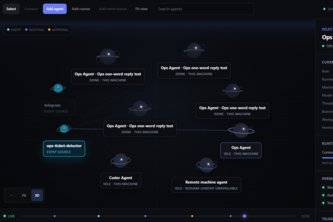
The author states that the project evolved from an initial focus on event-driven waking up of agents to support for multiple machines (via Tailscale), shared skill libraries, and integration with Telegram group chats. It also includes a 3D visualization dashboard and a wrapper around Codex App Server APIs.
Single most important open question
Does Squad AI have any real-world usage or adoption beyond the author’s own testing? The description offers no evidence of customers, revenue, or external traction — only self-reported claims about functionality and personal use.
Note
This analysis is based entirely on the self-reported project description. No independent verification, historical data, or third-party sources are available. All statements reflect the author's own account and should be treated as claims, not facts.
What The Product Actually Is
- The description states that Squad AI is a control plane for Codex agents.
- It enables agents to wake up and react to events (e.g., Jira tickets, flight price changes).
- It supports routing tasks to the right agent, queuing, managing persistent threads, and coordinating work across machines.
- It allows agents to be installed on any machine and connected to a unified control plane.
- It includes a 3D dashboard for visualizing agents in a distributed topology.
- The system uses Codex App Server as its backbone and wraps it with APIs for easier access by the control plane.
- It supports agent-to-agent communication across machines without requiring SSH or direct inter-machine command execution.
Inference The product appears to be a lightweight, developer-focused tool that abstracts away complexity in running autonomous agents at scale, especially in distributed environments. However, it is not evidenced to have any external users or production usage.
Positioning & Claim Evolution
- Initially, the author focused on event-driven automation for agents — making them reactive rather than waiting for manual prompts.
- Later, the system expanded to support multi-machine deployment via Tailscale and agent coordination across systems.
- The author emphasizes that agents are treated as instantiable objects (borrowed from OOP), allowing automatic instantiation of agents for repeated tasks.
- The project is positioned as a way to treat agents not just as chat windows but as intelligent components in system design.
- It differentiates itself by avoiding SSH-based communication between machines and instead using a centralized control plane.
Inference The positioning evolved from a simple automation tool to a distributed agent orchestration platform. However, there is no evidence of how this has been tested or validated beyond the author’s own use case.
Target Customer & ICP
- The description does not name specific customer segments.
- It implies that developers or engineers who work with distributed systems and LLM agents are likely users.
- The system supports running agents on local machines, suggesting a preference for developers or teams managing their own infrastructure.
- The mention of Codex App Server suggests targeting users already using Codex or similar tools.
Inference The ICP is likely technical users (developers, engineers) working in environments where they need to manage and scale autonomous agents across multiple machines. No evidence of customer personas or market segmentation.
Business Model & Pricing Evidence
- There is no mention of pricing models, monetization strategies, or business model.
- The project is described as a personal build, not a commercial product.
- It was submitted to a hackathon and has no indication of revenue streams or paid features.
Inference No evidence of any business model or pricing structure. The author’s intent seems to be exploratory rather than commercial.
Technical & Delivery Signals
- Built using Codex App Server, TypeScript, SQLite, GPT-5.6 (for complex logic), and distributed systems concepts.
- Uses a wrapper around Codex App Server APIs for integration with the control plane.
- Implements event listening, queuing, routing, and task management via GPT-5.6.
- Includes a 3D visualization dashboard built using Codex’s UI tools.
- Supports Tailscale for connecting multiple machines.
- Has support for Telegram group chat integration for multi-agent communication.
- The system decouples the control plane from the Codex App Server wrapper, enabling modular development.
Inference Technical architecture shows a strong understanding of distributed systems and LLM agent workflows. However, no evidence of production deployment or scalability testing.
Traction & Maturity Signals
- The author reports using the tool for 12 hours straight to automate debugging tasks.
- It was built during a hackathon (OpenAI 2026) and submitted as a project.
- No evidence of customer adoption, revenue, or user base.
- The author states they are proud of building a “mini distributed system” but provides no metrics on usage or performance.
Inference There is no evidence of traction or maturity beyond the author’s personal use. No data on adoption, retention, or impact.
Competitive Context
- The description mentions that other solutions exist for running agents in the cloud.
- Squad AI differentiates itself by allowing agents to run on local machines where existing setups and files are located.
- It avoids SSH-based communication between agents, instead relying on a centralized control plane.
- It supports agent instantiation as objects, enabling automatic scaling of similar tasks.
Inference The competitive landscape includes cloud-based agent platforms. Squad AI’s unique value proposition is its focus on local deployment and decentralized coordination. However, no evidence of existing competitors or market positioning beyond self-reporting.
Open Questions & Risks
- No evidence of any real-world usage or customer feedback.
- The project is described as a personal hackathon effort with no commercialization plan.
- Reliance on Codex App Server and GPT-5.6 suggests dependency on proprietary tools, which may limit scalability or portability.
- Lack of clear monetization or business model raises questions about long-term viability.
- No mention of security, reliability, or performance in production environments.
Inference The main risk is that the project remains experimental and unproven in real-world use. Dependency on specific tools (Codex, GPT-5.6) may hinder scalability or adoption.
Questions the description leaves open
- What is your plan for monetization or commercializing this product?
- Have you tested the system with more than one machine or in a real-world environment?
- How do you plan to handle agent-to-agent communication securely and reliably across machines?
- Are there any known limitations or scalability issues with the current architecture?
- What is your roadmap for expanding beyond Codex agents?
- Have you considered how this would integrate into existing DevOps or SaaS workflows?
Note
These questions are based on the limited information provided in the self-reported description.
Overall Assessment
- The project shows technical capability and a clear understanding of distributed systems and LLM agent orchestration.
- However, there is no evidence of traction, revenue, or customer adoption.
- It is presented as a personal hackathon effort with no indication of commercial intent or scalability.
- The author’s experience in distributed systems is evident, but the project lacks validation in real-world use cases.
Assessment Not ready for investment or partnership. This is an early-stage idea with potential, but lacks evidence of viability or market demand. Further due diligence would require proof of concept, user feedback, and commercialization strategy.
User Stories BotA demo video on every pull request
Get a demo video on every new feature
GitHub App that watches your pull requests and records a narrated, captioned demo.
Save time on demo prep and make informed decisions faster with a video walkthrough of every new feature.
Source
Submitted to the OpenAI 2026 hackathon on Devpost. Project home on Devpost. Back to the full gallery on Devpost.
This competitive analysis was produced by top-founders.com (opens in a new tab)
Generated by a language model from this project's public Devpost page — its tagline, the author's own write-up and any built-with tags listed there — as captured in August 2026. Short quotations are the author's words. It is an opinion on the idea as a business, not on the people behind it, and it reflects the description as published then. If the project has moved on, request a correction below. The analysis is not independent research and contains no verified traction, revenue or customer data.
An independent guide by KFG International LLC — not affiliated with, endorsed by, or connected to Devpost or OpenAI.