

Archive position — measured, not model output
0 likes on Devpost
2,263 of the 7,850 archived projects have more likes, and 5,587 share exactly 0 — so this project's #2,434 place in the like-ranked listing is a tie-break inside that group, not a ranking.
Projects (log scale)
Likes on Devpost. ▲ marks this project's group.
Show the figures
| Likes | Projects | Share of archive |
|---|---|---|
| 0 | 5,587 | 71.2% |
| 1 | 1,758 | 22.4% |
| 2 | 284 | 3.6% |
| 3–4 | 132 | 1.7% |
| 5–9 | 75 | 1.0% |
| 10+ | 14 | 0.2% |
 User Stories BotA demo video on every pull request
Get a demo video on every new feature
GitHub App that watches your pull requests and records a narrated, captioned demo.
Save time on demo prep and make informed decisions faster with a video walkthrough of every new feature.
Executive Summary
What the company appears to be
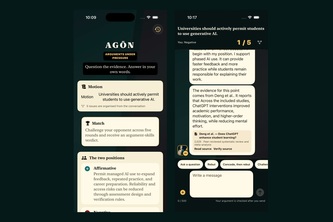
AGŌN is a single-player iPhone debate game built around evidence-bound free input, designed as a bounded practice space for users to engage with opposing viewpoints in a structured yet natural way. It is self-reported as an iOS app that uses AI to simulate a debate opponent within fixed Case Files.
What changed
The project was submitted by one developer (Daiki Matsui) as part of the OpenAI 2026 hackathon, indicating it is early-stage and likely not yet commercially launched or monetized. The author describes an experimental prototype with technical depth but no evidence of traction, revenue, or customer adoption.
Single most important open question
Is there any evidence that AGŌN has been tested beyond the developer's own implementation, or whether users have engaged with it in a way that suggests demand or utility beyond the author’s personal development?
What The Product Actually Is
The description states that AGŌN is:
- A single-player iPhone debate game
- Built around evidence-bound free input
- Intentionally a bounded, non-public practice space
- Where players are randomly assigned a side, including positions they may agree or disagree with
- Players write a natural message and may attach one source from a fixed Case File
- An AI opponent debates the player across five exchanges, with visible typing pauses and separate posts for claims and evidence
- The conversation is constrained: the opponent cannot cite anything outside the registered Case File
- The player’s message is never replaced by an AI-written answer
- After every post, the server maps prose to a registered argument action and evaluates responsiveness, evidence fit, rule compliance, and final comparison
- The model can make the exchange feel human but cannot change legal moves, evidence compatibility, scores, votes, or the winner
The product is described as supporting both English and Japanese, with localized UI elements including active match flow, 40 argument cards, 15 reviewed evidence records, source checks, and opponent dialogue.
Inference AGŌN appears to be a proof-of-concept prototype for an AI-powered educational or civic engagement tool. It is not described as having any commercial functionality beyond its own internal use or demonstration.
Positioning & Claim Evolution
The author states:
- AGŌN aims to create a bounded practice space where disagreement builds curiosity instead of widening fractures
- The goal is to help users examine the strongest arguments on both sides, notice limits of available evidence, and develop a deeper, fact-based interest in issues
- It is not intended to tell users what to think or eliminate disagreement, but rather to support evidence literacy and perspective-taking
The positioning suggests an educational or civic tech product focused on critical thinking and debate skills. The author frames it as a response to increasing social division and the lack of safe spaces for testing beliefs.
Inference This is a self-described mission-driven product, not a commercial offering. There is no indication that AGŌN has evolved from an idea into a market-ready solution or has been positioned for broader adoption.
Target Customer & ICP
The description does not name specific target customers or personas. However, the author implies:
- The app targets individuals interested in debate, critical thinking, and evidence-based reasoning
- It is designed for users who want to test their beliefs safely, especially when facing disagreement
- It may appeal to educators or learners seeking tools to improve argumentation skills
Inference There is no clear ICP defined beyond a general audience interested in debate or education. No segment, persona, or use case has been specified.
Business Model & Pricing Evidence
The description does not mention:
- Any pricing model
- Revenue streams
- Monetization strategy
- Subscription plans or in-app purchases
- Paid features or tiers
Inference No business model or pricing evidence is provided. The project appears to be a prototype, not a commercial product.
Technical & Delivery Signals
The author states:
- The iOS client uses SwiftUI, Observation, SwiftData, XCTest, and XCUITest
- The server uses TypeScript, Hono, Zod, Vitest, and an OpenAI Responses adapter
- Zod schemas generate the OpenAPI contract
- Golden fixtures are used for testing and regression gates
- The rules engine is pure and replayable — given same inputs, it reproduces identical outcomes
- In OpenAI mode, the model receives only server-generated candidate IDs and returns structured conversational output
- The prose stays outside the scoring boundary
The author also mentions:
- 111 server tests, lint, TypeScript build, OpenAPI drift check, iOS Simulator build, and a complete five-exchange English UI test pass
- The project was built during OpenAI Build Week
- Codex running GPT-5.6 was used throughout the development process
Inference The technical architecture is well-documented for a prototype. It shows strong engineering discipline but does not indicate production readiness or scalability.
Traction & Maturity Signals
The description states:
- AGŌN was submitted to the OpenAI 2026 hackathon
- It is described as a single-player iPhone app
- The author built it alone (team size: 1)
- There are no mentions of:
- Users, customers, or adoption
- Revenue or monetization
- Product-market fit or feedback loops
- Public launch or distribution
Inference There is no evidence of traction or maturity beyond the author’s own development. It is a prototype submitted to a hackathon.
Competitive Context
The description does not reference:
- Competitors in the debate, education, or AI interaction space
- Existing tools for critical thinking or argumentation practice
- Similar apps or platforms that offer comparable functionality
Inference No competitive landscape is described. The author does not position AGŌN against other products or services.
Open Questions & Risks
Key risks and open questions based on the description:
- Single-person development: No team, no external validation
- Prototype only: Submitted to a hackathon; no evidence of commercialization or user testing
- No revenue or monetization strategy: Not described as a product for sale or use
- Limited scope: Only supports English and Japanese; no mention of localization beyond that
- No public engagement or feedback: No indication of real-world usage or impact
Inference AGŌN is an experimental idea with no demonstrated traction, commercial viability, or user base. It may be a personal project or proof-of-concept.
Questions the description leaves open
- What was the purpose of the hackathon submission? Was this intended to be a prototype for further development?
- Has the app been tested with real users beyond the developer’s own use?
- Are there plans to expand beyond English and Japanese, or to add more Case Files or motions?
- How is the Case File content curated or validated?
- What are the long-term goals for AGŌN? Is it intended to be a commercial product or educational tool?
- Has the developer considered how to scale beyond one-person development?
Overall Assessment
The description states that AGŌN is:
- A single-player iPhone debate game
- Built as a prototype for an OpenAI hackathon
- Developed by one person (Daiki Matsui)
- Not yet commercially launched or monetized
- Intended to support evidence-based reasoning and perspective-taking
Assessment AGŌN is currently a self-reported prototype, not a commercial product. There is no evidence of traction, revenue, customers, or market validation. It may be an early-stage idea with potential for further development, but it does not meet the criteria for investment or partnership at this time.
Confidence Level Low — based entirely on self-reported information and no external corroboration.
User Stories BotA demo video on every pull request
Get a demo video on every new feature
GitHub App that watches your pull requests and records a narrated, captioned demo.
Save time on demo prep and make informed decisions faster with a video walkthrough of every new feature.
Source
Submitted to the OpenAI 2026 hackathon on Devpost. Project home on Devpost. Back to the full gallery on Devpost.
This competitive analysis was produced by top-founders.com (opens in a new tab)
Generated by a language model from this project's public Devpost page — its tagline, the author's own write-up and any built-with tags listed there — as captured in August 2026. Short quotations are the author's words. It is an opinion on the idea as a business, not on the people behind it, and it reflects the description as published then. If the project has moved on, request a correction below. The analysis is not independent research and contains no verified traction, revenue or customer data.
An independent guide by KFG International LLC — not affiliated with, endorsed by, or connected to Devpost or OpenAI.