

Archive position — measured, not model output
0 likes on Devpost
2,263 of the 7,850 archived projects have more likes, and 5,587 share exactly 0 — so this project's #2,436 place in the like-ranked listing is a tie-break inside that group, not a ranking.
Projects (log scale)
Likes on Devpost. ▲ marks this project's group.
Show the figures
| Likes | Projects | Share of archive |
|---|---|---|
| 0 | 5,587 | 71.2% |
| 1 | 1,758 | 22.4% |
| 2 | 284 | 3.6% |
| 3–4 | 132 | 1.7% |
| 5–9 | 75 | 1.0% |
| 10+ | 14 | 0.2% |
 User Stories BotA demo video on every pull request
Get a demo video on every new feature
GitHub App that watches your pull requests and records a narrated, captioned demo.
Save time on demo prep and make informed decisions faster with a video walkthrough of every new feature.
Executive Summary
What the company appears to be
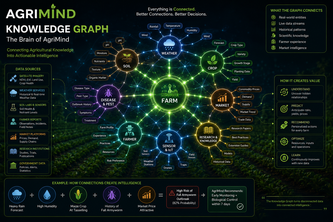
AGRIMIND is described as an AI-powered agricultural intelligence platform built by a single developer (Ronny Ochieng), a Computer Science student and farmer from Kenya. The system integrates multiple agricultural data sources — weather, satellite imagery, soil conditions, market prices, research reports, and farm observations — into a unified framework using a Knowledge Graph architecture and Graph Neural Networks (GNNs). It is designed to transform fragmented data into actionable insights for farmers, researchers, agribusinesses, and policymakers.
What changed
The author states that this project was built as part of the OpenAI 2026 hackathon. The description indicates a prototype or proof-of-concept system, not yet deployed in production.
Single most important open question
Is there evidence of real-world adoption, data integration, or traction from farmers or agricultural stakeholders beyond the author’s own development efforts?
What The Product Actually Is
The description states that AGRIMIND is an agricultural intelligence platform built using full-stack technologies including Next.js, React, TypeScript, and OpenAI APIs. It uses:
- Knowledge Graph architecture
- Graph Neural Networks (GNNs)
- AI Agents
- Data integration from multiple sources
It is described as a system that observes agricultural data, stores it in a Knowledge Graph, applies AI reasoning and prediction models, and outputs actionable insights.
Inference The system appears to be conceptual or prototype-level. It does not appear to have been deployed for real-world use at the time of submission.
Positioning & Claim Evolution
The author positions AGRIMIND as an intelligent machine that functions like a human mind, aimed at connecting fragmented agricultural knowledge and transforming it into actionable intelligence.
Key claims:
- The platform connects multiple data domains (weather, satellite, soil, market, research) into one system.
- It uses advanced AI techniques such as GNNs and Knowledge Graphs to reason over relationships.
- It aims to become the Intelligence Layer for African Agriculture.
- The vision includes building a digital brain for agriculture with capabilities like risk prediction, disease forecasting, and climate resilience intelligence.
Inference This is a strategic positioning toward becoming an infrastructure-level tool for agricultural decision-making in Africa. However, no evidence of actual deployment or adoption exists.
Target Customer & ICP
The description states that AGRIMIND targets:
- Farmers
- Researchers
- Agribusinesses
- Policymakers
It also mentions a vision to support governments and agribusinesses with decision support systems.
Inference The target customer segments are broad, but the author does not specify how they would be reached or whether any have been engaged. There is no evidence of segmentation or prioritization.
Business Model & Pricing Evidence
There is no evidence in the description of a business model or pricing strategy. The author mentions future capabilities such as:
- Intelligence-as-a-Service APIs
- Decision support systems for governments and agribusinesses
But no details are provided about monetization, pricing tiers, or customer acquisition.
Technical & Delivery Signals
The system is built using modern web technologies:
- Frontend: Next.js, React, TypeScript
- Backend: Python, JavaScript, Java
- AI/ML tools: OpenAI APIs, GNNs, Knowledge Graphs, AI Agent frameworks
It includes:
- Data integration layer
- Knowledge Graph architecture
- Graph Neural Network visualization
- Interactive dashboards
Inference The technical stack suggests a full-stack AI platform with some advanced features. However, the description does not indicate whether this is production-ready or has been tested in real-world settings.
Traction & Maturity Signals
The author states:
- AGRIMIND was built as part of a hackathon.
- It includes a working prototype.
- It integrates multiple data sources and uses AI concepts like GNNs and Knowledge Graphs.
- The author is proud of accomplishments such as designing the Knowledge Graph, integrating AI agents, and creating visualizations.
Not evidenced
There is no mention of:
- Real users or customers
- Revenue or monetization
- Deployment in production
- Feedback from farmers or stakeholders
Competitive Context
The description does not reference any competitors. It focuses on AGRIMIND’s unique approach using Knowledge Graphs and GNNs to connect agricultural data.
Inference While the approach is novel, there is no evidence of existing comparable platforms or market analysis.
Open Questions & Risks
- Single-person team: Only one developer (Ronny Ochieng) is listed.
- No traction or customers: No evidence of real-world usage or adoption.
- Unverified claims: The platform is described as a "working prototype" but no data on performance, accuracy, or impact.
- Unclear path to market: No mention of go-to-market strategy, partnerships, or distribution channels.
- Lack of business model clarity: No indication of how the product will be monetized.
Questions the description leaves open
- What specific agricultural data sources are currently integrated, and how is that data being collected?
- Has the system been tested with actual farmers or agricultural stakeholders? If so, what were the results?
- How does AGRIMIND plan to scale beyond a single developer’s effort?
- What is the current status of the platform — prototype, pilot, or deployed?
- Are there any partnerships or collaborations with agribusinesses, governments, or research institutions?
- How will the platform be monetized? Is there a pricing model or revenue plan in place?
- What are the key technical challenges that remain unresolved before full deployment?
Overall Assessment
Not evidenced
There is no evidence of:
- Revenue
- Customers
- Traction
- Market validation
- Business model
- Product-market fit
The description presents a compelling vision and technical architecture, but it remains a self-reported prototype or hackathon project, not a validated business. The author’s claims about AI agents, GNNs, and Knowledge Graphs are described as part of the system, but there is no evidence that they have been implemented in a way that delivers real value to users.
Confidence Level Low This analysis is based entirely on self-reported information with no external validation or data points. Any inference must be treated as speculative until further evidence is provided.
User Stories BotA demo video on every pull request
Get a demo video on every new feature
GitHub App that watches your pull requests and records a narrated, captioned demo.
Save time on demo prep and make informed decisions faster with a video walkthrough of every new feature.
Source
Submitted to the OpenAI 2026 hackathon on Devpost. Project home on Devpost. Back to the full gallery on Devpost.
This competitive analysis was produced by top-founders.com (opens in a new tab)
Generated by a language model from this project's public Devpost page — its tagline, the author's own write-up and any built-with tags listed there — as captured in August 2026. Short quotations are the author's words. It is an opinion on the idea as a business, not on the people behind it, and it reflects the description as published then. If the project has moved on, request a correction below. The analysis is not independent research and contains no verified traction, revenue or customer data.
An independent guide by KFG International LLC — not affiliated with, endorsed by, or connected to Devpost or OpenAI.