

Archive position — measured, not model output
2 likes on Devpost
221 of the 7,850 archived projects have more likes, and 284 share exactly 2 — so this project's #472 place in the like-ranked listing is a tie-break inside that group, not a ranking.
Projects (log scale)
Likes on Devpost. ▲ marks this project's group.
Show the figures
| Likes | Projects | Share of archive |
|---|---|---|
| 0 | 5,587 | 71.2% |
| 1 | 1,758 | 22.4% |
| 2 | 284 | 3.6% |
| 3–4 | 132 | 1.7% |
| 5–9 | 75 | 1.0% |
| 10+ | 14 | 0.2% |
 User Stories BotA demo video on every pull request
Get a demo video on every new feature
GitHub App that watches your pull requests and records a narrated, captioned demo.
Save time on demo prep and make informed decisions faster with a video walkthrough of every new feature.
Executive Summary
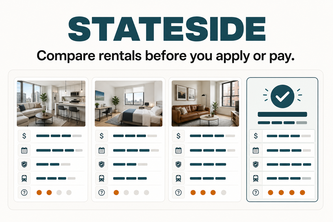
What the company appears to be: Stateside is a self-reported tool for international students in the U.S. to compare rental housing options. It claims to aggregate scattered information from listings, landlords, and university resources into one view, helping students make informed decisions before applying or paying.
What changed: The project was submitted as part of an OpenAI 2026 hackathon. It is described as a demo-only web application built with Next.js, React, TypeScript, and GPT-5.6, using structured outputs to interpret rental data.
Single most important open question: Does Stateside have any evidence of traction, revenue, or customer adoption beyond the author’s own demonstration?
What The Product Actually Is
The description states that Stateside is a housing comparison and preparation tool for international students renting in the U.S. It brings together information from rental listings, landlord messages, university resources, and lease terms into one clear view.
It helps students compare costs, qualification requirements, lease dates, photos, transportation, and missing information before applying or paying. The product does not function as a marketplace but rather as a decision and preparation layer that students use after finding listings and before committing.
The demo uses a researched UC Berkeley graduate student scenario, comparing three public rental listings. It is built using Next.js, React, TypeScript, and integrates with GPT-5.6 for structured interpretation of unstructured data.
It is described as a responsive web application that leads users through three stages: understanding needs, comparing places, and reviewing next steps.
Positioning & Claim Evolution
The author states that Stateside was inspired by their own experience searching for housing as an international student. The core claim is that international students face scattered, incomplete rental information, and that Stateside brings this into one clear comparison.
It positions itself not as a marketplace or platform but as a decision support tool. It avoids making guarantees about approval, legitimacy, or safety, instead focusing on helping users understand what they should verify before applying.
The author emphasizes that the product is designed to slow down decision-making, organize evidence, and explain tradeoffs rather than produce scores or declare one listing best.
It also claims to be a decision and preparation layer that students can use after finding listings but before making commitments. The tool does not earn revenue from bookings, which allows it to recommend pausing when important information remains unresolved.
Target Customer & ICP
The description states that Stateside is intended for international students renting in the United States. These students are described as often being unfamiliar with U.S. rental practices and may lack credit history, SSNs, or local income.
They are also said to arrive without a domestic guarantor and may be navigating housing decisions with limited prior experience.
The demo focuses on a UC Berkeley graduate student scenario, suggesting the initial target is graduate students at universities in the Bay Area. The author mentions future expansion to more schools, implying a potential ICP of international students across U.S. universities.
There is no evidence of segmentation beyond this group or any indication of other personas or verticals.
Business Model & Pricing Evidence
The description does not contain any information about pricing, monetization, or business model. It states that Stateside is not a rental marketplace, and it does not guarantee approval, legitimacy, or safety.
It also says the tool does not earn revenue from bookings, which implies no direct transactional income model. No mention of subscriptions, freemium tiers, or paid features is provided.
There is no evidence of any commercial activity beyond the demo.
Technical & Delivery Signals
Stateside is built using:
- Next.js
- React
- TypeScript
- Tailwind CSS
- Node.js
- GPT-5.6 (via OpenAI API)
- Structured outputs for interpreting messy data
- Deterministic application code for arithmetic and date calculations
The product is described as a responsive web application, designed around calm, accessible decision-making.
It uses structured output schemas to interpret listing descriptions, landlord messages, and lease information. It separates confirmed facts from inferences and identifies what still needs verification.
For the demo, results were generated from researched Berkeley listing records saved as fixtures, not live network requests.
Traction & Maturity Signals
There is no evidence of traction or adoption beyond the author’s own demonstration. The project is described as a demo-only tool, and it works without an account, payment information, personal documents, or live inventory access.
No data on users, usage metrics, revenue, or customer engagement is provided.
The demo is said to be responsive, tested, and designed for judges at a hackathon, not for real-world deployment or scaling.
Competitive Context
The description does not mention any competitors. It states that the team learned that rental marketplaces are already effective at helping people discover inventory, and that their opportunity lies in helping students evaluate listings gathered from different sources.
It is unclear whether Stateside directly competes with existing housing platforms or if it operates in a complementary space.
No evidence of competitive positioning, pricing strategies, or differentiation from other tools is provided.
Open Questions & Risks
- No traction or revenue: The tool exists only as a demo and has no evidence of real-world usage.
- Unverified claims: All statements are self-reported and unverified; there is no third-party validation.
- Limited scope: The current version works with pre-researched data, not live inputs from users.
- No monetization model: No indication of how the product will generate revenue or sustain itself.
- Dependency on AI hallucination risk: Reliance on GPT-5.6 for structured interpretation raises concerns about accuracy and consistency without real-world testing.
- Lack of scalability: The demo is built for a single university scenario; no evidence of plans to scale beyond the Bay Area.
Questions the description leaves open
- What specific data sources does Stateside currently support, and how are they integrated?
- How does the product handle discrepancies or inconsistencies in user-provided data?
- Are there any plans for user accounts, saved comparisons, or multi-device sync?
- What is the roadmap for expanding beyond the Bay Area and into other universities?
- Has the team considered legal or liability implications of offering advice on rental decisions?
- How does Stateside plan to monetize if it doesn’t earn from bookings?
- What are the technical limitations of relying on GPT-5.6 for structured interpretation?
- Are there any partnerships with universities, housing offices, or student services already in place?
Overall Assessment
The description indicates that Stateside is a demo-only project submitted to a hackathon, with no evidence of traction, revenue, or customer adoption.
It is described as a decision and preparation tool for international students, built using modern web technologies and AI integration. However, it lacks any commercial viability indicators, including pricing, monetization, or user engagement data.
Given the lack of verified evidence of real-world usage or business model, this project does not currently meet criteria for investment or partnership consideration based on the self-reported information alone.
Confidence level: Low — the entire analysis is based on a single unverified description.
User Stories BotA demo video on every pull request
Get a demo video on every new feature
GitHub App that watches your pull requests and records a narrated, captioned demo.
Save time on demo prep and make informed decisions faster with a video walkthrough of every new feature.
Source
Submitted to the OpenAI 2026 hackathon on Devpost. Project home on Devpost. Back to the full gallery on Devpost.
This competitive analysis was produced by top-founders.com (opens in a new tab)
Generated by a language model from this project's public Devpost page — its tagline, the author's own write-up and any built-with tags listed there — as captured in August 2026. Short quotations are the author's words. It is an opinion on the idea as a business, not on the people behind it, and it reflects the description as published then. If the project has moved on, request a correction below. The analysis is not independent research and contains no verified traction, revenue or customer data.
An independent guide by KFG International LLC — not affiliated with, endorsed by, or connected to Devpost or OpenAI.