

Archive position — measured, not model output
0 likes on Devpost
2,263 of the 7,850 archived projects have more likes, and 5,587 share exactly 0 — so this project's #6,920 place in the like-ranked listing is a tie-break inside that group, not a ranking.
Projects (log scale)
Likes on Devpost. ▲ marks this project's group.
Show the figures
| Likes | Projects | Share of archive |
|---|---|---|
| 0 | 5,587 | 71.2% |
| 1 | 1,758 | 22.4% |
| 2 | 284 | 3.6% |
| 3–4 | 132 | 1.7% |
| 5–9 | 75 | 1.0% |
| 10+ | 14 | 0.2% |
 User Stories BotA demo video on every pull request
Get a demo video on every new feature
GitHub App that watches your pull requests and records a narrated, captioned demo.
Save time on demo prep and make informed decisions faster with a video walkthrough of every new feature.
Executive Summary
What the company appears to be
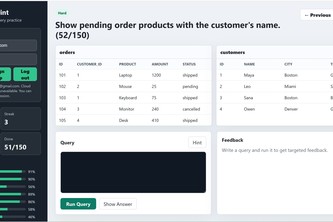
SQL Sprint is a self-reported adaptive SQL learning platform designed for individuals seeking to improve their SQL skills through rapid-fire practice drills with clause-level feedback. The author describes it as an educational tool that detects weak topics and personalizes practice sessions.
What changed
The project was submitted as part of the OpenAI 2026 hackathon, indicating a recent development phase. It is described as a solo effort built over a short timeframe using tools like Codex, Supabase, and Vercel.
Single most important open question
Is there evidence of user adoption or engagement beyond the author's own use and development?
What The Product Actually Is
The description states that SQL Sprint is an adaptive SQL learning platform with:
- 150 rapid-fire practice drills
- Browser-based SQL query writing
- Clause-level feedback on mistakes in SELECT, FROM, WHERE, JOIN, GROUP BY, ORDER BY, and other SQL concepts
- Tracking of performance metrics such as score, streak, accuracy, solved questions, missed questions, hint use, and performance by SQL topic
- Adaptive Practice Mode that detects weak topics and creates personalized practice sessions from validated SQL questions
The author reports building it using:
- HTML, CSS, JavaScript
- Supabase (for login and saved progress)
- Vercel (deployment)
- Codex (assistance in designing the SQL evaluator, feedback system, curriculum, etc.)
Inference The product appears to be a browser-based educational tool for SQL learners, built as a prototype or MVP with no external validation or user data.
Positioning & Claim Evolution
The author claims that SQL Sprint:
- Is inspired by tools like Power BI that give targeted feedback when formulas are wrong
- Provides a similar learning experience for SQL: short practice questions, immediate feedback, and clear guidance on the exact part of a query that needs fixing
- Was developed to address personal struggles with identifying specific parts of a query that were incorrect
Inference The positioning is that of an adaptive, personalized SQL learning platform, aiming to improve learner engagement by offering precise feedback. However, this is a self-reported claim without evidence of traction or user validation.
Target Customer & ICP
The description does not explicitly name target customers or define an Ideal Customer Profile (ICP). It implies the product targets individuals learning SQL, particularly those who struggle with identifying errors in their queries.
Inference The likely audience includes beginner to intermediate SQL learners, possibly students or professionals seeking skill development. No evidence of segmentation or targeting beyond this general category.
Business Model & Pricing Evidence
There is no information provided about pricing, monetization, or business model. The author does not mention any revenue streams, subscriptions, or paid features.
Not evidenced
Technical & Delivery Signals
The product was built with:
- Frontend: HTML, CSS, JavaScript
- Backend/Database: Supabase (handles login and saved progress)
- Deployment: Vercel
- AI Tooling: Codex used for SQL evaluator design, feedback rules, curriculum creation, and integration
Inference The technical stack suggests a lightweight, browser-based prototype, likely built in a short timeframe. Supabase is used for user management and progress tracking, while Codex was leveraged to assist in building core logic.
Traction & Maturity Signals
The description states:
- It is a solo project by Anna Olalere
- Built as part of a hackathon submission (OpenAI 2026)
- Contains 150 practice drills
- Tracks user performance metrics
Not evidenced No evidence of actual users, usage data, or product adoption beyond the author’s own development and testing.
Competitive Context
The description does not mention competitors or market positioning. It references Power BI as an inspiration for feedback mechanisms but does not compare SQL Sprint to existing platforms like Khan Academy, Mode Analytics, or other SQL learning tools.
Not evidenced
Open Questions & Risks
- Solo development: Only one team member is mentioned, which raises questions about scalability and long-term maintenance.
- No user data or traction: The product has no demonstrated adoption or usage metrics.
- Unverified claims: All descriptions are self-reported without external validation.
- Limited scope: The platform appears to be a prototype with 150 drills, not a full-fledged learning platform.
- Dependency on AI tooling: Reliance on Codex for development may indicate lack of in-house technical depth or scalability concerns.
Questions the description leaves open
- What is the actual user base or engagement level beyond your own use?
- How do you plan to scale beyond a single developer and 150 drills?
- Have you validated the effectiveness of the adaptive practice mode with real users?
- Are there any plans for monetization or pricing models?
- What are the technical limitations of the current implementation, especially around SQL parsing and feedback accuracy?
Overall Assessment
Not evidenced
The project is described as a hackathon submission by one person and lacks any evidence of traction, revenue, customers, or validated market demand. It appears to be an early-stage prototype with no commercial viability demonstrated.
Confidence Level Low
Reasoning
The entire analysis is based on self-reported information without external validation or metrics. Any claims about product effectiveness, user engagement, or business model are unproven.
User Stories BotA demo video on every pull request
Get a demo video on every new feature
GitHub App that watches your pull requests and records a narrated, captioned demo.
Save time on demo prep and make informed decisions faster with a video walkthrough of every new feature.
Source
Submitted to the OpenAI 2026 hackathon on Devpost. Project home on Devpost. Back to the full gallery on Devpost.
This competitive analysis was produced by top-founders.com (opens in a new tab)
Generated by a language model from this project's public Devpost page — its tagline, the author's own write-up and any built-with tags listed there — as captured in August 2026. Short quotations are the author's words. It is an opinion on the idea as a business, not on the people behind it, and it reflects the description as published then. If the project has moved on, request a correction below. The analysis is not independent research and contains no verified traction, revenue or customer data.
An independent guide by KFG International LLC — not affiliated with, endorsed by, or connected to Devpost or OpenAI.