

Archive position — measured, not model output
1 like on Devpost
505 of the 7,850 archived projects have more likes, and 1,758 share exactly 1 — so this project's #1,033 place in the like-ranked listing is a tie-break inside that group, not a ranking.
Projects (log scale)
Likes on Devpost. ▲ marks this project's group.
Show the figures
| Likes | Projects | Share of archive |
|---|---|---|
| 0 | 5,587 | 71.2% |
| 1 | 1,758 | 22.4% |
| 2 | 284 | 3.6% |
| 3–4 | 132 | 1.7% |
| 5–9 | 75 | 1.0% |
| 10+ | 14 | 0.2% |
 User Stories BotA demo video on every pull request
Get a demo video on every new feature
GitHub App that watches your pull requests and records a narrated, captioned demo.
Save time on demo prep and make informed decisions faster with a video walkthrough of every new feature.
Executive Summary
What the company appears to be
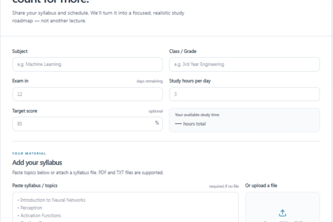
Exam Compass is a self-reported AI-powered study planner for students. The author states it helps students prioritize syllabus topics and create day-by-day study roadmaps based on time constraints, subject matter, and personal goals.
What changed
This is a single-person project submitted to the OpenAI 2026 hackathon. It was built over a short period (likely a hackathon timeframe) using Next.js, TypeScript, Tailwind CSS, and OpenAI’s API. No prior version or commercial product exists beyond this prototype.
The single most important open question
Is there any evidence of user adoption, revenue, or traction beyond the author's own submission? The description contains no data on users, usage, monetization, or market validation.
Note: This analysis is based entirely on the self-reported project description provided by the author. No external verification or historical data is available. All claims are stated by the author and not independently confirmed.
What The Product Actually Is
The description states that Exam Compass is an AI-powered study strategist designed to help students create optimized study roadmaps. It allows users to input:
- Subject
- Class or Grade
- Days remaining until exam
- Available study hours per day
- Optional target score
- Syllabus (via paste, PDF, or TXT upload)
The system extracts text from uploaded files, combines it with user inputs, and sends them to an AI model (GPT-5.6) to generate:
- Estimated study coverage
- Priority-ranked topics
- Day-by-day learning plan
- Revision strategy
- Personalized study tips
It also supports exporting the roadmap as a PDF and includes UI features like dark mode, regeneration, copying results, and error handling.
Inference: The tool appears to be a web-based prototype built for personal use or hackathon demonstration. It is not described as a commercial product or platform with ongoing users.
Positioning & Claim Evolution
The author claims that Exam Compass was inspired by the question:
“Given the time I have left, what is the smartest way to study my syllabus?”
This positions the tool as an AI-powered prioritization engine for students who are short on time but want structured guidance.
It distinguishes itself from generic planners and chatbots by focusing on optimizing study time rather than teaching content or creating schedules without context.
Claim: The product aims to be a smart, time-aware study strategist.
Not evidenced: There is no mention of how it differentiates from other tools, nor whether it has evolved beyond its initial prototype form.
Target Customer & ICP
The description states that the tool targets students preparing for exams who have limited time but no clear way to prioritize their syllabus.
It does not specify grade levels, subjects, or geographic markets. The author mentions “Class or Grade” as an input field, suggesting a broad educational audience.
Claim: Students needing exam preparation support.
Not evidenced: No segmentation, personas, or customer interviews are described. There is no indication of whether the tool has been tested with real students or used in classrooms.
Business Model & Pricing Evidence
The project description does not include any information about pricing, monetization, or business model.
It is presented as a hackathon submission and lacks evidence of paid features, subscriptions, or revenue streams.
Not evidenced: No indication of how the tool would be sold or who would pay for it.
Technical & Delivery Signals
The author reports building Exam Compass with:
- Next.js
- TypeScript
- Tailwind CSS
- shadcn/ui
- OpenAI GPT-5.6 (Responses API)
Key technical elements include:
- Server-side PDF/TXT extraction
- Structured JSON outputs from AI responses
- Typed API routes in Next.js
- Responsive UI states for loading, errors, and results
- Downloadable PDF export functionality
Inference: The tool is a functional prototype built with modern web stack and AI integration.
Not evidenced: No production deployment details, scalability considerations, or performance metrics are provided.
Traction & Maturity Signals
There is no evidence of traction, adoption, or user engagement beyond the author’s own submission.
The project was submitted to a hackathon, indicating it is likely in early development or prototype stage.
Not evidenced: No data on active users, usage frequency, retention, or feedback from students.
Competitive Context
The description does not reference competitors or existing tools in the space.
It implies that current solutions either offer generic schedules or focus too heavily on teaching rather than prioritizing.
Inference: The tool may compete with general study planners or AI tutoring platforms, but no competitive analysis is given.
Open Questions & Risks
- No commercial traction or revenue: The project is a hackathon submission with no evidence of market validation.
- Single-person development: No team, no external contributors, and no indication of ongoing support or iteration.
- Unclear AI reliability: While the author mentions structured prompts and JSON outputs, there is no demonstration of how well the AI actually performs in practice.
- Limited scope: The tool only supports syllabus input via text or file upload; no integration with LMS or other platforms.
- Unverified claims: All features are self-reported without independent verification.
Not evidenced: No data on user satisfaction, accuracy of AI outputs, or long-term viability.
Questions the description leaves open
- What is the actual performance of the AI in generating study roadmaps? How often do generated plans fail to align with available time?
- Have you tested this tool with real students? If so, what were their reactions and how did they use it?
- Is there any plan for scaling beyond a single-person prototype? What would that look like?
- Are there any existing users or pilot programs?
- How do you intend to monetize the product if at all?
- What are the key assumptions behind your AI prompt design and how were they validated?
Overall Assessment
Not evidenced: There is no evidence of a viable business, customer base, or scalable model.
Confidence level: Very low — this is a single-person hackathon project with no commercial traction or data to support investment or partnership interest.
Conclusion: Based on the self-reported description alone, Exam Compass appears to be an early-stage prototype that has not yet demonstrated product-market fit, user adoption, or monetization potential. It should not be considered for due diligence unless further evidence of traction or development is provided.
User Stories BotA demo video on every pull request
Get a demo video on every new feature
GitHub App that watches your pull requests and records a narrated, captioned demo.
Save time on demo prep and make informed decisions faster with a video walkthrough of every new feature.
Source
Submitted to the OpenAI 2026 hackathon on Devpost. Project home on Devpost. Back to the full gallery on Devpost.
This competitive analysis was produced by top-founders.com (opens in a new tab)
Generated by a language model from this project's public Devpost page — its tagline, the author's own write-up and any built-with tags listed there — as captured in August 2026. Short quotations are the author's words. It is an opinion on the idea as a business, not on the people behind it, and it reflects the description as published then. If the project has moved on, request a correction below. The analysis is not independent research and contains no verified traction, revenue or customer data.
An independent guide by KFG International LLC — not affiliated with, endorsed by, or connected to Devpost or OpenAI.