

Archive position — measured, not model output
0 likes on Devpost
2,263 of the 7,850 archived projects have more likes, and 5,587 share exactly 0 — so this project's #6,921 place in the like-ranked listing is a tie-break inside that group, not a ranking.
Projects (log scale)
Likes on Devpost. ▲ marks this project's group.
Show the figures
| Likes | Projects | Share of archive |
|---|---|---|
| 0 | 5,587 | 71.2% |
| 1 | 1,758 | 22.4% |
| 2 | 284 | 3.6% |
| 3–4 | 132 | 1.7% |
| 5–9 | 75 | 1.0% |
| 10+ | 14 | 0.2% |
 User Stories BotA demo video on every pull request
Get a demo video on every new feature
GitHub App that watches your pull requests and records a narrated, captioned demo.
Save time on demo prep and make informed decisions faster with a video walkthrough of every new feature.
Executive Summary
What the company appears to be
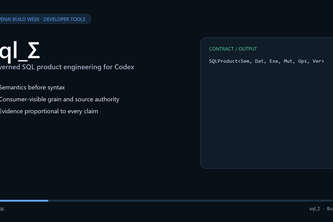
The project described as sql_Σ is an AI-first Codex Skill for governed SQL product engineering. It aims to improve SQL generation by enforcing semantic, data, execution, mutation, operations, and verification constraints on code before it is approved or executed.
What changed
This is a self-reported submission to the OpenAI 2026 hackathon, built over a few days during the competition period. The author states that prior internal iterations led to consolidation into a single installable Skill, with rules raised from incident classes into typed product dimensions and admission invariants.
Single most important open question
Is there evidence of real-world usage or traction beyond this one-off hackathon submission? The description does not indicate any revenue, customers, or adoption outside the author’s own demonstration.
Note
This analysis is based entirely on the self-reported project description provided by the caller. No external verification or historical data is available. All claims are treated as stated by the author and not proven.
What The Product Actually Is
The description states that sql_Σ is an AI-first Codex Skill for governed SQL product engineering. It reconstructs a SQL product contract across six dimensions:
- Semantics
- Data
- Execution
- Mutation
- Operations
- Verification
It is described as a tool that does not merely validate syntax but enforces meaning, authority, and evidence-based claims in generated SQL code.
The author says it was built using Codex, with GPT-5.6, and uses a compact ontology rather than a catalog of preferred snippets. It gives direction to Codex while leaving engine-specific choices to the actual contract and evidence.
It includes:
- A synthetic SQL Server challenge
- An independent oracle for comparison
- A deterministic verifier
- An audit-pack generator
Inference The product is not a standalone SaaS offering but a skill or plugin intended for use within Codex environments. It is not described as a commercial product, nor does it appear to be available for general consumption beyond the author’s own demonstration.
Positioning & Claim Evolution
The description states that sql_Σ was built to address failures above syntax, such as incorrect grain, hardcoded business logic, silent data loss, and improper field sizing. It positions itself as a way to turn plausible SQL generation into a consumer-visible, authority-aware, evidence-backed data product.
It claims to:
- Prevent common SQL refactoring failures
- Enforce semantic correctness without prescribing specific constructs (e.g., CTEs, temp tables)
- Reduce unnecessary durable objects and technical overhead
Claim
The project positions itself as an AI-driven SQL governance tool that improves quality by enforcing product-level constraints.
Inference It evolved from internal iterations into a single installable skill during the hackathon period. There is no indication of prior commercialization or broader market traction.
Target Customer & ICP
The description does not name specific customers or personas. However, it implies that the target is developers or data engineers working with SQL, especially those using AI-assisted tools like Codex.
It targets users who:
- Generate or review SQL code
- Are concerned about product correctness over syntactic validity
- Want to avoid common pitfalls in SQL refactoring
Inference The ICP appears to be technical users of AI-assisted development environments, particularly those working with SQL and data pipelines. No explicit segmentation beyond this is provided.
Business Model & Pricing Evidence
There is no evidence of a business model or pricing structure in the description. It is presented as a hackathon submission and not described as a commercial product or service.
Not evidenced
Technical & Delivery Signals
The project is built with:
- Codex
- GPT-5.6
- Python
- SQL / T-SQL
It uses:
- A compact ontology instead of a catalog of preferred snippets
- A deterministic verifier for package structure, references, and syntax
- An audit-pack generator
- A synthetic challenge with an independent oracle
The author notes that the demo repairs product semantics without creating helper objects or unnecessary infrastructure.
Inference The tool is built as a skill or plugin to be used within AI-assisted development environments. It is not described as a standalone SaaS or CLI tool.
Traction & Maturity Signals
There is no evidence of traction, revenue, customers, or adoption beyond the author’s own demonstration and internal iterations.
The project was submitted to a hackathon, and the description explicitly states that it was built during a short competition period. It does not indicate any ongoing product development or market presence.
Not evidenced
Competitive Context
There is no mention of competitors or existing tools in the description. The author does not reference other SQL governance, AI-assisted coding, or data engineering platforms.
Not evidenced
Open Questions & Risks
- No commercial traction: The project is presented as a hackathon submission with no evidence of real-world use.
- Unproven adoption: There is no indication that the tool has been adopted by others or integrated into production workflows.
- Limited scope: It appears to be a narrow-purpose skill for Codex environments, not a general-purpose product.
- Self-reported only: All claims are unverified and based solely on the author’s own account.
Inference The risk of misalignment with market needs is high if there is no evidence of real-world demand or usage beyond the author’s own testing.
Questions the description leaves open
- What was the actual outcome of using this tool in a real SQL development workflow?
- Has it been tested on any production-like datasets or environments?
- Are there any plans to commercialize this skill, and if so, how?
- How does it integrate with existing data engineering or AI-assisted development tools beyond Codex?
- What are the key limitations of the current version that would prevent broader adoption?
Overall Assessment
There is no evidence of a functioning product, revenue, customers, or traction beyond the author’s own demonstration.
The project is presented as a hackathon submission, not a commercial offering. It lacks any indication of market validation or scalability.
Assessment Not suitable for investment or partnership at this stage. The project shows potential in concept but has no demonstrated product-market fit or commercial viability.
User Stories BotA demo video on every pull request
Get a demo video on every new feature
GitHub App that watches your pull requests and records a narrated, captioned demo.
Save time on demo prep and make informed decisions faster with a video walkthrough of every new feature.
Source
Submitted to the OpenAI 2026 hackathon on Devpost. Project home on Devpost. Back to the full gallery on Devpost.
This competitive analysis was produced by top-founders.com (opens in a new tab)
Generated by a language model from this project's public Devpost page — its tagline, the author's own write-up and any built-with tags listed there — as captured in August 2026. Short quotations are the author's words. It is an opinion on the idea as a business, not on the people behind it, and it reflects the description as published then. If the project has moved on, request a correction below. The analysis is not independent research and contains no verified traction, revenue or customer data.
An independent guide by KFG International LLC — not affiliated with, endorsed by, or connected to Devpost or OpenAI.