

Archive position — measured, not model output
0 likes on Devpost
2,263 of the 7,850 archived projects have more likes, and 5,587 share exactly 0 — so this project's #2,997 place in the like-ranked listing is a tie-break inside that group, not a ranking.
Projects (log scale)
Likes on Devpost. ▲ marks this project's group.
Show the figures
| Likes | Projects | Share of archive |
|---|---|---|
| 0 | 5,587 | 71.2% |
| 1 | 1,758 | 22.4% |
| 2 | 284 | 3.6% |
| 3–4 | 132 | 1.7% |
| 5–9 | 75 | 1.0% |
| 10+ | 14 | 0.2% |
 User Stories BotA demo video on every pull request
Get a demo video on every new feature
GitHub App that watches your pull requests and records a narrated, captioned demo.
Save time on demo prep and make informed decisions faster with a video walkthrough of every new feature.
Executive Summary
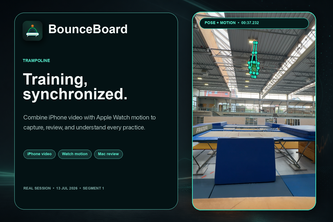
BounceBoard is a self-reported local-first training workflow for trampoline gymnastics, built by a solo developer (Vincent Wack) using Apple devices and AI tools like Codex and GPT-5.6. The product enables athletes and coaches to record synchronized video, sensor data, and pose analysis from an iPhone, Apple Watch, and Mac, with the goal of creating shared evidence for training without replacing human coaching.
The author states that BounceBoard is a prototype built during a hackathon, using Apple Vision for local pose detection and integrating motion data from the Watch. It includes features like clock alignment, multi-pass recovery of poses, and human-reviewed labels to maintain trust in automated outputs.
Key commercial due-diligence read
The description does not provide evidence of revenue, customers, or adoption beyond the author’s own development experience. There is no indication of a product-market fit, pricing model, or business traction. The project appears to be an experimental prototype with limited commercial evidence.
What The Product Actually Is
The description states that BounceBoard is:
- A local-first trampoline training workflow across Apple Watch, iPhone, and Mac.
- It uses:
- Apple Watch to record workout, accelerometer, and device-motion data.
- iPhone to control practice, record synchronized video, align clocks, and receive Watch recordings.
- macOS Review Hub to bring together video, sensor signals, pose analysis, and annotations into a timeline.
- The system supports:
- Synchronized recording across devices.
- Local Apple Vision-based 2D pose extraction.
- Human review of skill intervals and athlete identity.
- Automated suggestions that are not treated as final until confirmed by a coach.
- Data remains on user devices unless explicitly exported.
Inference: The system is designed to support a coach’s workflow, not replace it. It emphasizes shared evidence and documentation over automation.
Positioning & Claim Evolution
The author states:
- BounceBoard is built by a coach, with Codex, for athletes and coaches.
- It aims to make training easier to document, with an automated training diary and trustworthy practice history.
- The system is not meant to replace a coach, but to give better shared evidence.
Inference: The positioning is that of a coaching assistant tool, not a standalone automation or performance analytics platform. It is framed as a way to improve documentation and communication, not to drive performance gains directly.
Target Customer & ICP
The description states:
- BounceBoard is built for athletes and coaches in trampoline gymnastics.
- The author has experience as both an athlete (national level) and coach.
- It is designed for practical use with everyday Apple devices (iPhone, Apple Watch, Mac).
Inference: The ICP appears to be coaches and athletes in niche sports, particularly those using Apple ecosystems. The product is not positioned for mass market or general fitness.
Business Model & Pricing Evidence
The description does not state:
- Any pricing model.
- Revenue streams.
- Monetization strategy.
- Customer acquisition plans.
Not evidenced: No evidence of a business model, pricing, or monetization strategy beyond the author’s own development use case.
Technical & Delivery Signals
The description states:
- Built with Codex and GPT-5.6 as development-time collaborators (not used at runtime).
- Uses Apple technologies:
- HealthKit, Core Motion, WatchConnectivity, AVFoundation, Apple Vision, GRDB/SQLite, SwiftUI, Swift.
- Implements a two-pass recovery pipeline for pose detection using alternative orientations.
- Includes clock alignment, reliable transfer protocols, and human-reviewed labels.
- The system is designed to preserve reliability over performance.
Inference: The technical approach emphasizes reliability, privacy, and multimodal sensor fusion, with a focus on robustness in edge computing environments. It is not a cloud-based or AI-as-a-service solution.
Traction & Maturity Signals
The description states:
- BounceBoard was built during a hackathon (OpenAI 2026).
- The author has no external users beyond personal testing.
- No revenue, customers, or adoption data are provided.
- It is described as a working prototype, not a commercial product.
Not evidenced: No evidence of traction, user base, or commercial adoption. The project is self-reported as experimental and not yet deployed in real-world settings.
Competitive Context
The description does not state:
- Any competitors.
- Market size or competitive landscape.
- Existing tools for trampoline training or gymnastics analytics.
Not evidenced: No competitive analysis or market positioning beyond the author’s own claims.
Open Questions & Risks
The description states:
- The system is not yet tested with real athletes and coaches, only in development.
- It is a solo-developer project (1-person team).
- Reliability was a major challenge, with issues around device synchronization and data loss.
- No large public datasets exist for trampoline gymnastics, so automation is limited.
Inference: Key risks include:
- Lack of real-world testing.
- Limited scalability or commercial viability due to niche market.
- Dependency on Apple ecosystem and developer tools (Codex, GPT).
- Risk of over-engineering for a small user base.
Questions the description leaves open
- What is the expected adoption rate among coaches and athletes in trampoline gymnastics?
- How does BounceBoard plan to scale beyond a solo developer’s prototype?
- Are there any plans to expand beyond Apple devices or integrate with other platforms?
- What are the key assumptions about user behavior that underpin the product design?
- Has the author considered how to monetize this tool, if at all?
- How does BounceBoard handle data privacy and consent in real-world usage?
Overall Assessment
The description states:
- BounceBoard is a self-reported prototype built during a hackathon.
- It has no commercial traction, revenue, or customer base.
- The author is the only team member.
- It is not yet deployed in real-world settings.
Not evidenced: No evidence of investment readiness, partnership potential, or commercial viability. The project is described as experimental and not yet ready for market deployment.
Assessment: Not commercially viable at this stage. The product shows technical capability but lacks evidence of traction, scalability, or monetization strategy. It may be a promising concept for further development, but not an investment or partnership opportunity in its current form.
User Stories BotA demo video on every pull request
Get a demo video on every new feature
GitHub App that watches your pull requests and records a narrated, captioned demo.
Save time on demo prep and make informed decisions faster with a video walkthrough of every new feature.
Source
Submitted to the OpenAI 2026 hackathon on Devpost. Project home on Devpost. Back to the full gallery on Devpost.
This competitive analysis was produced by top-founders.com (opens in a new tab)
Generated by a language model from this project's public Devpost page — its tagline, the author's own write-up and any built-with tags listed there — as captured in August 2026. Short quotations are the author's words. It is an opinion on the idea as a business, not on the people behind it, and it reflects the description as published then. If the project has moved on, request a correction below. The analysis is not independent research and contains no verified traction, revenue or customer data.
An independent guide by KFG International LLC — not affiliated with, endorsed by, or connected to Devpost or OpenAI.