

Archive position — measured, not model output
0 likes on Devpost
2,263 of the 7,850 archived projects have more likes, and 5,587 share exactly 0 — so this project's #2,998 place in the like-ranked listing is a tie-break inside that group, not a ranking.
Projects (log scale)
Likes on Devpost. ▲ marks this project's group.
Show the figures
| Likes | Projects | Share of archive |
|---|---|---|
| 0 | 5,587 | 71.2% |
| 1 | 1,758 | 22.4% |
| 2 | 284 | 3.6% |
| 3–4 | 132 | 1.7% |
| 5–9 | 75 | 1.0% |
| 10+ | 14 | 0.2% |
 User Stories BotA demo video on every pull request
Get a demo video on every new feature
GitHub App that watches your pull requests and records a narrated, captioned demo.
Save time on demo prep and make informed decisions faster with a video walkthrough of every new feature.
Executive Summary
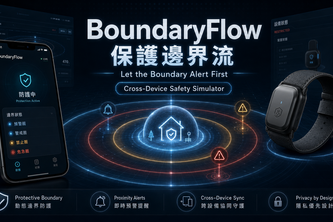
BoundaryFlow is a self-reported concept simulator for a cross-device safety system intended to transform legal restraining orders into dynamic, responsive boundaries. The project was submitted as part of the OpenAI 2026 hackathon and is described by its author as an interactive web prototype demonstrating how a future system might operate across three surfaces: a protected-person mobile app, a restricted-person wearable device, and an authorized management console.
The description states that BoundaryFlow aims to make legally authorized protection boundaries "visible, responsive, traceable, and harder to ignore" without engaging in surveillance or punitive tracking. It simulates four boundary levels (Awareness, Caution, Restricted, Critical) and includes features such as cross-device synchronization, offline event handling, and tamper detection.
The system is built using Next.js, React, TypeScript, Tailwind CSS, and SVG components, with a focus on privacy-preserving design principles. The prototype does not use live GPS or connect to real-world systems; it functions solely as an interactive demonstration layer.
Key commercial due-diligence read: The project appears to be a conceptual proof-of-concept for a safety infrastructure system. No evidence of revenue, customers, traction, or product-market fit is provided. The author's own description indicates that the current form is a "simulator" and not a deployed product. The single most important open question is whether this concept can evolve into a viable commercial offering with sufficient technical, legal, and social validation to gain adoption among stakeholders such as courts, law enforcement, or domestic violence organizations.
What The Product Actually Is
The description states that BoundaryFlow is an "app-and-wearable safety system demonstrated through an interactive cross-device web simulator."
It represents a conceptual future system composed of:
- A protected-person mobile app
- A restricted-person wearable device
- An authorized management console
- Boundary, friction, event-trace, relay, and configuration engines
The project is described as a "browser-based cross-device system simulator" built with Next.js, React, TypeScript, Tailwind CSS, and SVG components.
The system simulates how these elements would react together when distance changes between protected and restricted individuals. It includes:
- Four boundary levels: Awareness, Caution, Restricted, Critical
- Cross-device synchronization of alerts, warnings, and event logging
- Device offline events and suspected tampering scenarios
- Notification escalation and evidence timeline preservation
The description makes clear that "the web experience is the demonstration layer, not the final product form."
Positioning & Claim Evolution
The author states that BoundaryFlow began with the question: "What if the boundary could react before the violation became harm?"
It positions itself as a system that transforms a "silent restraining order" into a "dynamic, perceivable safety boundary across three coordinated product surfaces." The goal is described as making legally authorized protection boundaries "visible, responsive, traceable, and harder to ignore."
The project claims to avoid common pitfalls such as turning the concept into a "conventional dashboard," instead aiming for a system where all components feel like parts of one "living system."
The positioning emphasizes:
- Ethical design principles (no reverse location exposure, no private tracking)
- Non-punitive approach (not surveillance or punitive tracking)
- Judicial authorization only
- Auditable event records
- Simulated data only
Target Customer & ICP
The description states that BoundaryFlow is designed for:
- Protected persons (those with restraining orders)
- Restricted individuals (those subject to restraining orders)
- Authorized personnel (managers of the system)
It does not specify a clear internal customer profile beyond these three categories. The author notes that the system's "critical safety principle" is that the restricted device receives boundary warnings without revealing the protected person’s precise location.
The description makes no mention of specific market segments, user personas, or customer acquisition strategies.
Business Model & Pricing Evidence
Not evidenced.
The description does not contain any information about pricing models, monetization strategies, revenue streams, or business model assumptions. There is no indication of whether the system would be sold to individuals, courts, social services, or other institutions, nor how it would generate value for any potential paying customer.
Technical & Delivery Signals
The project is built with:
- Next.js
- React
- TypeScript
- Tailwind CSS
- SVG-driven boundary visualization
- Vercel deployment
It uses reusable SVG and React components to generate the live boundary field, which is described as being "generated through reusable SVG and React components rather than a static image."
The system synchronizes multiple surfaces through shared simulator state that includes:
- Distance
- Current boundary level
- Protected-person app alerts
- Wearable warning states
- Vibration and indicator behavior
- Event timeline entries
- Notification relay states
- Offline and tamper scenarios
The description notes several technical challenges overcome during development, including:
- Synchronizing multiple product surfaces through one state model
- Mapping distance correctly so moving closer to the center means greater risk
- Making the boundary field responsive without allowing its geometry to drift
- Preserving privacy while still communicating proximity risk
- Making the wearable function as a real system surface rather than a decorative product image
Traction & Maturity Signals
Not evidenced.
The description makes no mention of revenue, customers, user adoption, or any form of traction. It explicitly states that the current prototype "does not use live GPS, does not connect to law enforcement or court systems, and does not send real emergency notifications." The project is described as a "simulator" and "concept simulator showing how such a future system could operate."
The author notes that this was submitted to a hackathon (OpenAI 2026) but provides no evidence of any follow-up development, pilot programs, or market validation.
Competitive Context
Not evidenced.
The description does not contain any information about existing competitive products, market positioning relative to competitors, or competitive advantages. No mention is made of similar systems in the domestic violence prevention, safety technology, or wearable device markets.
Open Questions & Risks
- Conceptual vs. commercial gap: The project is described as a "simulator" and "concept simulator," not a deployed product. There is no evidence that it has moved beyond the prototype stage.
- Legal and regulatory uncertainty: The system involves legal boundaries and court orders, which require extensive legal review and compliance before any real-world deployment. No mention of legal validation or partnerships with legal institutions.
- Privacy and security concerns: While the description emphasizes privacy-preserving design, the concept of tracking individuals through wearable devices raises significant privacy and data security questions that are not addressed in the description.
- Technical feasibility: The project is described as a "browser-based cross-device system simulator" built for demonstration purposes. No evidence of real device integration or production-ready architecture is provided.
- Market validation: There is no evidence of customer needs, market demand, or user testing beyond the author's own conceptual development.
Questions the description leaves open
- What specific legal and regulatory frameworks must be navigated before this system could be deployed in real-world settings?
- How does the system handle edge cases such as device failures, network outages, or intentional tampering?
- What are the actual technical requirements for integrating with existing court systems or law enforcement databases?
- Has there been any engagement with domestic violence organizations, legal experts, or public safety professionals to validate the concept?
- What is the path from this prototype to a commercial product? What resources would be required for that transition?
- How does the system ensure compliance with privacy laws (e.g., GDPR, CCPA) when collecting and storing proximity data?
- Are there any existing partnerships or pilot programs with courts, social services, or advocacy organizations?
Overall Assessment
Not evidenced.
The description provides no information about funding rounds, valuations, or investment history. It also does not indicate whether the founders are seeking investment or partnership opportunities. The project is presented as a hackathon submission without any indication of commercial intent beyond the prototype phase.
Given that this is a self-reported concept simulator with no evidence of traction, revenue, or product-market fit, and considering the high-risk nature of safety technology in legal contexts, there is insufficient basis to recommend investment or partnership at this stage. The project appears to be in early conceptual development rather than a mature commercial opportunity.
User Stories BotA demo video on every pull request
Get a demo video on every new feature
GitHub App that watches your pull requests and records a narrated, captioned demo.
Save time on demo prep and make informed decisions faster with a video walkthrough of every new feature.
Source
Submitted to the OpenAI 2026 hackathon on Devpost. Project home on Devpost. Back to the full gallery on Devpost.
This competitive analysis was produced by top-founders.com (opens in a new tab)
Generated by a language model from this project's public Devpost page — its tagline, the author's own write-up and any built-with tags listed there — as captured in August 2026. Short quotations are the author's words. It is an opinion on the idea as a business, not on the people behind it, and it reflects the description as published then. If the project has moved on, request a correction below. The analysis is not independent research and contains no verified traction, revenue or customer data.
An independent guide by KFG International LLC — not affiliated with, endorsed by, or connected to Devpost or OpenAI.