

Archive position — measured, not model output
0 likes on Devpost
2,263 of the 7,850 archived projects have more likes, and 5,587 share exactly 0 — so this project's #3,000 place in the like-ranked listing is a tie-break inside that group, not a ranking.
Projects (log scale)
Likes on Devpost. ▲ marks this project's group.
Show the figures
| Likes | Projects | Share of archive |
|---|---|---|
| 0 | 5,587 | 71.2% |
| 1 | 1,758 | 22.4% |
| 2 | 284 | 3.6% |
| 3–4 | 132 | 1.7% |
| 5–9 | 75 | 1.0% |
| 10+ | 14 | 0.2% |
 User Stories BotA demo video on every pull request
Get a demo video on every new feature
GitHub App that watches your pull requests and records a narrated, captioned demo.
Save time on demo prep and make informed decisions faster with a video walkthrough of every new feature.
Executive Summary
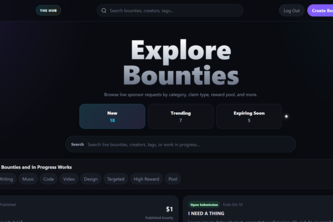
Bounty HTR is a self-reported platform that the author describes as a "virtual bounty board for creatives and freelancers," designed to connect sponsors with real human work and resources. The project was built as part of the OpenAI 2026 hackathon, with no evidence of revenue, customers or traction beyond the author's own account.
The core positioning is that it offers a creative alternative to AI-driven tools by emphasizing "real human work" and using AI only for "laborious parts in between." The platform appears to be in early-stage development, with no public launch or user base evident. The single most important open question is whether the author's vision of connecting sponsors with human creatives can be executed at scale without losing the human touch that it claims to champion.
This analysis is based entirely on self-reported information from the project description and submission text provided by the author, with no independent verification or historical data available. The author states that the platform is built using Codex, GPT 5.6, HTML, SOL, and VS Studio.
What The Product Actually Is
The description states:
- Bounty HTR functions as a "virtual bounty board for creatives and freelancers"
- It allows sponsors to source "genuine human works and resources for their needs"
- The platform is built with the input of real artists and coders
- The author describes it as designed to put "real human work at the fingertips of individuals who need a human touch"
The product is described as being built from the ground up with the needs of creatives, sponsors, and freelancers in mind. It is not evidenced whether this is a web-based platform, mobile app, or other format.
Positioning & Claim Evolution
The author states:
- The platform takes the concept of "coding bounty boards" to a "creative audience"
- It focuses on "real human work and design"
- AI (specifically GPT 5.6) is used only for "laborious parts in between"
- The goal is to show how AI can "enhance the output of people looking to build things" without stealing from creatives
- The platform aims to demonstrate that AI can be used to "BUILD tools for creatives to USE"
The positioning appears to be a response to perceived tensions between AI and creative communities, with an emphasis on human agency in the face of AI adoption. The claim evolution suggests a shift from generic bounty board concepts to a specialized platform focused on creative work.
Target Customer & ICP
The description states:
- The target audience includes "creatives and freelancers"
- Sponsors who need "genuine human works and resources for their needs"
- The platform is designed for individuals who "need a human touch"
No specific customer segments or personas are detailed. The author mentions working with "real artists and coders" but does not specify which types of creatives or what size sponsors they target.
Business Model & Pricing Evidence
Not evidenced. The description does not contain any information about:
- Revenue streams
- Pricing models
- Monetization strategy
- Fees or commissions
- Subscription structures
Technical & Delivery Signals
The description states:
- Built with Codex, GPT 5.6, HTML, SOL, and VS Studio
- Developed "from the ground up with the needs of creatives, sponsors, and freelancers who were vocal about just what they wanted to see in a platform designed for PEOPLE"
- The author mentions working alongside real artists and coders
No information is provided about:
- Technical architecture
- Scalability considerations
- User interface design
- Platform deployment or hosting
- Integration capabilities
Traction & Maturity Signals
Not evidenced. The description does not contain any information about:
- User adoption or engagement
- Customer base or user numbers
- Revenue generation
- Product maturity or development stage beyond the hackathon submission
- Market validation or feedback
- Any form of testing, beta, or live deployment
Competitive Context
Not evidenced. The description does not contain any information about:
- Competitors in the marketplace
- Market size or opportunity
- Competitive advantages or differentiators
- Industry trends or market positioning
- Prior art or similar platforms
Open Questions & Risks
Inferences based on self-reported information:
- The platform is described as being built for "creatives and freelancers" but lacks any evidence of actual user testing or feedback from these groups
- The author states that AI was used only for "laborious parts in between" but does not explain how this will be implemented or maintained
- There is no evidence of a sustainable business model or path to monetization
- The platform appears to be in early development stage (hackathon project) with no indication of progress beyond the submission
- The author mentions "lawyer fees can get expensive" which may indicate legal or regulatory challenges ahead
Questions the description leaves open
- What specific creative work categories will Bounty HTR support, and how will it ensure quality control?
- How will the platform verify that work is genuinely human-created rather than AI-assisted?
- What mechanisms are in place to match sponsors with appropriate freelancers or creatives?
- Can you describe the process for handling disputes or quality issues between sponsors and creators?
- What is your plan for scaling beyond the hackathon prototype?
- How do you intend to monetize this platform, and what revenue model have you considered?
- What specific feedback did you receive from real creatives during development?
- How will you handle payment processing and escrow services?
- What are the key technical challenges that remain before launch?
- How do you plan to attract and retain both sponsors and creators on the platform?
Overall Assessment
Not evidenced. The description does not contain any information about:
- Financial performance or projections
- Valuation or funding requirements
- Strategic fit for potential partners
- Market opportunity size
- Competitive positioning in terms of investment attractiveness
The project is described as being in an early stage (hackathon submission) with no evidence of traction, revenue, or customer base. The author's claims about the platform's purpose and functionality are self-reported without independent verification. Any investment or partnership decision would require additional due diligence beyond this self-description.
User Stories BotA demo video on every pull request
Get a demo video on every new feature
GitHub App that watches your pull requests and records a narrated, captioned demo.
Save time on demo prep and make informed decisions faster with a video walkthrough of every new feature.
Source
Submitted to the OpenAI 2026 hackathon on Devpost. Project home on Devpost. Back to the full gallery on Devpost.
This competitive analysis was produced by top-founders.com (opens in a new tab)
Generated by a language model from this project's public Devpost page — its tagline, the author's own write-up and any built-with tags listed there — as captured in August 2026. Short quotations are the author's words. It is an opinion on the idea as a business, not on the people behind it, and it reflects the description as published then. If the project has moved on, request a correction below. The analysis is not independent research and contains no verified traction, revenue or customer data.
An independent guide by KFG International LLC — not affiliated with, endorsed by, or connected to Devpost or OpenAI.