

Archive position — measured, not model output
3 likes on Devpost
128 of the 7,850 archived projects have more likes, and 93 share exactly 3 — so this project's #203 place in the like-ranked listing is a tie-break inside that group, not a ranking.
Projects (log scale)
Likes on Devpost. ▲ marks this project's group.
Show the figures
| Likes | Projects | Share of archive |
|---|---|---|
| 0 | 5,587 | 71.2% |
| 1 | 1,758 | 22.4% |
| 2 | 284 | 3.6% |
| 3–4 | 132 | 1.7% |
| 5–9 | 75 | 1.0% |
| 10+ | 14 | 0.2% |
 User Stories BotA demo video on every pull request
Get a demo video on every new feature
GitHub App that watches your pull requests and records a narrated, captioned demo.
Save time on demo prep and make informed decisions faster with a video walkthrough of every new feature.
Executive Summary
What the company appears to be
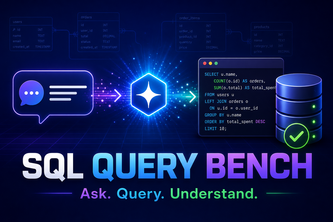
SQL Query Bench is an AI-powered tool that enables users to query databases using natural language. The product uses OpenAI Codex to translate plain English questions into safe, executable SQL. It allows users to connect their own database, upload context files, and see live progress of query execution.
What changed
The project was submitted as part of the OpenAI 2026 hackathon. It represents a proof-of-concept or prototype built in a short timeframe, likely with limited production-grade features or infrastructure.
Single most important open question
Is there any evidence of actual usage, revenue, or customer traction beyond the author’s self-reported description?
Note: This analysis is based entirely on the self-reported and unverified project description provided by the caller. No external verification, archived data, or third-party sources are available.
What The Product Actually Is
The description states that SQL Query Bench is an AI-powered workspace for querying databases with natural language. It allows users to:
- Sign in securely via OpenAI Codex OAuth
- Connect their own database
- Ask questions in plain English
- Watch the agent’s progress through Server-Sent Events (SSE)
- Inspect generated SQL, tool activity, results, and token usage
- Upload context files containing schema notes or business rules
- Maintain persistent chat history
- Explore schema and review query analytics
It is built using Angular.js, TypeScript, FastAPI, Python, PostgreSQL, SQLite, and integrates with OpenAI Codex.
Claim: The product turns plain English into safe, executable SQL.
Evidence: Yes — the description explicitly states this functionality.
Inference: It uses a tool-based agent architecture to generate and execute SQL.
Evidence: Yes — described as using an MCP-style tool architecture with tools for discovering tables, generating SQL, validating SQL, executing queries, etc.
Positioning & Claim Evolution
The project positions itself as a conversational, grounded, and transparent way to query databases without needing technical knowledge of SQL or schema structure. It emphasizes:
- Conversational interface: Users ask questions in plain English.
- Grounded answers: Answers are tied to the actual database schema and context.
- Transparency: Live streaming of agent progress shows how queries are constructed and executed.
It also claims to be more than a code generator — it aims to function as a “tool-using data assistant.”
Claim: It makes database exploration conversational, grounded, and transparent.
Evidence: Yes — stated in both the inspiration and what-it-does sections.
Inference: It is positioned as an alternative to general-purpose AI assistants that may guess or hallucinate SQL.
Evidence: Yes — mentioned in the “Inspiration” section.
Target Customer & ICP
The description does not name specific customer segments. However, it implies a target audience of:
- Users who need to access databases but lack SQL knowledge
- Data analysts or business users working with structured data
- Teams looking for a secure and transparent way to query databases
It also suggests that the product is intended for individuals or small teams who want to connect their own databases.
Claim: The target customer is someone who wants to explore databases without needing technical skills.
Evidence: Yes — implied in the “Inspiration” section.
Inference: It targets users with access to a database and an OpenAI account.
Evidence: Yes — described as requiring database connection and OpenAI OAuth sign-in.
Business Model & Pricing Evidence
There is no evidence of pricing, monetization strategy, or business model in the description. The project appears to be a hackathon submission without any indication of commercial intent or revenue streams.
Claim: There is no stated business model or pricing.
Evidence: Not evidenced — no mention of fees, subscriptions, or monetization.
Technical & Delivery Signals
The product is built with:
- Frontend: Angular.js, TypeScript
- Backend: FastAPI, Python
- Database support: PostgreSQL, SQLite
- AI integration: OpenAI Codex via OAuth
- Streaming: Server-Sent Events (SSE)
- Tool architecture: MCP-style agent with tools for schema discovery, SQL generation, validation, and execution
It supports features like:
- Real-time progress streaming
- Context file upload
- Read-only SQL execution
- Conversation persistence
- Model selection from authenticated account
Claim: The system uses a tool-based agent to execute queries.
Evidence: Yes — described as using MCP-style tools.
Inference: It supports live schema introspection and validation.
Evidence: Yes — mentioned in the “How we built it” section.
Traction & Maturity Signals
There is no evidence of traction, revenue, customers, or adoption beyond the author’s own description. The project was submitted to a hackathon and does not appear to have any production deployment or user base.
Claim: No traction or customer data.
Evidence: Not evidenced — no mention of users, customers, or revenue.
Competitive Context
The description does not reference competitors directly. However, it implies a space that includes:
- General-purpose AI assistants for SQL generation
- Database exploration tools with natural language interfaces
- Conversational AI platforms for data access
It positions itself as distinct by emphasizing grounding in live schema and transparency of execution.
Claim: No direct competitor comparison.
Evidence: Not evidenced — no mention of existing products or market positioning.
Open Questions & Risks
Key risks include:
- Lack of traction or commercial viability — the project is a hackathon submission with no evidence of real-world usage.
- Dependency on OpenAI Codex — reliance on an external API that may change or become unavailable.
- Limited database support — currently supports PostgreSQL and SQLite, not all database engines.
- No monetization strategy — unclear how the product would be sold or funded.
Inference: The project lacks production-grade infrastructure or scalability.
Evidence: Not evidenced — no mention of deployment, scaling, or performance metrics.
Questions the description leaves open
- What is the current status of the product? Is it in active development or a prototype?
- Are there any users or early adopters currently using the tool?
- How does the product handle data privacy and security for connected databases?
- What are the plans for monetization, if any?
- Has the team considered expanding to other database engines beyond PostgreSQL and SQLite?
- What is the roadmap for deployment and hosting options?
Overall Assessment
There is no evidence of a viable business or product market fit beyond the author’s own description. The project appears to be a hackathon prototype with no demonstrated traction, revenue, or customer base.
Claim: No commercial viability or investment-ready status.
Evidence: Not evidenced — no data on users, revenue, or scalability.
Inference: It may have potential as a proof-of-concept but lacks the maturity for investment or partnership consideration.
Evidence: Not evidenced — no indication of product-market fit or business traction.
User Stories BotA demo video on every pull request
Get a demo video on every new feature
GitHub App that watches your pull requests and records a narrated, captioned demo.
Save time on demo prep and make informed decisions faster with a video walkthrough of every new feature.
Source
Submitted to the OpenAI 2026 hackathon on Devpost. Project home on Devpost. Back to the full gallery on Devpost.
This competitive analysis was produced by top-founders.com (opens in a new tab)
Generated by a language model from this project's public Devpost page — its tagline, the author's own write-up and any built-with tags listed there — as captured in August 2026. Short quotations are the author's words. It is an opinion on the idea as a business, not on the people behind it, and it reflects the description as published then. If the project has moved on, request a correction below. The analysis is not independent research and contains no verified traction, revenue or customer data.
An independent guide by KFG International LLC — not affiliated with, endorsed by, or connected to Devpost or OpenAI.