

Archive position — measured, not model output
1 like on Devpost
505 of the 7,850 archived projects have more likes, and 1,758 share exactly 1 — so this project's #1,980 place in the like-ranked listing is a tie-break inside that group, not a ranking.
Projects (log scale)
Likes on Devpost. ▲ marks this project's group.
Show the figures
| Likes | Projects | Share of archive |
|---|---|---|
| 0 | 5,587 | 71.2% |
| 1 | 1,758 | 22.4% |
| 2 | 284 | 3.6% |
| 3–4 | 132 | 1.7% |
| 5–9 | 75 | 1.0% |
| 10+ | 14 | 0.2% |
 User Stories BotA demo video on every pull request
Get a demo video on every new feature
GitHub App that watches your pull requests and records a narrated, captioned demo.
Save time on demo prep and make informed decisions faster with a video walkthrough of every new feature.
Executive Summary
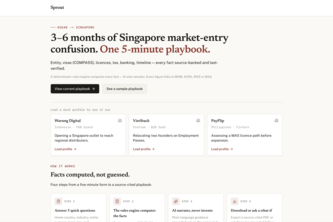
Sprout is a self-reported tool that claims to help ASEAN founders enter the Singapore market by generating playbooks based on five input questions. The product uses a rules engine for regulatory answers and an AI model to explain those answers in natural language. It was built as part of the OpenAI 2026 hackathon.
The description states that Sprout is designed to address the difficulty of reverse-engineering Singapore’s regulatory requirements for foreign founders, particularly around entity structure, visas, licensing, tax, banking, timeline, and risk.
Key commercial due-diligence read: There is no evidence of revenue, customers, or traction. The product appears to be a prototype or demo built in a hackathon context. The core architecture — separating factual computation from AI narration — is described but not validated.
Single most important open question: Is there any evidence that this tool has been used by actual founders beyond the hackathon demo?
What The Product Actually Is
The description states that Sprout is a tool that takes five short questions from a founder (home country, industry, entity purpose, founders/staff relocating, projected Singapore revenue, EntrePass evidence) and returns a full playbook including:
- Entity structure
- Licensing
- Tax
- Banking
- Timeline
- Risk matrix
The system uses a rules engine for factual answers derived from real government sources, and an AI model to generate narrative explanations based on those facts.
It is described as a "5-minute playbook", suggesting it aims to reduce the time required to understand regulatory requirements.
Positioning & Claim Evolution
The description states that Sprout positions itself as a tool that turns Singapore market entry into a 5-minute playbook for ASEAN founders. It claims to compute answers using rules, not AI hallucinations.
It also states that the team learned that “rules engine computes, LLM narrates” is a stronger approach than letting an LLM generate everything and hope it’s accurate.
This suggests a positioning evolution from a generic AI assistant to a hybrid system where factual accuracy is prioritized through rule-based logic, with AI used only for explanation.
Inference: The product likely emerged from a hackathon context and may not yet be a commercial offering. It reflects an early-stage idea about compliance automation.
Target Customer & ICP
The description states that Sprout targets ASEAN founders who want to expand into Singapore but struggle with reverse-engineering regulatory requirements.
It also mentions that the tool is designed for those who are “in Jakarta, Ho Chi Minh City, or Manila” — implying a regional focus on Southeast Asia.
The team built three demo profiles representing different industries (F&B, SaaS, retail, medical devices, fintech) to show how it works across sectors.
Inference: The target customer is likely early-stage founders in ASEAN looking for guidance on Singapore market entry. However, there is no evidence of actual customers or usage beyond the hackathon demo.
Business Model & Pricing Evidence
The description does not mention any pricing model or business model.
It mentions that the team explored adjacent monetization opportunities such as:
- Corp-sec firm partnerships
- Bank partnerships
- EDB collaboration for verified incentive matching
These are speculative ideas, not confirmed business models.
Inference: No evidence of a functioning business model. The project is described as a demo or prototype.
Technical & Delivery Signals
The description states that the product uses:
- A rules engine to compute regulatory answers based on real government sources
- An AI model (e.g., ChatGPT, Google Gemini) for narrative explanations
- A hybrid architecture where AI only describes facts already computed by the rules engine
It also mentions that the team had to correct a mistake in their initial implementation of the COMPASS benchmark, showing attention to regulatory accuracy.
The tech stack includes:
- Next.js, React, TypeScript
- Vercel AI SDK, Groq, Zod, Zustand
- Framer Motion, TailwindCSS, shadcn-ui, base-ui
Inference: The architecture shows a deliberate attempt to separate factual computation from narrative generation. However, no evidence of production deployment or scalability.
Traction & Maturity Signals
The description states that this project was built for the OpenAI 2026 hackathon and includes:
- Three demo profiles
- A corrected implementation of a regulatory rule (COMPASS benchmark)
- A working prototype
There is no evidence of revenue, customers, or adoption beyond the demo.
Inference: The product is in an early-stage prototype phase. No traction or market validation is evidenced.
Competitive Context
The description does not mention any competitors.
It implies that there is a gap in the market for tools that help ASEAN founders navigate Singapore’s regulatory environment, but no evidence of existing solutions or competitive landscape.
Inference: The competitive context is unknown. There is no evidence of prior art or market presence.
Open Questions & Risks
- No traction or revenue: The product is described as a hackathon demo with no evidence of real-world usage.
- Unverified regulatory accuracy: While the team claims to use rules from government sources, there is no independent verification of this.
- Limited scope: The demo only covers five industries and five questions — not a full solution.
- Unclear monetization path: No business model or revenue streams are described beyond speculative partnerships.
- AI hallucination risk: Even though the team claims AI is only used for narration, there’s no evidence that this is enforced in practice.
Questions the description leaves open
- What specific government sources were used to build the rules engine?
- How was the accuracy of the regulatory rules validated?
- Has the tool been tested with real ASEAN founders or only in demo mode?
- What is the plan for scaling beyond the five demo industries?
- Are there any partnerships or pilot programs with legal, financial, or government entities already underway?
- How does the team intend to monetize this product beyond speculative collaborations?
Overall Assessment
Not evidenced: There is no evidence of revenue, customers, traction, or a validated business model.
The project appears to be an early-stage prototype built in a hackathon context. It shows technical sophistication in separating factual computation from AI narration but lacks commercial proof-of-concept.
Confidence level: Low — based entirely on self-reported information with no external validation or market data.
Assessment: Not ready for investment or partnership at this stage. The team should demonstrate real-world usage, regulatory accuracy, and a clear monetization path before further consideration.
User Stories BotA demo video on every pull request
Get a demo video on every new feature
GitHub App that watches your pull requests and records a narrated, captioned demo.
Save time on demo prep and make informed decisions faster with a video walkthrough of every new feature.
Source
Submitted to the OpenAI 2026 hackathon on Devpost. Project home on Devpost. Back to the full gallery on Devpost.
This competitive analysis was produced by top-founders.com (opens in a new tab)
Generated by a language model from this project's public Devpost page — its tagline, the author's own write-up and any built-with tags listed there — as captured in August 2026. Short quotations are the author's words. It is an opinion on the idea as a business, not on the people behind it, and it reflects the description as published then. If the project has moved on, request a correction below. The analysis is not independent research and contains no verified traction, revenue or customer data.
An independent guide by KFG International LLC — not affiliated with, endorsed by, or connected to Devpost or OpenAI.