

Archive position — measured, not model output
0 likes on Devpost
2,263 of the 7,850 archived projects have more likes, and 5,587 share exactly 0 — so this project's #3,943 place in the like-ranked listing is a tie-break inside that group, not a ranking.
Projects (log scale)
Likes on Devpost. ▲ marks this project's group.
Show the figures
| Likes | Projects | Share of archive |
|---|---|---|
| 0 | 5,587 | 71.2% |
| 1 | 1,758 | 22.4% |
| 2 | 284 | 3.6% |
| 3–4 | 132 | 1.7% |
| 5–9 | 75 | 1.0% |
| 10+ | 14 | 0.2% |
 User Stories BotA demo video on every pull request
Get a demo video on every new feature
GitHub App that watches your pull requests and records a narrated, captioned demo.
Save time on demo prep and make informed decisions faster with a video walkthrough of every new feature.
Executive Summary
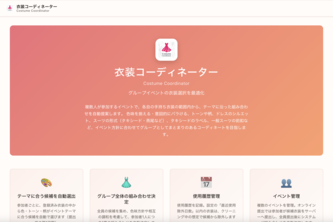
What the company appears to be: Ensemble AI is a self-reported project that builds a deterministic, privacy-preserving tool for group outfit coordination using on-device image processing. The author describes it as an extension of a pre-existing "Costume Coordinator" with added photo-based garment registration and group optimization features.
What changed: During Build Week, the team extended the existing system to support photo-first registration, improved local color extraction, conservative pattern matching, favorite complete outfits, automatic outfit proposals, and deterministic scoring across multiple garment types. The system also introduced online submission capabilities using Cloudflare infrastructure while maintaining privacy by default.
The single most important open question: Is there any evidence of actual usage or adoption beyond the author's own development work? The description states no revenue, customers, or traction data exist beyond the project itself.
Note: This analysis is based entirely on the self-reported, unverified description provided by the author. No external verification, historical data, or third-party sources are available. All claims are attributed to the author's own account and should be treated as stated rather than proven.
What The Product Actually Is
The description states that Ensemble AI is a tool for group outfit coordination, extending a pre-existing "Costume Coordinator" system. It allows organizers to define visual themes for events and participants to register garments via photos. The system uses on-device processing (Canvas, TypeScript) to suggest colors, tones, and patterns without sending images to external AI services.
It supports:
- Photo-based garment registration
- Manual entry fallback
- Favorite complete outfits (up to three pieces)
- Automatic outfit proposals based on deterministic rules
- Group optimization that preserves physical component identity
- Online submission via Cloudflare Workers with D1 and R2 storage
The system is described as a Progressive Web App (PWA) built with React, TypeScript, and Vite, using IndexedDB for local data storage.
Claim: The product is a deterministic group outfit coordination tool.
Evidence: Author's own write-up.
Inference: It appears to be a niche SaaS or developer tool for performance groups.
Justification: Based on the stated use cases (choirs, orchestras, dance groups) and technical architecture.
Positioning & Claim Evolution
The author positions Ensemble AI as:
- A deterministic alternative to AI-driven outfit tools
- Private by default, with no per-use AI costs
- Human-reviewed and explainable
- Free for users
It evolved from a single-user wardrobe search tool ("Costume Coordinator") into a group coordination system during Build Week. The evolution includes:
- Photo-first registration flow
- Improved on-device processing
- Deterministic scoring rules
- Online sharing capabilities
Claim: Ensemble AI is positioned as a privacy-preserving, deterministic outfit coordination tool.
Evidence: Author's own write-up.
Inference: It targets performance groups or teams requiring coordinated looks.
Justification: Use cases mentioned (choirs, orchestras, wedding parties) suggest a B2B niche.
Target Customer & ICP
The description states that Ensemble AI is designed for:
- Choirs
- Chamber groups
- Orchestras
- Dance groups
- Wedding parties
- Other teams requiring coordinated looks
It was inspired by real music events and aims to solve the problem of coordinating outfits in group performances where individuals own different clothes.
Claim: The target customer is performance groups or teams needing coordinated outfits.
Evidence: Author's own write-up.
Inference: Likely B2B SaaS or marketplace-style users.
Justification: Use cases imply organizational coordination needs, not individual consumers.
Business Model & Pricing Evidence
There is no evidence in the description of a business model or pricing structure. The author states that the tool is free by default and does not incur per-use AI costs. No mention of monetization, subscriptions, or paid features.
Claim: No pricing or business model information provided.
Evidence: Author's own write-up.
Inference: May be free-to-use with optional premium features or a freemium model.
Justification: Not stated explicitly; speculative based on typical SaaS patterns.
Technical & Delivery Signals
The system is built as a PWA using:
- React
- TypeScript
- Vite
- IndexedDB for local storage
- Cloudflare Workers, D1, R2 for online submission
- On-device Canvas processing for image analysis
It uses deterministic logic to avoid AI token charges and ensures privacy by default. The system supports retry-safe submissions, legacy compatibility, and secure image handling.
Claim: The product is technically built as a PWA with on-device processing.
Evidence: Author's own write-up.
Inference: Likely low-cost, scalable architecture due to PWA + Cloudflare stack.
Justification: Use of modern web technologies and edge computing.
Traction & Maturity Signals
There is no evidence of traction or maturity beyond the author’s own development work. The project was submitted to a hackathon (OpenAI 2026), and there are no mentions of:
- Revenue
- Customers
- Adoption rates
- User base
- Product usage metrics
The team size is listed as zero, and no headcount or funding information is provided.
Claim: No traction or maturity data available.
Evidence: Author's own write-up.
Inference: Likely early-stage prototype or proof-of-concept.
Justification: No evidence of real-world usage or product-market fit.
Competitive Context
The description does not provide any information about competitors. It does not mention:
- Existing tools for group outfit coordination
- Similar privacy-preserving AI systems
- Market positioning relative to other SaaS or marketplace platforms
Claim: No competitive context provided.
Evidence: Author's own write-up.
Inference: Likely a niche solution with limited competition, but this cannot be confirmed.
Justification: Absence of evidence means no known competitors mentioned.
Open Questions & Risks
Key risks and open questions based on the description:
- No traction or adoption data suggests early-stage development
- Zero team size implies no operational capacity
- No revenue or customer data raises questions about viability
- The system relies heavily on manual confirmation, which may limit scalability
- Use of GPT-5.6 and Codex for development but not runtime indicates a non-AI product
Claim: Risk factors include lack of traction, zero team size, and no monetization strategy.
Evidence: Author's own write-up.
Inference: Product may be underdeveloped or unproven in real-world use.
Justification: No evidence of actual usage or market validation.
Questions the description leaves open
- What is the current status of the product beyond the Build Week prototype?
- Are there any users or early adopters currently testing the system?
- How does the team plan to scale beyond a single developer's effort?
- Is there a monetization strategy in place or planned?
- What are the key assumptions about user behavior and adoption?
- Has the system been tested with real-world performance groups?
- What is the long-term roadmap for features, privacy, and scalability?
Note: These questions aim to uncover gaps in the self-reported description.
Overall Assessment
There is insufficient evidence to assess whether Ensemble AI represents a viable investment or partnership opportunity. The project appears to be an early-stage prototype developed during a hackathon with no demonstrated traction, revenue, or team structure. It lacks any indication of product-market fit or commercial viability beyond the author’s own development work.
Claim: No clear investment or partnership case due to lack of evidence.
Evidence: Author's own write-up.
Inference: Likely not ready for commercial deployment or investment.
Justification: No signs of traction, customers, or operational capacity.
User Stories BotA demo video on every pull request
Get a demo video on every new feature
GitHub App that watches your pull requests and records a narrated, captioned demo.
Save time on demo prep and make informed decisions faster with a video walkthrough of every new feature.
Source
Submitted to the OpenAI 2026 hackathon on Devpost. Project home on Devpost. Back to the full gallery on Devpost.
This competitive analysis was produced by top-founders.com (opens in a new tab)
Generated by a language model from this project's public Devpost page — its tagline, the author's own write-up and any built-with tags listed there — as captured in August 2026. Short quotations are the author's words. It is an opinion on the idea as a business, not on the people behind it, and it reflects the description as published then. If the project has moved on, request a correction below. The analysis is not independent research and contains no verified traction, revenue or customer data.
An independent guide by KFG International LLC — not affiliated with, endorsed by, or connected to Devpost or OpenAI.