

Archive position — measured, not model output
1 like on Devpost
505 of the 7,850 archived projects have more likes, and 1,758 share exactly 1 — so this project's #1,982 place in the like-ranked listing is a tie-break inside that group, not a ranking.
Projects (log scale)
Likes on Devpost. ▲ marks this project's group.
Show the figures
| Likes | Projects | Share of archive |
|---|---|---|
| 0 | 5,587 | 71.2% |
| 1 | 1,758 | 22.4% |
| 2 | 284 | 3.6% |
| 3–4 | 132 | 1.7% |
| 5–9 | 75 | 1.0% |
| 10+ | 14 | 0.2% |
 User Stories BotA demo video on every pull request
Get a demo video on every new feature
GitHub App that watches your pull requests and records a narrated, captioned demo.
Save time on demo prep and make informed decisions faster with a video walkthrough of every new feature.
Executive Summary
What the company appears to be
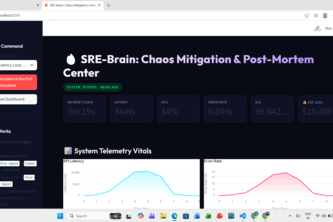
SRE-Brain is a self-reported AI-powered Site Reliability Engineering (SRE) platform designed to automate incident detection, triage, communication, and post-mortem generation for infrastructure outages. It uses a multi-agent architecture with statistical anomaly detection and LLM integration (Google Gemini), and includes a benchmark suite for evaluation.
What changed
The project is presented as a hackathon submission (Devpost entry) for the OpenAI 2026 hackathon, indicating it is in an early-stage prototype or proof-of-concept phase. It has no evidence of commercial traction, revenue, or customer adoption.
Single most important open question
Is there any evidence that SRE-Brain has been tested in real-world environments beyond the demo and mock scenarios described? The author states its functionality but does not provide verification of performance or deployment outside of a development context.
What The Product Actually Is
The description states that SRE-Brain is an AI-powered SRE platform with:
- A multi-agent architecture composed of three agents: TelemetryTriageAgent, CommsSyncAgent, and PostMortemAgent.
- Statistical anomaly detection using Z-score analysis.
- Integration with Slack and GitHub for context.
- Automated post-mortem generation using LLMs (Gemini).
- Financial impact calculation per incident.
- A benchmark suite for evaluation.
It is built using Python, Streamlit, Docker, and integrates with Google’s Gemini API. The system is described as being deployable via Docker and includes a frontend dashboard built with Streamlit.
Inference The product appears to be a prototype or proof-of-concept tool intended for SRE teams to detect and respond to infrastructure incidents using AI-assisted automation.
Positioning & Claim Evolution
The author positions SRE-Brain as:
- A system that detects simulated incident scenarios in under 30 seconds.
- Capable of preventing tens of thousands of dollars in losses per incident.
- Designed for use in high-stakes environments like Black Friday outages.
- An automated solution for infrastructure reliability and incident documentation.
The claims are framed around:
- Speed of detection (MTTD).
- Financial loss mitigation.
- Automation of SRE tasks including communication and post-mortem writing.
- Use of AI to generate root cause hypotheses and lessons learned.
Inference This is a self-positioned tool aimed at reducing SRE burden through automation, with an emphasis on minimizing financial impact from outages. It does not claim to be a commercial product or service yet.
Target Customer & ICP
The description implies that the target customer is:
- Site Reliability Engineers (SREs) working in high-stakes environments.
- Organizations experiencing frequent infrastructure incidents, particularly those with measurable financial impact per minute of downtime.
No explicit segmentation beyond SRE teams is provided. The project does not describe specific enterprise use cases or personas.
Inference The ICP likely includes small to mid-sized tech companies or engineering teams focused on reliability and incident response, but this is inferred from the context of the problem being solved rather than stated directly.
Business Model & Pricing Evidence
There is no evidence in the description of:
- A pricing model.
- Revenue streams.
- Monetization strategy.
- Customer acquisition plans.
- Subscription or licensing details.
The project is described as a hackathon submission and includes open-source components (MIT License).
Inference No business model or pricing information is evident. The tool appears to be non-commercial in nature at this stage.
Technical & Delivery Signals
Key technical elements include:
- Multi-agent architecture with cyclic graph execution.
- Statistical Z-score anomaly detection with sliding window baselines.
- Integration with Slack and GitHub via mock and live modes.
- Use of LLMs (Gemini) for hypothesis generation and lessons learned.
- Built using Python, Streamlit, Docker, Pydantic, and Altair.
- Unit tests and quantitative benchmark suite included.
The system supports:
- Real-time alerting.
- Financial impact estimation.
- Automated communication drafts.
- Markdown report output.
Inference The technical stack suggests a developer-focused prototype with strong integration capabilities. It is designed for internal use or experimentation rather than production deployment at scale.
Traction & Maturity Signals
There is no evidence of:
- Customers or users.
- Revenue or monetization.
- Product adoption metrics.
- Deployment in live environments.
- Feedback from real-world usage.
- Market validation or pilot programs.
The project is described as a hackathon submission and includes only mock incident scenarios and unit tests.
Inference No traction or maturity signals are evident. The product remains at the prototype or experimental stage.
Competitive Context
The description does not mention:
- Competitors.
- Market positioning relative to existing SRE tools.
- Differentiation from other incident management platforms.
However, it is implied that SRE-Brain targets a niche within SRE automation and post-mortem generation. It may compete with tools like PagerDuty, Splunk, or internal SRE tooling used by large tech firms.
Inference The competitive landscape is not described, but the product likely addresses gaps in current SRE workflows around automation and documentation — though no direct comparison or differentiation is made.
Open Questions & Risks
- Unverified claims: The description makes strong claims about financial loss prevention and detection speed without evidence of real-world testing.
- Prototype-only status: No indication of production readiness, scalability, or deployment beyond a demo environment.
- No commercialization path: The project is open-source (MIT License) and lacks any mention of monetization or go-to-market strategy.
- Limited team size: Only one founder listed, which may limit execution capacity.
- Dependency on LLMs: Reliance on Google Gemini API introduces potential dependency risks and cost considerations if scaled.
Inference The project is in a very early stage with no commercial viability or traction. Risks include unproven performance, lack of validation, and limited scalability.
Questions the description leaves open
- Has SRE-Brain been tested in any real-world or simulated environments beyond the demo?
- What are the actual performance metrics from the benchmark suite? Are they reproducible?
- How does the system handle false positives or missed alerts in practice?
- Is there a plan to commercialize this tool, and if so, what is the monetization strategy?
- What is the current development roadmap, and how will it evolve beyond the hackathon version?
- Are there any partnerships or early adopters currently engaged with the tool?
Overall Assessment
Not evidenced — No data on financials, traction, or commercial viability exists in the description.
Confidence level Low This is a self-reported, unverified prototype submitted as part of a hackathon. There is no evidence of revenue, customers, or product-market fit. The tool may have potential for future development but currently lacks any indication of commercial readiness or impact.
Inference At this stage, SRE-Brain is best viewed as an experimental idea with possible future value — not a viable investment or partnership opportunity without further validation and development.
User Stories BotA demo video on every pull request
Get a demo video on every new feature
GitHub App that watches your pull requests and records a narrated, captioned demo.
Save time on demo prep and make informed decisions faster with a video walkthrough of every new feature.
Source
Submitted to the OpenAI 2026 hackathon on Devpost. Project home on Devpost. Back to the full gallery on Devpost.
This competitive analysis was produced by top-founders.com (opens in a new tab)
Generated by a language model from this project's public Devpost page — its tagline, the author's own write-up and any built-with tags listed there — as captured in August 2026. Short quotations are the author's words. It is an opinion on the idea as a business, not on the people behind it, and it reflects the description as published then. If the project has moved on, request a correction below. The analysis is not independent research and contains no verified traction, revenue or customer data.
An independent guide by KFG International LLC — not affiliated with, endorsed by, or connected to Devpost or OpenAI.