

Archive position — measured, not model output
5 likes on Devpost
54 of the 7,850 archived projects have more likes, and 35 share exactly 5 — so this project's #85 place in the like-ranked listing is a tie-break inside that group, not a ranking.
Projects (log scale)
Likes on Devpost. ▲ marks this project's group.
Show the figures
| Likes | Projects | Share of archive |
|---|---|---|
| 0 | 5,587 | 71.2% |
| 1 | 1,758 | 22.4% |
| 2 | 284 | 3.6% |
| 3–4 | 132 | 1.7% |
| 5–9 | 75 | 1.0% |
| 10+ | 14 | 0.2% |
 User Stories BotA demo video on every pull request
Get a demo video on every new feature
GitHub App that watches your pull requests and records a narrated, captioned demo.
Save time on demo prep and make informed decisions faster with a video walkthrough of every new feature.
Executive Summary
What the company appears to be
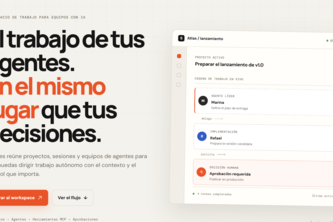
Spaces is a self-reported cloud-native workspace for AI agents to execute code, commit to Git, deploy containers, and edit files in real time. It is described as an execution environment where autonomous AI agents operate directly within project repositories and file systems.
What changed
The author states that Spaces was built with the premise that projects are not task lists but real execution environments. This implies a shift from traditional project management tools to a system where AI agents perform actual work inside the codebase, rather than just summarizing or suggesting changes.
Single most important open question
Is there any evidence of traction, revenue, or customer adoption beyond the author’s own description? The self-reported nature of the information makes it impossible to assess whether this is a viable product or just an idea in development.
What The Product Actually Is
The description states that Spaces is a cloud-native workspace where autonomous AI agents run code, commit to Git, deploy containers, and edit files in real time. It includes:
- A dashboard built with React 19, Vite, TypeScript, and Tailwind CSS.
- A backend runtime powered by Bun + Hono.
- Multi-agent orchestration using a Controller ↔ Specialist pattern.
- Native integration with 9 AI providers (OpenAI, Gemini, DeepSeek, etc.).
- Real-time synchronization via WebSocket pipeline.
- Persistent memory management for long sessions.
Inference The product appears to be an experimental or prototype system designed to allow AI agents to interact directly with code repositories and execute tasks autonomously within a secure sandboxed environment.
Positioning & Claim Evolution
The author claims that Spaces treats projects as “real execution environments” rather than task lists. It positions itself as a platform where AI agents do not just suggest or summarize but actually commit code, run tests, and deploy changes.
Inference This suggests a move away from traditional project management tools (e.g., Jira) toward an AI-first development workflow that emphasizes execution over planning or documentation.
Target Customer & ICP
Not evidenced. The description does not identify specific customer segments or personas. It only describes the tool’s functionality and architecture.
What would fill this gap
Information about who uses Spaces, what problems they solve, and how it fits into their workflow.
Business Model & Pricing Evidence
Not evidenced. There is no mention of pricing models, monetization strategies, or customer acquisition plans in the description.
What would fill this gap
Details on whether Spaces will be sold as SaaS, freemium, enterprise licensing, or other business models.
Technical & Delivery Signals
The project was built using:
- Frontend: React 19, Vite, TypeScript, Tailwind CSS v4
- Backend: Bun + Hono
- Architecture: pnpm monorepo with shared Zod schemas
- Agent Orchestration: Controller ↔ Specialist pattern
- AI Integration: Native support for 9 AI providers and MCP server integration
Inference The technical stack reflects a modern, performance-oriented approach to building real-time, agent-based systems. The use of strict typing (Zod) and streaming capabilities suggests attention to robustness and scalability.
Traction & Maturity Signals
Not evidenced. There is no mention of users, customers, revenue, or adoption metrics beyond the author’s own account.
What would fill this gap
Data on usage, retention, or feedback from early adopters; evidence of product-market fit or commercial traction.
Competitive Context
Not evidenced. No comparison to existing tools or platforms is made in the description.
What would fill this gap
A discussion of competitors such as GitHub Copilot, GitLab, Notion, or other AI-powered development environments.
Open Questions & Risks
- Unverified claims: All information is self-reported and unverifiable.
- No traction or revenue: No evidence of customers, users, or monetization.
- Single-person team: The project was built by one individual (Efrain Clark), which raises questions about scalability and long-term maintenance.
- Prototype nature: Described as a hackathon submission, implying it may be experimental or incomplete.
Inference The lack of independent verification and external validation makes it difficult to assess whether Spaces is a viable product or just an idea in early development.
Questions the description leaves open
- What specific use cases are you targeting with Spaces?
- How do you plan to monetize the platform?
- Have you tested Spaces with any users or teams yet?
- What are your plans for scaling beyond a single developer?
- Are there any known limitations or trade-offs in the current architecture?
Overall Assessment
Not evidenced. No information is provided about funding, partnerships, or investment interest.
Inference Given that this is a self-reported hackathon project with no evidence of traction or commercial viability, it does not appear to be ready for investment or partnership at this stage. However, the underlying concept may have potential if further developed and validated.
User Stories BotA demo video on every pull request
Get a demo video on every new feature
GitHub App that watches your pull requests and records a narrated, captioned demo.
Save time on demo prep and make informed decisions faster with a video walkthrough of every new feature.
Source
Submitted to the OpenAI 2026 hackathon on Devpost. Project home on Devpost. Back to the full gallery on Devpost.
This competitive analysis was produced by top-founders.com (opens in a new tab)
Generated by a language model from this project's public Devpost page — its tagline, the author's own write-up and any built-with tags listed there — as captured in August 2026. Short quotations are the author's words. It is an opinion on the idea as a business, not on the people behind it, and it reflects the description as published then. If the project has moved on, request a correction below. The analysis is not independent research and contains no verified traction, revenue or customer data.
An independent guide by KFG International LLC — not affiliated with, endorsed by, or connected to Devpost or OpenAI.