

Archive position — measured, not model output
0 likes on Devpost
2,263 of the 7,850 archived projects have more likes, and 5,587 share exactly 0 — so this project's #6,870 place in the like-ranked listing is a tie-break inside that group, not a ranking.
Projects (log scale)
Likes on Devpost. ▲ marks this project's group.
Show the figures
| Likes | Projects | Share of archive |
|---|---|---|
| 0 | 5,587 | 71.2% |
| 1 | 1,758 | 22.4% |
| 2 | 284 | 3.6% |
| 3–4 | 132 | 1.7% |
| 5–9 | 75 | 1.0% |
| 10+ | 14 | 0.2% |
 User Stories BotA demo video on every pull request
Get a demo video on every new feature
GitHub App that watches your pull requests and records a narrated, captioned demo.
Save time on demo prep and make informed decisions faster with a video walkthrough of every new feature.
Executive Summary
What the company appears to be
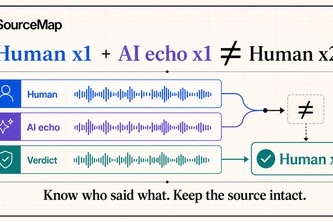
Source Map is a self-reported tool designed to help teams manage and analyze AI-generated content by distinguishing human statements from AI echoes, preserving sources, and mapping patterns, contradictions, and gaps in output.
What changed
The project was submitted to the OpenAI 2026 hackathon on Devpost. No further development or public updates are evidenced.
Single most important open question
Does Source Map actually solve a real problem for teams using AI tools, or is it a conceptual idea without traction?
Analysis basis
This report is based solely on the self-reported project description provided by the caller. All claims are unverified and should be treated as statements made by the author, not facts. There is no evidence of revenue, customers, product usage, or team size beyond what is stated in the submission.
What The Product Actually Is
The description states that Source Map "separates human statements from AI echoes, preserves every source, and maps patterns, contradictions, and gaps—so teams can use AI without confusing repetition with evidence."
- Claimed function: To distinguish between human-generated and AI-generated content.
- Claimed feature: Preservation of sources for all inputs.
- Claimed capability: Mapping of patterns, contradictions, and gaps in output.
Inference The tool appears to be aimed at teams working with AI-assisted writing or content creation where clarity about origin and consistency is important. However, the description does not specify how it performs these functions technically or whether it is a standalone product or an integration.
Not evidenced No details on how the mapping works, what kind of data it processes, or if it's a web app, API, plugin, or CLI tool.
Positioning & Claim Evolution
The tagline positions Source Map as a solution for teams using AI without conflating repetition with evidence. It implies a concern about the quality and traceability of AI outputs in collaborative environments.
- Claimed positioning: A tool that helps teams manage AI-generated content responsibly.
- Evolution of claims: The project is presented as a hackathon submission, suggesting it may be early-stage or conceptual.
Not evidenced No indication of prior versions, user feedback, or evolution from earlier iterations. The description does not suggest any market validation or prior product development beyond the hackathon entry.
Target Customer & ICP
The description states that Source Map is for "teams" using AI, and aims to help them avoid confusing repetition with evidence.
- Claimed customer: Teams working with AI-assisted content creation.
- ICP inferred from claim: Likely B2B SaaS or productivity tool users who rely on AI tools like ChatGPT, Claude, etc., and need source tracking and consistency checks.
Not evidenced No specific industry, role, or team size mentioned. No evidence of customer personas or use cases beyond general AI team needs.
Business Model & Pricing Evidence
There is no mention of pricing, monetization strategy, or business model in the description.
- Claimed business model: Not stated.
- Pricing evidence: None provided.
Inference If this is a commercial product, it likely would be priced for teams or enterprises. However, there is no evidence to support this assumption.
Not evidenced No indication of revenue streams, subscription tiers, or monetization approach.
Technical & Delivery Signals
The author lists several technologies used in building the project: ai, apiu, cloudflare, codex, data, github, gpt, html, human, java, node.js, providence, react, response, rest, script, structured, visulation, workprodutivity.
- Claimed tech stack: A mix of frontend (React), backend (Node.js), AI integrations (GPT, Codex), and infrastructure (Cloudflare).
- Delivery method: Not specified — whether it's a web app, CLI, browser extension, or API.
Inference The project likely involves some form of AI content processing and visualization. However, the lack of detail on how this is implemented makes it difficult to assess technical maturity.
Not evidenced No evidence of architecture, scalability, or delivery mechanism beyond the tech stack listed.
Traction & Maturity Signals
The only signal of traction is that the project was submitted to a hackathon (OpenAI 2026).
- Claimed traction: None beyond hackathon submission.
- Maturity level: Not evidenced — no product demo, usage metrics, or user feedback.
Inference This is likely an early-stage idea or prototype. No evidence of product-market fit or adoption.
Not evidenced No evidence of users, revenue, or product development beyond the hackathon submission.
Competitive Context
No mention of competitors or market context in the description.
- Claimed competitive landscape: Not stated.
- Market positioning: Not described.
Inference If this is a tool for managing AI content, it may compete with tools like Notion, Airtable, or AI collaboration platforms. However, no such comparison is made.
Not evidenced No evidence of existing solutions or competitive differentiation.
Open Questions & Risks
- Risk of conceptual over implementation: The project appears to be a hackathon submission with no further development.
- No team or headcount: The team size is listed as 0, suggesting no active development or commercialization effort.
- Unproven market need: No evidence of real-world use cases or customer validation.
Open question
Lack of any traction, revenue, or product development beyond the hackathon submission raises questions about whether this is a viable business idea or just an idea in early form.
Questions the description leaves open
- What specific problem are you solving for teams using AI tools?
- How does Source Map distinguish between human and AI-generated content?
- What data sources does it process, and how is that data handled?
- Is this a standalone product or an integration with existing AI platforms?
- Have you tested this with real users or teams?
- What is your path to market or monetization?
- How do you plan to scale beyond the hackathon prototype?
Overall Assessment
The project is presented as a hackathon submission and has no evidence of traction, revenue, or team development.
- Assessment: Not evidenced as a viable investment or partnership opportunity at this stage.
- Confidence level: Low — based on thin self-reported evidence only.
Inference If the founders are serious about commercializing this idea, they would need to demonstrate product-market fit, early traction, and a clear path to monetization. As it stands, there is no indication of such progress.
User Stories BotA demo video on every pull request
Get a demo video on every new feature
GitHub App that watches your pull requests and records a narrated, captioned demo.
Save time on demo prep and make informed decisions faster with a video walkthrough of every new feature.
Source
Submitted to the OpenAI 2026 hackathon on Devpost. Project home on Devpost. Back to the full gallery on Devpost.
This competitive analysis was produced by top-founders.com (opens in a new tab)
Generated by a language model from this project's public Devpost page — its tagline and any built-with tags listed there, since the author published no write-up — as captured in August 2026. Short quotations are the author's words. It is an opinion on the idea as a business, not on the people behind it, and it reflects the description as published then. If the project has moved on, request a correction below. The analysis is not independent research and contains no verified traction, revenue or customer data.
An independent guide by KFG International LLC — not affiliated with, endorsed by, or connected to Devpost or OpenAI.