

Archive position — measured, not model output
0 likes on Devpost
2,263 of the 7,850 archived projects have more likes, and 5,587 share exactly 0 — so this project's #6,848 place in the like-ranked listing is a tie-break inside that group, not a ranking.
Projects (log scale)
Likes on Devpost. ▲ marks this project's group.
Show the figures
| Likes | Projects | Share of archive |
|---|---|---|
| 0 | 5,587 | 71.2% |
| 1 | 1,758 | 22.4% |
| 2 | 284 | 3.6% |
| 3–4 | 132 | 1.7% |
| 5–9 | 75 | 1.0% |
| 10+ | 14 | 0.2% |
 User Stories BotA demo video on every pull request
Get a demo video on every new feature
GitHub App that watches your pull requests and records a narrated, captioned demo.
Save time on demo prep and make informed decisions faster with a video walkthrough of every new feature.
Executive Summary
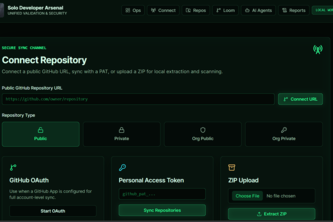
The company appears to be a solo developer project named "Solo Developer Arsenal", submitted as a hackathon entry to the OpenAI 2026 Build Week. The description states it is an AI-powered repository intelligence and engineering validation platform that allows developers to upload GitHub repositories or ZIP archives and receive automated analysis, reporting, and insights.
The author claims the platform builds a "Repository Digital Twin", runs multiple validation engines, and generates executive-grade reports in various formats. It uses technologies including Next.js, TypeScript, Node.js, React, PostgreSQL/Neon, Better Auth, and OpenAI's GPT-5.6 and Codex.
What changed
The project was submitted as a hackathon entry, suggesting it is at an early stage of development with no commercial traction or revenue evidence.
The single most important open question
Is there any evidence of actual usage, customers, or revenue beyond the author's self-reported claims?
What The Product Actually Is
- The description states that Solo Developer Arsenal is an AI-powered repository intelligence and engineering validation platform.
- Developers can connect a GitHub repository or upload a ZIP archive.
- The platform automatically:
- Builds a Repository Digital Twin to understand application architecture.
- Explains modules, dependencies, project structure, and engineering patterns using AI.
- Runs multiple engineering validation engines covering build quality, security, architecture, and production readiness.
- Generates executive-grade reports in PDF, HTML, Excel, JSON, Markdown, and SARIF formats.
- Produces actionable engineering insights instead of raw scanner output.
Inference The platform appears to be a unified workspace for repository analysis, validation, and reporting, designed to reduce time spent understanding unfamiliar codebases.
Positioning & Claim Evolution
- The author states the product was built to address the problem of "understanding, validating, and trusting an unfamiliar codebase".
- It is positioned as a tool that "transforms any GitHub repository or ZIP archive into an understandable, validated, and production-ready engineering workspace."
- The platform aims to "help developers spend less time understanding code and more time building great software."
Inference The positioning has evolved from solving a personal pain point (as a solo developer) to addressing broader needs in software development workflows—particularly around onboarding, validation, and reporting.
Target Customer & ICP
- The description states that the platform is intended for:
- Developers joining new projects.
- Reviewing open-source repositories.
- Preparing for hackathons.
- Solo developers who want to build enterprise-quality engineering tooling.
Inference The primary customer segment appears to be individual developers, especially those working in solo or small-team environments, with a focus on onboarding and validation tasks.
Business Model & Pricing Evidence
- No evidence of pricing, business model, monetization strategy, or revenue streams is provided.
- The description does not mention any paid features, subscriptions, or commercial offerings.
Not evidenced.
Technical & Delivery Signals
- Built with:
- Next.js, TypeScript, Node.js, React
- PostgreSQL/Neon, Better Auth
- OpenAI GPT-5.6 and Codex
- GitHub OAuth integration, ZIP extraction workflows, CI/CD pipeline integrations (mentioned in roadmap)
- Uses AI for:
- Backend implementation
- GitHub OAuth integration
- Repository ingestion improvements
- Scan engine implementation
- Executive report generation
- TypeScript refactoring
- Debugging and troubleshooting
- Build validation
- Test workflow improvements
- Code review and optimization
- GPT-5.6 used for:
- Engineering discussions
- Architecture refinement
- Product planning
- Documentation
- User experience improvements
Inference The platform is built using modern full-stack technologies with AI integration, suggesting a technical foundation suitable for enterprise-level development.
Traction & Maturity Signals
- No evidence of traction, customers, or adoption.
- The project was submitted as a hackathon entry (OpenAI 2026 Build Week).
- No mention of revenue, users, or usage metrics.
- The author states that the platform is still in early development stages.
Not evidenced.
Competitive Context
- No evidence of competitors or competitive landscape is provided.
- The description does not reference existing tools in this space such as Snyk, SonarQube, CodeQL, or similar repository analysis platforms.
Not evidenced.
Open Questions & Risks
- Solo developer project: Only one team member (K adarsh) is listed, which raises questions about scalability and long-term maintenance.
- No commercial traction: The platform is described as a hackathon submission with no evidence of real-world usage or revenue.
- Unverified claims: All features and capabilities are self-reported without independent verification.
- AI dependency: Heavy reliance on AI tools like GPT-5.6 and Codex may pose risks related to availability, cost, and consistency.
- Limited scope in current version: The platform is described as a prototype with many future features planned (e.g., CI/CD integrations, code review recommendations).
Questions the description leaves open
- What specific problems are you solving for developers today?
- Have you tested the platform with real users or teams?
- How do you plan to monetize this product?
- What is your roadmap beyond the hackathon submission?
- Are there any existing partnerships or integrations in place?
- How does the platform handle edge cases in repository structures?
- What are the key assumptions behind your AI-powered analysis approach?
Overall Assessment
- The project is currently a hackathon submission with no evidence of commercial traction, revenue, or customer adoption.
- It is described as an early-stage prototype, built by a single developer using modern technologies and AI tools.
- There is no evidence of a business model, pricing strategy, or market validation.
Assessment Not ready for investment or partnership at this stage. The project shows potential but lacks commercial evidence and maturity indicators. A follow-up analysis would be needed once there is evidence of usage, traction, or product-market fit.
User Stories BotA demo video on every pull request
Get a demo video on every new feature
GitHub App that watches your pull requests and records a narrated, captioned demo.
Save time on demo prep and make informed decisions faster with a video walkthrough of every new feature.
Source
Submitted to the OpenAI 2026 hackathon on Devpost. Project home on Devpost. Back to the full gallery on Devpost.
This competitive analysis was produced by top-founders.com (opens in a new tab)
Generated by a language model from this project's public Devpost page — its tagline, the author's own write-up and any built-with tags listed there — as captured in August 2026. Short quotations are the author's words. It is an opinion on the idea as a business, not on the people behind it, and it reflects the description as published then. If the project has moved on, request a correction below. The analysis is not independent research and contains no verified traction, revenue or customer data.
An independent guide by KFG International LLC — not affiliated with, endorsed by, or connected to Devpost or OpenAI.