

Archive position — measured, not model output
0 likes on Devpost
2,263 of the 7,850 archived projects have more likes, and 5,587 share exactly 0 — so this project's #6,828 place in the like-ranked listing is a tie-break inside that group, not a ranking.
Projects (log scale)
Likes on Devpost. ▲ marks this project's group.
Show the figures
| Likes | Projects | Share of archive |
|---|---|---|
| 0 | 5,587 | 71.2% |
| 1 | 1,758 | 22.4% |
| 2 | 284 | 3.6% |
| 3–4 | 132 | 1.7% |
| 5–9 | 75 | 1.0% |
| 10+ | 14 | 0.2% |
 User Stories BotA demo video on every pull request
Get a demo video on every new feature
GitHub App that watches your pull requests and records a narrated, captioned demo.
Save time on demo prep and make informed decisions faster with a video walkthrough of every new feature.
Executive Summary
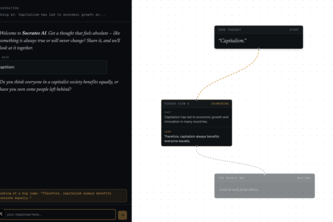
The description states that "socratic method AI" is a tool designed to guide users through reasoning by asking questions rather than providing answers — aiming for a philosophical mentorship experience. It was built as part of the OpenAI 2026 hackathon and uses Next.js, React Flow, and OpenAI API among other technologies.
The product appears to be an early-stage prototype focused on cognitive clarity through structured questioning, with minimal UI and no gamification elements. The team has not yet demonstrated any revenue, customers or traction beyond the hackathon submission.
The single most important open question
Is there evidence of a viable market need for this type of reasoning tool, or is it an experimental idea that lacks commercial viability?
What The Product Actually Is
The description states that socratic method AI is "an AI that never gives you the answer, only the right questions." It turns any topic into a guided dialogue — an AI mentor that sharpens your reasoning through questions.
It uses structured outputs and JSON schema to enforce format compliance from the AI. It includes features like:
- A "fact versus leap" card design
- Middle way emergence animation (blur to clear with ivory glow)
- Progressive node reveal in React Flow
The tool is described as having a "warm ink dark mode" and "ochre and sage accents," contrasting with generic AI color schemes.
Not evidenced What specific functionality or interface users interact with, how the system prompts are structured beyond the mention of rewriting prompts eight times, or whether it supports real-time interaction or session history.
Positioning & Claim Evolution
The description states that socratic method AI aims to be:
- An AI mentor
- A tool for sharpening reasoning through questions
- A guide for cognitive clarity
- Not a lecture tone or debate-driven system
It positions itself as:
- Quiet and respectful, like a real philosophical conversation
- Focused on tangible cognitive distortions rather than explanations
- Avoiding gamification (scores, streaks, progress bars)
The author notes they "killed every gamification idea" and went with minimal UI.
Inferred The positioning reflects an attempt to differentiate from typical AI chatbots by emphasizing questioning over answering. However, the claim of being a mentor or guide is not substantiated beyond self-description.
Target Customer & ICP
The description states that socratic method AI is intended for users who want to:
- Learn by thinking
- Sharpen their reasoning
- Engage in deep worldview deconstruction
- Track how their thinking shifts over time
It also mentions a "lighter mode" for everyday worries versus deep thinking, suggesting potential segmentation.
Not evidenced Who the actual target customers are, what demographics they represent, or whether there is any market research to support these claims. No evidence of customer personas, user interviews, or usage data.
Business Model & Pricing Evidence
The description does not provide any information about:
- Revenue streams
- Pricing models
- Monetization strategy
- Subscription plans or fees
Not evidenced Any indication of how the product would generate value for users or monetize its service. The project is presented as a hackathon submission with no commercial framework described.
Technical & Delivery Signals
The description states that:
- Built with Next.js, OpenAI API, React Flow, Tailwind CSS, TypeScript, Vercel
- Structured Outputs and JSON schema were used to enforce format compliance
- System prompts were rewritten multiple times to eliminate lecture tone
- Progressive node reveal in React Flow required careful state management
It also mentions:
- Middle way emergence animation (blur to clear with ivory glow)
- "Fact versus leap" card design
- Original spec had five node types, reduced to three: root, assumption, middle way
Inferred The technical stack suggests a web-based application built using modern frontend and AI integration tools. However, no evidence of scalability, performance metrics, or production deployment is provided.
Traction & Maturity Signals
The description states that this project was submitted to the OpenAI 2026 hackathon on Devpost.
It also mentions:
- Session history as a future feature
- Voice input for journaling
- Mobile layout development
- Custom belief profiles planned
Not evidenced Any evidence of user adoption, retention, or revenue. No data points on usage frequency, customer feedback, or product maturity beyond the hackathon prototype.
Competitive Context
The description does not provide any information about:
- Direct competitors
- Indirect substitutes
- Market size or competitive landscape
- Differentiation from existing tools
Not evidenced The competitive environment or positioning relative to other AI reasoning or cognitive enhancement tools.
Open Questions & Risks
Key risks and open questions based on the description include:
- Lack of commercial traction: No evidence of revenue, customers, or adoption beyond a hackathon submission.
- Unproven market need: The self-reported positioning lacks validation through customer feedback or market research.
- Prototype stage: The tool is described as a hackathon project with future features planned but not yet implemented.
- Limited team size: Only two team members are mentioned, which may limit execution capacity.
- Unclear monetization strategy: No indication of how the product will generate revenue.
Inferred Without traction or validation, there's a high risk that this remains an experimental idea rather than a viable business.
Questions the description leaves open
- What specific user problems are you solving, and how do you know those problems exist?
- How did you validate the need for this tool before building it?
- Are there any early adopters or users who have provided feedback beyond the hackathon context?
- What is your plan to scale beyond a prototype into a sustainable product?
- How do you intend to monetize this tool, and what pricing model are you considering?
- What are the key technical challenges that remain unresolved in moving from prototype to production?
Overall Assessment
The description states that socratic method AI is a hackathon project submitted to the OpenAI 2026 hackathon. It is not evidenced to have any revenue, customers, or traction beyond its initial development.
Assessment Not evidenced as a viable investment or partnership opportunity at this stage due to lack of commercial validation, market research, and traction. The product appears to be an experimental idea with no demonstrated path to monetization or user adoption.
User Stories BotA demo video on every pull request
Get a demo video on every new feature
GitHub App that watches your pull requests and records a narrated, captioned demo.
Save time on demo prep and make informed decisions faster with a video walkthrough of every new feature.
Source
Submitted to the OpenAI 2026 hackathon on Devpost. Project home on Devpost. Back to the full gallery on Devpost.
This competitive analysis was produced by top-founders.com (opens in a new tab)
Generated by a language model from this project's public Devpost page — its tagline, the author's own write-up and any built-with tags listed there — as captured in August 2026. Short quotations are the author's words. It is an opinion on the idea as a business, not on the people behind it, and it reflects the description as published then. If the project has moved on, request a correction below. The analysis is not independent research and contains no verified traction, revenue or customer data.
An independent guide by KFG International LLC — not affiliated with, endorsed by, or connected to Devpost or OpenAI.