

Archive position — measured, not model output
0 likes on Devpost
2,263 of the 7,850 archived projects have more likes, and 5,587 share exactly 0 — so this project's #6,830 place in the like-ranked listing is a tie-break inside that group, not a ranking.
Projects (log scale)
Likes on Devpost. ▲ marks this project's group.
Show the figures
| Likes | Projects | Share of archive |
|---|---|---|
| 0 | 5,587 | 71.2% |
| 1 | 1,758 | 22.4% |
| 2 | 284 | 3.6% |
| 3–4 | 132 | 1.7% |
| 5–9 | 75 | 1.0% |
| 10+ | 14 | 0.2% |
 User Stories BotA demo video on every pull request
Get a demo video on every new feature
GitHub App that watches your pull requests and records a narrated, captioned demo.
Save time on demo prep and make informed decisions faster with a video walkthrough of every new feature.
Executive Summary
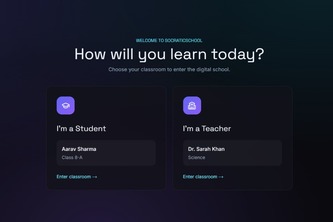
SocraticSchool, as described by its authors, is an AI-powered digital learning platform that uses GPT-5.6 to implement a Socratic method of education — asking adaptive questions instead of providing answers. The platform claims to support personalized learning, knowledge graph building, student progress tracking, teacher analytics, and classroom management.
The description states this is a self-reported, unverified project submitted for the OpenAI 2026 hackathon. No evidence exists regarding revenue, customers, or adoption beyond what the authors claim.
Key commercial due-diligence read: The platform's positioning as an AI-native education tool that follows the Socratic method is ambitious but lacks traction data or proof of concept in real-world usage. The single most important open question is whether the described AI workflows can be effectively implemented and scaled without compromising educational quality or user experience.
What The Product Actually Is
The description states that SocraticSchool is an AI-powered digital learning platform built with:
- Technology stack: Next.js 14, TypeScript, Tailwind CSS, Supabase, OpenAI GPT-5.6, Framer Motion, Recharts, D3.js.
- Core functionality:
- Guided learning using GPT-5.6 to ask adaptive questions.
- Personalized assessments.
- Live knowledge graph generation.
- Student progress tracking.
- Weakness detection.
- Teacher analytics.
- Parent report automation.
- Syllabus planning and classroom management.
Inference: The platform appears to be a full-stack educational SaaS prototype, integrating AI workflows into a single interface for students, teachers, and parents. It is not evidenced to have launched or been used beyond the hackathon submission.
Positioning & Claim Evolution
The description states that SocraticSchool aims to transform education through:
- Guided learning using the Socratic method.
- AI-powered personalization across learning, assessment, and analytics.
- Seamless integration of multiple workflows into one platform.
It also claims to be a complete AI-native digital school, not just a chatbot. The authors emphasize that their approach is about discovery over answers, which reflects a positioning shift from traditional educational tools toward critical thinking facilitation.
Inference: The positioning suggests an intent to move beyond rote learning and into adaptive, inquiry-based education, using AI as a facilitator rather than a dispenser of knowledge. However, this is a claim, not a demonstrated outcome.
Target Customer & ICP
The description states that the platform supports:
- Students (through guided learning and progress tracking).
- Teachers (via analytics dashboards and classroom insights).
- Parents (through automated reports).
It also mentions schools as potential users, with a vision of global adoption.
Inference: The ICP appears to be educational institutions, particularly those seeking AI-enhanced learning environments. However, no evidence exists about specific customer segments or use cases beyond the authors' self-description.
Business Model & Pricing Evidence
The description does not state anything about:
- Revenue model.
- Pricing structure.
- Monetization strategy.
- Customer acquisition plans.
Not evidenced: No information is provided on how SocraticSchool intends to generate revenue or whether it has a defined monetization path.
Technical & Delivery Signals
The project was built using:
- Next.js 14
- TypeScript
- Tailwind CSS
- Supabase
- OpenAI GPT-5.6
- Framer Motion, Recharts, D3.js
It is described as a full-stack application with AI workflows integrated across:
- Socratic tutoring.
- Concept extraction.
- Adaptive assessments.
- Weakness detection.
- Parent reports.
- Classroom insights.
Inference: The technical stack suggests a modern, scalable web platform, but the description does not confirm whether these features are live or tested in production. The use of GPT-5.6 implies an AI-native architecture, though no evidence is provided about performance, latency, or scalability.
Traction & Maturity Signals
The description states that this is a hackathon submission (OpenAI 2026) and that the team built a complete AI-native digital school, not just a chatbot.
It also mentions accomplishments such as:
- Personalized knowledge graphs.
- Adaptive Socratic conversations.
- Dashboards for students and teachers.
- Integration of learning, assessment, analytics, and classroom management.
Not evidenced: No data on user adoption, retention, or usage metrics. The project is described as a prototype, not a product in use.
Competitive Context
The description does not mention any competitors or market positioning relative to existing educational platforms.
Not evidenced: No competitive analysis, market size, or differentiation from other AI-based learning tools is provided.
Open Questions & Risks
- Unproven AI implementation: The platform claims to use GPT-5.6 in multiple workflows but does not demonstrate how these are implemented or tested.
- Lack of traction: No evidence of real-world usage, customers, or revenue.
- Ambitious scope without execution proof: The platform aims to integrate learning, assessment, analytics, and classroom management — a complex task with no evidence of successful delivery.
- No pricing or monetization model: The business model is not described.
- Hackathon origin: The project is a hackathon submission, which implies it may be in early development.
Questions the description leaves open
- What specific educational outcomes have you observed from using the Socratic method with GPT-5.6?
- How do you plan to validate that your AI workflows are actually improving learning outcomes?
- Have you tested the platform with real students, teachers, or schools?
- What is your plan for scaling beyond a hackathon prototype?
- How do you intend to monetize this platform, and what are your assumptions about pricing?
- What are the technical challenges you've faced in implementing adaptive question generation?
- Do you have any partnerships with educational institutions or platforms?
Overall Assessment
Not evidenced: No information is provided on whether SocraticSchool has traction, revenue, or customer adoption. The description is a self-reported project, not a commercial product.
Confidence level: Low — the evidence is limited to a hackathon submission and self-descriptive claims.
Assessment: This is an early-stage concept with strong ambition but no demonstrated commercial viability or traction. It may be a promising idea for further development, but it does not yet meet the criteria for investment or partnership at this stage.
User Stories BotA demo video on every pull request
Get a demo video on every new feature
GitHub App that watches your pull requests and records a narrated, captioned demo.
Save time on demo prep and make informed decisions faster with a video walkthrough of every new feature.
Source
Submitted to the OpenAI 2026 hackathon on Devpost. Project home on Devpost. Back to the full gallery on Devpost.
This competitive analysis was produced by top-founders.com (opens in a new tab)
Generated by a language model from this project's public Devpost page — its tagline, the author's own write-up and any built-with tags listed there — as captured in August 2026. Short quotations are the author's words. It is an opinion on the idea as a business, not on the people behind it, and it reflects the description as published then. If the project has moved on, request a correction below. The analysis is not independent research and contains no verified traction, revenue or customer data.
An independent guide by KFG International LLC — not affiliated with, endorsed by, or connected to Devpost or OpenAI.