

Archive position — measured, not model output
0 likes on Devpost
2,263 of the 7,850 archived projects have more likes, and 5,587 share exactly 0 — so this project's #2,906 place in the like-ranked listing is a tie-break inside that group, not a ranking.
Projects (log scale)
Likes on Devpost. ▲ marks this project's group.
Show the figures
| Likes | Projects | Share of archive |
|---|---|---|
| 0 | 5,587 | 71.2% |
| 1 | 1,758 | 22.4% |
| 2 | 284 | 3.6% |
| 3–4 | 132 | 1.7% |
| 5–9 | 75 | 1.0% |
| 10+ | 14 | 0.2% |
 User Stories BotA demo video on every pull request
Get a demo video on every new feature
GitHub App that watches your pull requests and records a narrated, captioned demo.
Save time on demo prep and make informed decisions faster with a video walkthrough of every new feature.
Executive Summary
What the company appears to be
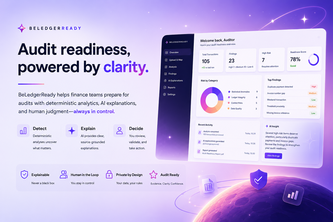
BeLedgerReady is an AI-powered audit readiness assistant designed for small and medium-sized organisations with financial transaction datasets stored in spreadsheets. It combines deterministic analytics (repeatable checks) with explainable AI to help users review financial data with confidence, while maintaining human control over final decisions.
What changed
The project was built as a hackathon submission by one developer (Sabrina Palis), using a structured human-AI engineering workflow involving OpenAI Codex and GPT-5.6. It represents an experimental approach to combining AI with traditional audit practices, emphasizing evidence-based findings before AI explanations.
Single most important open question
Does BeLedgerReady have any commercial traction or revenue-generating potential beyond its hackathon prototype?
What The Product Actually Is
The description states that BeLedgerReady is an AI-powered Audit Readiness Assistant. It enables users to:
- Upload financial transaction datasets.
- Map columns through a guided interface.
- Run deterministic audit-readiness checks.
- Explore findings alongside supporting evidence.
- Request AI-generated explanations for individual findings.
- Produce an audit readiness report combining evidence and optional AI explanations.
It is described as using a full-stack architecture built with Python, FastAPI, Next.js, React, TypeScript, and OpenAI APIs. The system performs deterministic checks first, then offers AI-generated explanations only after findings are established.
Inference The product appears to be a proof-of-concept or prototype, not yet deployed in production for real users.
Positioning & Claim Evolution
The author claims BeLedgerReady is an "AI-powered Audit Readiness Assistant" that uses deterministic analytics and explainable AI. It positions itself as a tool that helps organisations review financial data with confidence, without replacing professional judgment.
It emphasizes:
- Evidence-first approach.
- Human control over decisions.
- Separation between deterministic checks and generative AI explanations.
- Accessibility for non-experts in accounting or data science.
Inference The positioning reflects an intent to offer a trustworthy, transparent AI system that supports rather than replaces human auditors. However, this is a self-stated claim without evidence of adoption or impact.
Target Customer & ICP
The description states that BeLedgerReady targets "small and medium-sized organisations" that hold thousands of financial transactions in spreadsheets but lack the time, tools, or specialist knowledge to identify what deserves closer attention before an audit or financial review.
Inference The target customer segment is likely small businesses or mid-sized firms with limited internal audit resources. However, there is no evidence of actual customers or user feedback.
Business Model & Pricing Evidence
There is no mention of pricing models, monetization strategies, or business model details in the description.
Not evidenced.
Technical & Delivery Signals
The project was built using:
- Backend: Python and FastAPI.
- Frontend: Next.js, React, TypeScript.
- AI integration: OpenAI API (for explanations), Codex and GPT-5.6 for development.
- Data handling: Synthetic datasets used for demonstration and testing.
It uses a structured human-AI engineering workflow where:
- Codex was used for implementation tasks via explicit work orders.
- GPT-5.6 supported product design, architecture, and documentation.
The system separates deterministic checks from AI-generated explanations to ensure traceability and defensibility of results.
Inference The technical stack suggests a modern, scalable approach. However, the delivery is limited to a hackathon prototype with no indication of deployment or scalability beyond testing.
Traction & Maturity Signals
There is no evidence of revenue, customers, user engagement, or product adoption beyond the author’s own account.
Not evidenced.
Competitive Context
No information about competitors or market context is provided in the description.
Not evidenced.
Open Questions & Risks
- Prototype only: The project is described as a hackathon submission with no evidence of commercial viability.
- No revenue or customers: There is no indication that BeLedgerReady has been monetized or adopted by users.
- Unverified claims: All assertions are self-reported and unverified — including the effectiveness of its approach, user experience, or technical performance.
- Single founder: The team consists of one person (Sabrina Palis), which may limit development capacity or scalability.
Questions the description leaves open
- What is the actual use case for this tool in real-world audits?
- Has there been any pilot testing with actual financial data from small businesses?
- Are there plans to expand beyond the current prototype into a full product?
- How does BeLedgerReady differentiate itself from existing audit tools or platforms?
- What are the key assumptions behind the deterministic vs. AI explanation model, and how were they validated?
Overall Assessment
This is a self-reported hackathon project with no evidence of traction, revenue, or customer adoption. The author describes an innovative approach to combining deterministic analytics with explainable AI in audit contexts, but there is no indication that this has moved beyond the prototype stage.
Confidence level: Low
The description does not provide sufficient evidence to assess commercial viability, scalability, or market demand. It remains a conceptual idea backed by one developer’s vision and engineering process — not a product with demonstrated value or market fit.
User Stories BotA demo video on every pull request
Get a demo video on every new feature
GitHub App that watches your pull requests and records a narrated, captioned demo.
Save time on demo prep and make informed decisions faster with a video walkthrough of every new feature.
Source
Submitted to the OpenAI 2026 hackathon on Devpost. Project home on Devpost. Back to the full gallery on Devpost.
This competitive analysis was produced by top-founders.com (opens in a new tab)
Generated by a language model from this project's public Devpost page — its tagline, the author's own write-up and any built-with tags listed there — as captured in August 2026. Short quotations are the author's words. It is an opinion on the idea as a business, not on the people behind it, and it reflects the description as published then. If the project has moved on, request a correction below. The analysis is not independent research and contains no verified traction, revenue or customer data.
An independent guide by KFG International LLC — not affiliated with, endorsed by, or connected to Devpost or OpenAI.