

Archive position — measured, not model output
0 likes on Devpost
2,263 of the 7,850 archived projects have more likes, and 5,587 share exactly 0 — so this project's #2,908 place in the like-ranked listing is a tie-break inside that group, not a ranking.
Projects (log scale)
Likes on Devpost. ▲ marks this project's group.
Show the figures
| Likes | Projects | Share of archive |
|---|---|---|
| 0 | 5,587 | 71.2% |
| 1 | 1,758 | 22.4% |
| 2 | 284 | 3.6% |
| 3–4 | 132 | 1.7% |
| 5–9 | 75 | 1.0% |
| 10+ | 14 | 0.2% |
 User Stories BotA demo video on every pull request
Get a demo video on every new feature
GitHub App that watches your pull requests and records a narrated, captioned demo.
Save time on demo prep and make informed decisions faster with a video walkthrough of every new feature.
Executive Summary
BenchPilot is a self-reported AI-powered tool designed to help researchers and engineers transform unstructured experimental data (notes, images, measurements) into structured scientific evidence using GPT-5.6. The author describes it as an assistant that organizes evidence, preserves uncertainty, challenges assumptions, and recommends next experiments—rather than simply summarizing or generating conclusions.
The project is presented as a personal hackathon submission with no external validation, revenue, or customer data. It uses Next.js, React, TypeScript, GPT-5.6, OpenAI APIs, and other developer tools. The system is claimed to support structured analysis of scientific experiments, including hypothesis matrices, uncertainty representation, and next-step recommendations.
Key open question: Is there evidence that BenchPilot has moved beyond a proof-of-concept into actual usage or impact by researchers or engineers?
What The Product Actually Is
The description states that BenchPilot:
- Transforms messy experiment notes and images into structured scientific evidence using GPT-5.6.
- Extracts observations from images and notes.
- Separates facts, observations, hypotheses, and unknowns.
- Identifies missing evidence and experimental uncertainty.
- Challenges the user's interpretation with competing explanations.
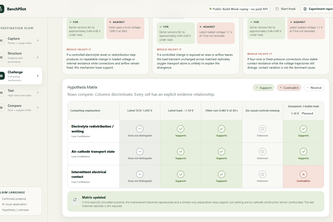
- Builds a Hypothesis Matrix to compare possible causes.
- Recommends the next experiment most likely to reduce uncertainty.
- Produces a clean exportable experiment report.
It is described as behaving more like a thoughtful research partner than a chatbot, aiming to encourage better scientific reasoning by keeping evidence and conclusions separate.
Inference: The tool appears to be an AI-assisted workflow for organizing and analyzing experimental data in scientific or engineering contexts. It is not a general-purpose AI assistant but one tailored for structured experimentation.
Positioning & Claim Evolution
The author positions BenchPilot as:
- An AI assistant that acts like a "thoughtful research partner."
- Not just a summarizer, but a tool that encourages better scientific reasoning.
- Designed to challenge assumptions and preserve uncertainty.
- A system that separates facts from hypotheses and unknowns.
It is described as being built for researchers, engineers, and inventors who work with messy, unstructured experimental data.
Inference: BenchPilot positions itself as a specialized AI tool for scientific workflow automation, emphasizing the importance of structured reasoning over confident conclusions. It is not positioned as a general-purpose AI or productivity tool.
Target Customer & ICP
The description states that BenchPilot is intended for:
- Researchers
- Engineers
- Independent inventors
These users are described as those who collect photos, handwritten notes, measurements, observations, and ideas during experiments and struggle to turn this into reproducible scientific evidence.
Inference: The target customer is likely individuals or small teams working in R&D, prototyping, or experimental science. No specific industry or company size is mentioned.
Business Model & Pricing Evidence
No information is provided about pricing, monetization, or business model.
The description mentions that the public demo replays a structured GPT-5.6 analysis from a real experiment, and that the private live version supports real analysis while keeping API keys protected.
Inference: There is no evidence of a commercial offering or pricing structure. The tool appears to be a personal project with no stated revenue model.
Technical & Delivery Signals
The author states that BenchPilot was built using:
- Next.js, React, TypeScript
- GPT-5.6, OpenAI APIs (including Responses API)
- Zod for validation
- Playwright and Vitest for testing
- GitHub for version control
- ChatGPT Sites for deployment
- Codex as a collaborative engineering partner
It is described as having:
- A production-quality public deployment
- Strong automated testing and validation
- A deterministic public replay to avoid exposing private infrastructure
Inference: The tool uses modern web stack and AI APIs. It is built with developer tools and testing practices, suggesting some level of technical maturity.
Traction & Maturity Signals
The project is described as a hackathon submission (Devpost entry for OpenAI 2026 hackathon). No evidence of:
- Revenue
- Customers
- Users
- Adoption
- Product-market fit
- Market traction
The author mentions that the public demo replays a structured GPT-5.6 analysis from a real zinc-air battery experiment, but this is presented as a demonstration, not a live product in use.
Inference: No evidence of traction or commercial adoption. The project is at an early stage and likely a prototype or proof-of-concept.
Competitive Context
No information is provided about competitors or market context.
The author does not reference existing tools for scientific data management, lab notebooks, or AI-assisted experimentation.
Inference: No evidence of competitive landscape or positioning relative to other tools in the space. The project appears to be standalone without a known peer group.
Open Questions & Risks
- Unverified claims: All features and functionality are self-reported.
- No commercial traction: No customers, revenue, or usage data.
- Single-person team: A single developer (Samurai Cobra) is listed as the sole member.
- Limited scope: The demo uses a single experiment (zinc-air battery), with no indication of broader application.
- Unclear monetization: No business model or pricing strategy described.
- Unproven impact: The tool is described as a personal project, not a product in active use.
Inference: The project lacks commercial validation and may be a prototype or proof-of-concept. Risks include lack of scalability, unclear market demand, and limited team capacity.
Questions the description leaves open
- What is the actual user base or adoption rate for BenchPilot?
- How does BenchPilot handle data privacy and security in real-world use cases?
- Are there any plans to integrate with existing lab notebook or research management tools?
- What are the technical limitations of GPT-5.6 in this domain, and how are they being addressed?
- Is there a plan for monetization or commercial deployment beyond the demo?
- How does BenchPilot differentiate from other AI-assisted scientific tools or lab notebooks?
Overall Assessment
Not evidenced: There is no evidence of revenue, customers, traction, or commercial viability to support an investment or partnership decision.
The project is described as a personal hackathon submission with no external validation. It is not demonstrated to be in use by researchers or engineers beyond the author’s own experiments.
Inference: At this stage, BenchPilot appears to be a prototype or proof-of-concept. It has potential if it can move from demonstration to real-world adoption and commercial viability, but there is no evidence of that yet.
User Stories BotA demo video on every pull request
Get a demo video on every new feature
GitHub App that watches your pull requests and records a narrated, captioned demo.
Save time on demo prep and make informed decisions faster with a video walkthrough of every new feature.
Source
Submitted to the OpenAI 2026 hackathon on Devpost. Project home on Devpost. Back to the full gallery on Devpost.
This competitive analysis was produced by top-founders.com (opens in a new tab)
Generated by a language model from this project's public Devpost page — its tagline, the author's own write-up and any built-with tags listed there — as captured in August 2026. Short quotations are the author's words. It is an opinion on the idea as a business, not on the people behind it, and it reflects the description as published then. If the project has moved on, request a correction below. The analysis is not independent research and contains no verified traction, revenue or customer data.
An independent guide by KFG International LLC — not affiliated with, endorsed by, or connected to Devpost or OpenAI.