

Archive position — measured, not model output
1 like on Devpost
505 of the 7,850 archived projects have more likes, and 1,758 share exactly 1 — so this project's #941 place in the like-ranked listing is a tie-break inside that group, not a ranking.
Projects (log scale)
Likes on Devpost. ▲ marks this project's group.
Show the figures
| Likes | Projects | Share of archive |
|---|---|---|
| 0 | 5,587 | 71.2% |
| 1 | 1,758 | 22.4% |
| 2 | 284 | 3.6% |
| 3–4 | 132 | 1.7% |
| 5–9 | 75 | 1.0% |
| 10+ | 14 | 0.2% |
 User Stories BotA demo video on every pull request
Get a demo video on every new feature
GitHub App that watches your pull requests and records a narrated, captioned demo.
Save time on demo prep and make informed decisions faster with a video walkthrough of every new feature.
Executive Summary
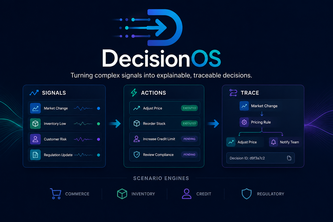
What the company appears to be: DecisionOS is a self-reported demo project built as part of an OpenAI 2026 hackathon. The author states it is a scenario-based decision engine that transforms complex signals into explainable, traceable decisions using mock data and a local rules engine.
What changed: This is a hackathon submission with no evidence of prior development or commercial traction. It represents a single, self-contained demo built in a short timeframe.
The single most important open question: Is there evidence that this demo reflects a viable product idea that can scale beyond the current scope?
What The Product Actually Is
The description states:
- DecisionOS is a "scenario-based decision engine demo"
- It uses mock business and operational data
- It runs data through local rules to recommend next steps
- It shows three core views: Signals, Actions, and Trace
- It demonstrates scenarios including Commerce, Inventory, Credit, and Regulatory operations
- It was built with React, TypeScript, Vite, and a local rules engine
- There is no backend, database, authentication, or external API integration
Evidence: The author's own write-up.
Confidence: Low. This is a self-reported demo with no evidence of actual product use or commercial deployment.
Positioning & Claim Evolution
The description states:
- DecisionOS "turns complex signals into explainable, traceable decisions through scenario-based decision engines"
- It addresses the problem that teams have "lot of data, dashboards, alerts, and reports, but still struggle to understand why a decision should be made and what action should follow"
- The demo focuses on showing how scattered signals can become clear actions
- It emphasizes explainability as core to usability
Evidence: The author's own write-up.
Inference: The positioning appears to be for teams struggling with decision-making from fragmented data sources, targeting a need for clarity and traceability in business decisions.
Target Customer & ICP
The description states:
- The target problem is "modern teams" who have "lot of data, dashboards, alerts, and reports"
- It demonstrates scenarios including Commerce, Inventory, Credit, and Regulatory operations
- The demo focuses on "business and operational data"
Evidence: The author's own write-up.
Confidence: Low. No specific customer segments or personas are identified beyond general "teams" and "business operations".
Business Model & Pricing Evidence
Not evidenced.
The description does not mention any business model, pricing strategy, monetization approach, or revenue streams.
Technical & Delivery Signals
The description states:
- Built with React, TypeScript, Vite
- Uses local mock data and a local rules engine
- No backend, database, authentication, or external API integration
- The project was built using an AI-assisted development workflow
- Early iterations showed that precise direction was needed to avoid scope creep
Evidence: The author's own write-up.
Confidence: Low. This is a frontend demo with no indication of scalability, performance, or production readiness.
Traction & Maturity Signals
Not evidenced.
There is no mention of customers, revenue, usage metrics, or any signs of product-market fit or adoption beyond the hackathon submission.
Competitive Context
Not evidenced.
The description does not reference competitors, market size, or competitive positioning.
Open Questions & Risks
- No commercial traction: This is a hackathon demo with no evidence of real-world use.
- Limited scope: The project is intentionally minimal (no backend, no integrations).
- Unproven product-market fit: No evidence that the described problem has been validated or that users need this solution.
- Self-reported only: All claims are unverified and lack corroboration.
Questions the description leaves open
- What specific business problems are you trying to solve, and how do you know teams struggle with them?
- Have you tested the core idea with actual users or stakeholders?
- What would a production-ready version of this look like, and what resources would it take?
- How does this differ from existing decision support tools or rule engines in the market?
- Are there any early adopters or pilot customers who have shown interest?
Overall Assessment
Not evidenced.
There is no evidence of a viable business model, traction, or commercial potential beyond the hackathon demo. The project appears to be an experimental idea with no demonstrated path to monetization or scalability.
The author states that this is a "demo" and that future versions could include real integrations, configurable rules, and team workflows — but there is no evidence of progress toward those goals.
User Stories BotA demo video on every pull request
Get a demo video on every new feature
GitHub App that watches your pull requests and records a narrated, captioned demo.
Save time on demo prep and make informed decisions faster with a video walkthrough of every new feature.
Source
Submitted to the OpenAI 2026 hackathon on Devpost. Project home on Devpost. Back to the full gallery on Devpost.
This competitive analysis was produced by top-founders.com (opens in a new tab)
Generated by a language model from this project's public Devpost page — its tagline, the author's own write-up and any built-with tags listed there — as captured in August 2026. Short quotations are the author's words. It is an opinion on the idea as a business, not on the people behind it, and it reflects the description as published then. If the project has moved on, request a correction below. The analysis is not independent research and contains no verified traction, revenue or customer data.
An independent guide by KFG International LLC — not affiliated with, endorsed by, or connected to Devpost or OpenAI.